GHK Cu Vial Guide for Laboratory Research
GHK cu vial reference covering formulations, sizes, storage, COA expectations, and verified batch documentation for research workflows.
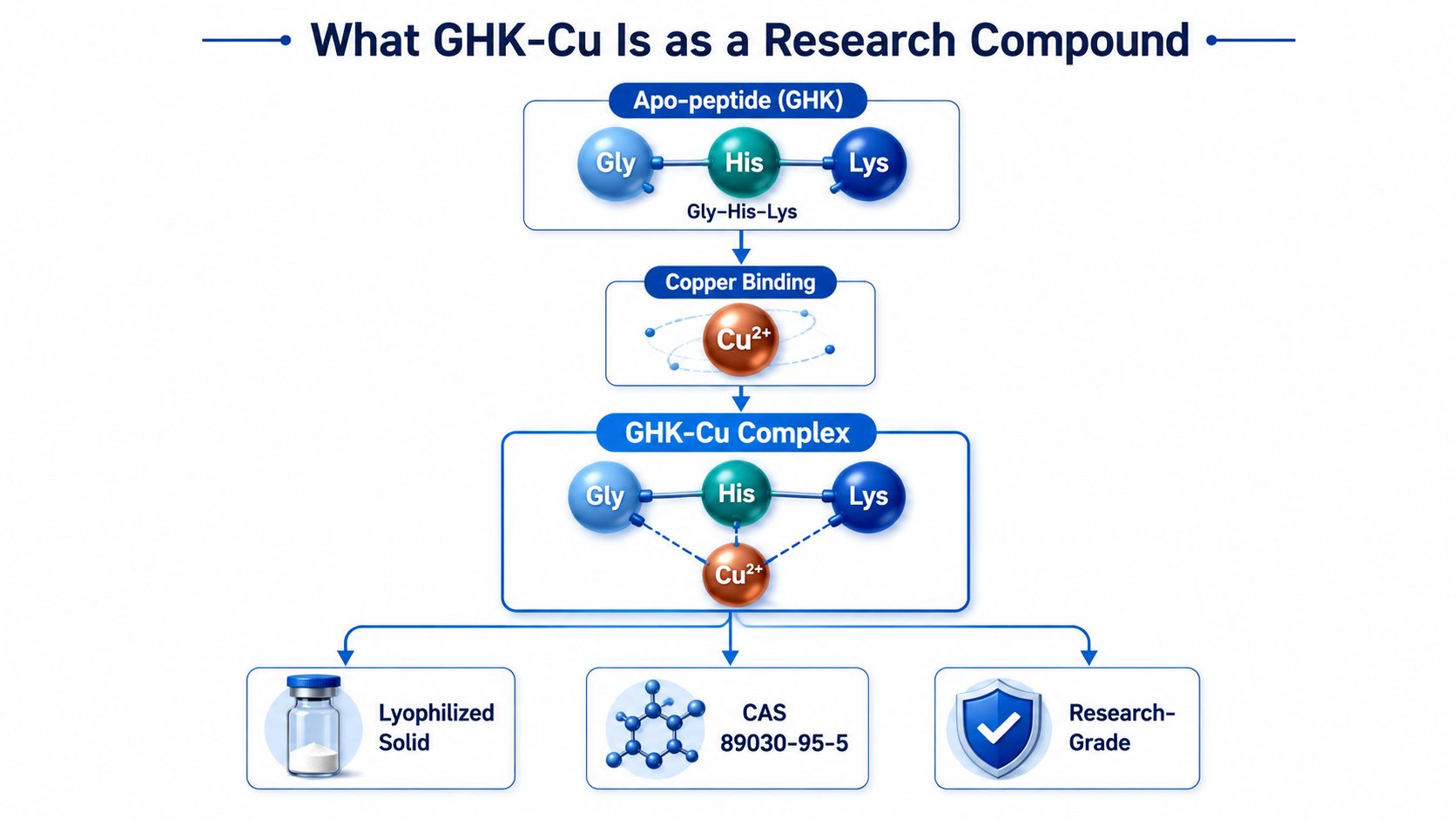
GHK-Cu is a copper-binding tripeptide in lyophilized form, commonly listed under CAS 89030-95-5. The chelated complex is built from glycine, histidine, and lysine, with the free peptide around 340.4 g/mol and the copper complex about 401.9–403.9 g/mol (PubChem).
What usually gets missed is that a GHK Cu vial is not just a peptide mass on a label, it's a two-component system whose real identity depends on the copper staying attached.
What GHK-Cu Is as a Research Compound
GHK-Cu refers to glycyl-L-histidyl-L-lysine bound to copper, most commonly as a 1:1 copper complex. The coordination chemistry matters because the histidine imidazole nitrogen is a key binding site, so the biologically relevant material is the chelated species, not just the apo-peptide sitting on its own. In practical lab terms, that means a vial can look like a simple peptide product while needing documentation that proves both the peptide backbone and the copper complex survived manufacturing and shipping.
GHK-Cu has long been treated as a benchmark molecule in regenerative biology because its history is tied to age-related plasma activity. The original work linked stronger extracellular-matrix-related activity to younger donor plasma in the 20 to 25 range compared with older donor plasma in the 60 to 80 range, which is part of why the complex became central to later wound-healing and tissue-repair literature (AminoCore Research).
Practical rule: when a vial is labeled GHK-Cu, the relevant question isn't only whether the peptide is present. The real question is whether the copper-chelated species is still intact.
The blue tone often seen in aqueous handling is consistent with copper coordination, but appearance alone doesn't prove identity. A research-grade vial should be treated as a laboratory reagent, not a pharmaceutical substance, and it belongs in assay design, characterization work, and controlled sample preparation only.
How the Literature Has Studied GHK-Cu
GHK-Cu has shown up in several study formats, but the records aren't equally strong. Cell culture work is the most common, especially in fibroblasts, keratinocytes, and mesenchymal lineages, because those models let researchers observe matrix signaling, migration behavior, and repair-associated readouts without the noise of whole-organism systems. Animal studies are useful when the question shifts toward wound closure, dermal remodeling, or age-related tissue response, but the route, species, and duration vary enough that direct comparisons can get messy fast.
Study Types That Have Used GHK-Cu
| Study Type | Common Models | Typical Readouts | Documentation Strength |
|---|---|---|---|
| In vitro | Fibroblasts, keratinocytes, mesenchymal cells | Matrix markers, migration, morphology, viability | Strong for mechanism, variable for concentration reporting |
| Animal model | Dermal and wound models | Repair speed, tissue appearance, remodeling markers | Moderate, but protocol details vary widely |
| Human studies | Smaller clinical or translational reports | Skin-related endpoints, repair-associated outcomes | Thinner than preclinical literature |
The human record is noticeably thinner than the cell and animal literature, so a new team should avoid over-reading any single result. Older papers also don't always report the same analytical basis, some focus on peptide mass, while others refer to the copper complex itself, which complicates cross-study comparison and makes a lot of “same compound” claims less clean than they look on paper.
A useful way to read the literature is to ask whether the paper measured the apo-peptide, the copper complex, or just a biological response without strong characterization. That distinction matters more for GHK-Cu than for many simpler peptides because the copper state changes what's in the vial and what's being tested.
Physical and Chemical Profile of the Vial Contents
A credible spec sheet for a GHK Cu vial should read like a characterization document, not a sales sheet. Treat the vial as a two-component system, the peptide backbone plus the copper complex. The material is usually supplied as a blue to deep-blue lyophilized cake, and that color is a useful visual cue that copper coordination is present. It still does not replace analytical confirmation.
Specification Sheet Values to Look For
| Parameter | Typical Range / Limit | Method |
|---|---|---|
| Peptide purity | Commonly ≥95% to ≥98% | HPLC |
| Copper content | Near the theoretical complex value, not just peptide mass | ICP-MS or ICP-OES |
| Identity | Expected peptide and copper complex signals | LC-MS, UV-Vis |
| Residual solvents | Acetonitrile and TFA within accepted limits | Analytical solvent panel |
| Water content | Low residual water in a dry cake | Karl Fischer |
| Appearance | Blue to blue-violet lyophilized solid | Visual inspection |
The peptide purity number and the copper content number are not interchangeable. A clean HPLC trace can still miss a copper problem if the complex dissociated, and a copper assay alone will not prove the peptide backbone is correct. That is why a complete product sheet should include backbone identity, metal confirmation, residual solvent data, and water content. Those fields tell you whether the lyophilized cake still reflects the intended chelated species.
Handling chemistry that matters
GHK-Cu behaves better in water and in pH 4.5 to 7.4 buffers than many labs expect, but the complex is still sensitive to basic and oxidative stress. Published characterization found slower degradation under acidic stress and confirmed stability in those buffered ranges for at least two weeks at 60°C (PubMed). Keep the vial sealed, dry, and light-protected, and avoid prolonged exposure to alkaline buffers or oxidizing conditions during sample prep. That advice is about preserving the chelated species, not just protecting peptide mass.
Lyophilized Formulations and Common Vial Sizes
Most research catalogs offer GHK-Cu as a lyophilized solid, not a premade solution. That choice is practical, because solution storage invites copper displacement, hydrolysis, and contamination risk much earlier than the dry state does. Lyophilization also helps preserve the chelated species rather than leaving the lab to guess how much copper is still bound after weeks in buffer.
Common GHK-Cu Lyophilized Vial Fills and Typical Research Use
| Vial Fill | Approximate Peptide Mass | Typical Research Scale | Planning Note |
|---|---|---|---|
| 10 mg | Small screening work | Pilot assays, method checks | Good when the readout is still being optimized |
| 25 mg | Moderate screening | Replicate cell work | Useful for parallel plates and a few condition sets |
| 50 mg | Mid-scale studies | Dose-response mapping, short series | Often the cleanest starting point for a new protocol |
| 100 mg | Larger batch work | Longer study windows, repeated runs | Better when the same lot will support multiple experiments |
The fill size should follow the study design, not the other way around. A team running a handful of plates doesn't need a large overhang of material that may sit open too long, while a longitudinal animal or formulation program benefits from enough material to stay within one batch.
Carrier excipients like mannitol or trehalose sometimes show up in lyophilized cakes, and they change what the vial looks like and how fast it dissolves. They can also affect downstream blanking in assays if the lab doesn't account for them, so the exact formulation matters as much as the nominal fill mass.
Reconstitution and Aliquoting in the Lab
Reconstitution should be treated as sample preparation, not a casual mixing step. The safest default for many assays is ultrapure water, especially when chloride or phosphate could compete with copper coordination, while PBS or saline makes more sense when the downstream system is cell-based and osmolarity matters more than metal chemistry.
Slow dissolution sometimes leads teams to use low-concentration HCl or acetic acid as a starter solvent, but that trade-off needs attention. Acid can help the cake disappear, yet aggressive acidification can also disturb the complex if the solution is left standing too long or is pushed into an incompatible buffer too soon.
Practical rule: if the first drop of diluent changes the chemistry more than the assay needs, the wrong solvent was chosen.
A working stock in the 1 to 10 mg/mL range is usually easier to pipette than a very dilute solution, and it reduces repeated freeze-thaw pressure on small-volume stocks. The downside is that higher concentration stocks can be harder to dissolve cleanly, so the target should fit the actual assay format rather than a generic habit.
A few handling habits matter every time:
- Use single-use aliquots. Repeated access increases the chance of copper displacement and contamination.
- Reserve sterile filtration for when sterility is required downstream. A 0.22 µm filter can adsorb material at low concentration.
- Avoid solvents such as DMSO or ethanol above 1%. Those conditions can perturb the chelate and complicate interpretation.
- Label every tube with lot number, prep date, diluent, and analyst initials. That record is what makes the work auditable later.
The point isn't to be fussy. The point is to preserve the same chelated species from vial to bench that the COA claims was shipped.
Storage Temperature Bands and Stability Windows
Storage should be separated into two categories, lyophilized solid and reconstituted solution, because the two-component vial does not hold up the same way in each form. The dry cake gives you more room for handling error than the liquid stock, but that margin comes from chemistry, not appearance.
For the dry solid, 2 to 8°C is a reasonable short-term holding band, -20°C fits medium-term storage, and -80°C is better when the vial is being held as an archive. Cold-chain guidance usually treats those ranges as distinct storage classes rather than vague “cool” or “cold” labels (CASRAI cold-chain guide). Keep the vial dry, dark, and tightly sealed, and use desiccation support if the packaging allows it.
Why the solution is different
Once the material is in water, the stability window narrows. Hydrolysis and copper displacement can move faster, so bench time, repeated thaw cycles, and competing ligands all become real trade-offs for the chelated species. Basic and oxidative stress are the conditions that usually raise concern, so neutral-to-alkaline buffers should be handled with care if the solution will sit for long.
Frozen aliquots can extend useful handling time, but they are still a working solution, not the same thing as the dry vial. Check how long the stock has been open, how many freeze-thaw events it has seen, and whether the material is still within the lot-specific COA window.
A practical lab habit is to treat reconstituted GHK-Cu as material for near-term use. If the vial is being managed as a peptide plus copper complex, the storage plan should protect both parts of that complex, not just the peptide mass.
Reading a Batch-Specific Certificate of Analysis
A batch-specific Certificate of Analysis is the document that belongs to the exact vial on the bench, and the batch identifier has to match the vial label exactly. If the lot number on the COA doesn't match the vial, the document is invalid for that container, even if the rest of the sheet looks polished (batch-specific CoA guide).
COA Fields to Cross-Check Against the Vial Label
| COA Field | Expected Value / Pass Criterion |
|---|---|
| Product name | GHK-Cu, glycyl-L-histidyl-L-lysine copper complex |
| CAS number | 89030-95-5 |
| Batch or lot number | Exact match to the vial label |
| Manufacture date | Present and legible |
| Expiry or retest date | Present and within the study window |
| Appearance | Blue to blue-violet lyophilized cake |
| Peptide purity | HPLC result reported on the same lot |
| Copper content | Included on the same lot |
| Identity method | MS data present |
| Storage condition | Listed clearly |
A complete COA should also include analytical methods, storage conditions, and the issuing lab's credentials (CoA field guide). For GHK-Cu, the important analytical sections are not just peptide purity by HPLC, but also copper content by ICP-MS or ICP-OES, because a peptide-only document can miss a dissociated complex.
The most useful habit is to read the COA before the vial goes into the freezer log. That way, mismatches, missing heavy-metal data, or absent mass data get flagged while the shipment is still easy to quarantine.
Verifying Copper Content and Complex Integrity
Copper content is what separates a GHK Cu vial from the apo-peptide, so this check needs to hit the metal directly. The clearest quantitative route is ICP-MS or ICP-OES after digestion, because those methods measure total copper rather than assuming the copper stayed attached through handling and storage (analytical QC guidance).
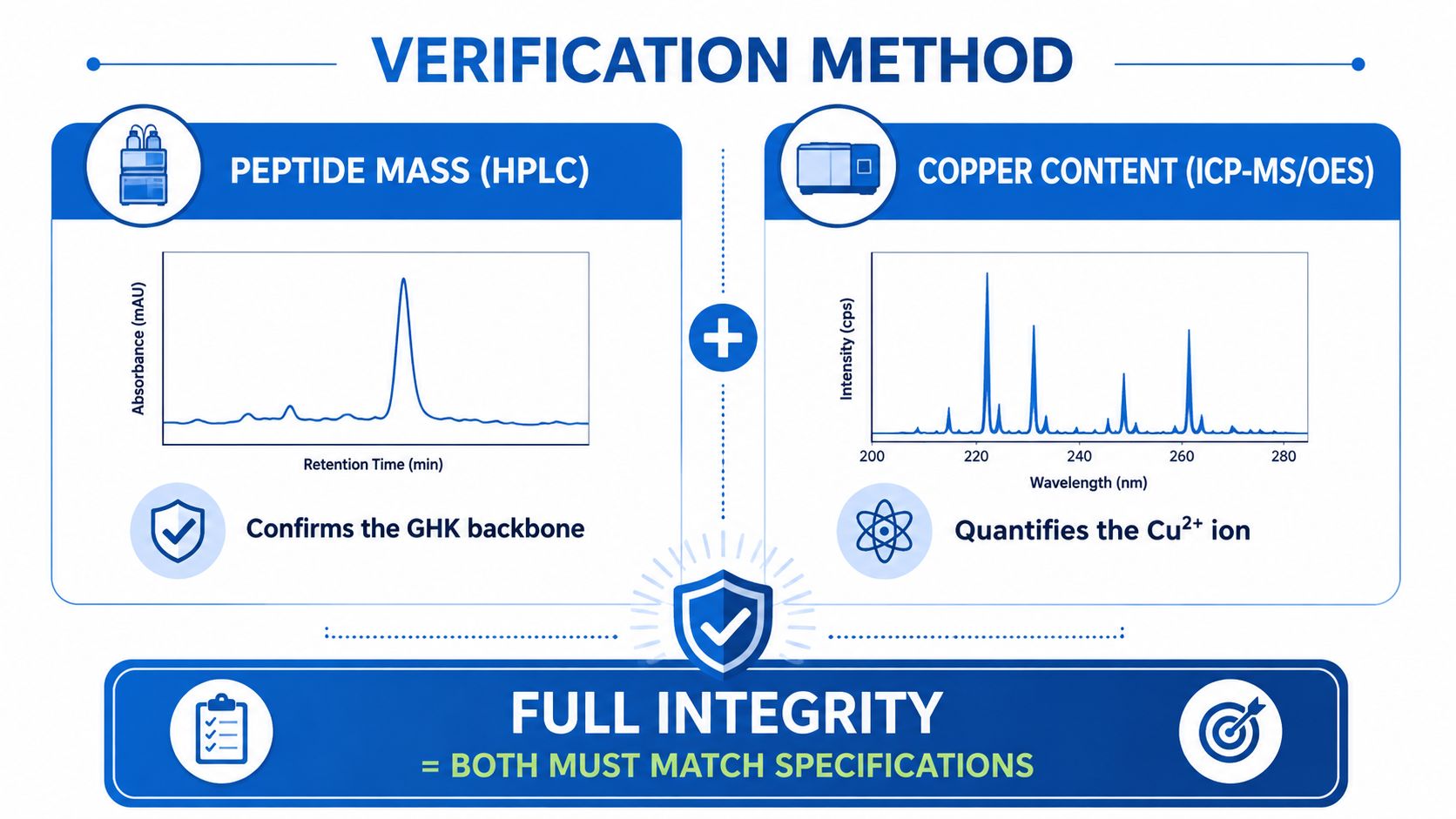
A peptide-only assay can still pass if copper has drifted off the complex, because the backbone remains recognizable. That's why HPLC-UV, amino acid analysis, or LC-MS alone are not enough to prove the chelated species is intact.
Orthogonal checks that help
- UV-Vis: A band near 525 nm supports the Cu(II)-peptide complex, and absorbance around 610 nm can be consistent with the d-d transition of chelated copper.
- EPR: A copper signature typical of the complex strengthens the case that the metal is still coordinated.
- Challenge studies: Resistance to EDTA challenge is useful when comparing the complex to the apo-peptide.
The most defensible lot release for a research vial pairs peptide identity with copper confirmation on the same batch. Without both, the material may still be a peptide, but it's no longer fully proven as GHK-Cu.
Procurement and Receipt Checklist for Research Teams
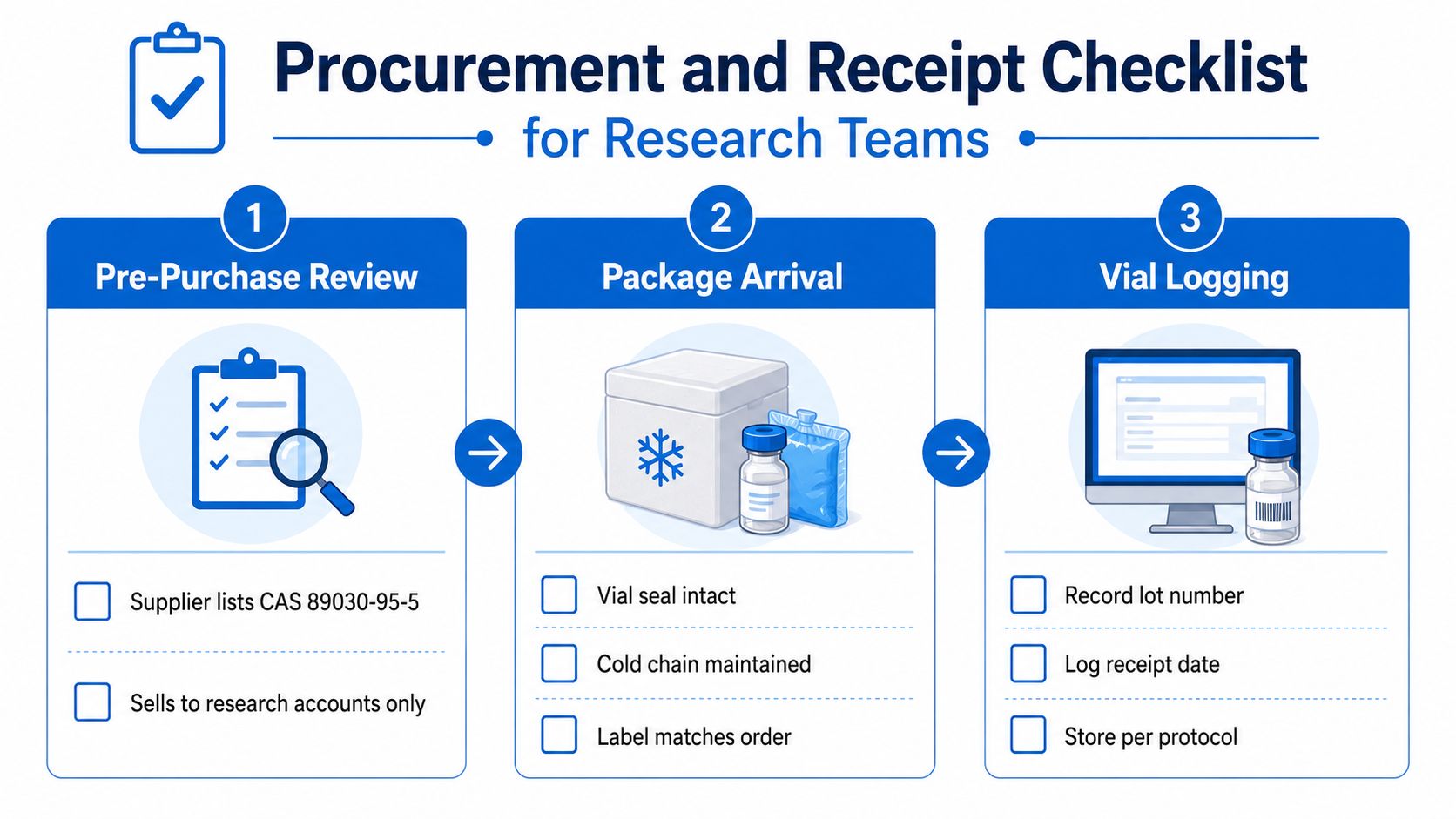
Procurement starts before the box lands at the receiving bench. The supplier should list CAS 89030-95-5, provide a research-use-only statement, and attach a batch-specific COA that includes peptide identity, copper content, and the same lot number on the label and paperwork (age-gating and RUO policy example).
At receipt
The outer shipper should show cold-chain evidence, such as a temperature indicator card or a data-logger report. The vial label, crimp code, and flip-off cap should be photographed on arrival, and the package should be weighed against the expected empty mass if the lab uses that check internally. Any collapse, leakage, or label mismatch belongs in quarantine, not in the freezer.
After logging
The COA, SDS, packing list, and shipping temperature record should be filed under the lot number. Only an aliquot should be opened for an internal QC check, and the sealed vial should stay quarantined until that check is complete.
A failed cold-chain record or an unreadable batch identifier is enough reason to reject the shipment. There's no way to restore a copper peptide to trustworthy status once the documentation trail has gone missing.
Documentation That Supports Reproducible Studies
Good documentation turns one vial into a paper trail that can survive peer review, procurement audit, and internal QA. The minimum useful set includes a batch-specific COA, an SDS marked for research use only, a chain-of-custody or cold-chain log, and a product sheet that states peptide content, copper content, counter-ion details, and residual solvent results.
Documentation Map for Reproducible GHK-Cu Studies
| Vendor Document | Where It Is Cited in the Paper |
|---|---|
| Batch-specific COA | Methods, reagent characterization, supplement |
| SDS | Safety or materials handling section |
| Cold-chain log | Methods, when temperature control is relevant |
| Product specification sheet | Materials characterization and supplement |
| Copper assay chromatogram | Characterization evidence when reviewers ask for metal confirmation |
The COA usually supplies the purity figure that gets referenced in the methods section, while the chromatogram and metal assay support characterization claims when reviewers want proof that the lot was not just a peptide mass. Storage records matter too, because temperature-control language is showing up more often in methods and supplement sections, especially when a compound is known to be fragile in solution.
One common gap is the absence of endotoxin data or copper-specific assay chromatograms. Those omissions matter more for publication-grade work than they do for a simple bench screen, so teams should request them early if the study might move beyond internal assay development.
Frequently Asked Questions for New Research Teams
Does GHK-Cu count as a drug or a research reagent? In a laboratory setting, it should be handled as a research-use-only compound unless a specific regulatory pathway says otherwise. The absence of FDA-approved drug status matters when writing methods, labeling inventory, and deciding what claims are supportable.
Should the CAS number appear on the vial and COA? Yes. CAS 89030-95-5 belongs on the documentation trail and should be visible on the product record so the lot can be matched without ambiguity.
How should the compound name be written in a methods section? The cleanest phrasing is GHK-Cu, glycyl-L-histidyl-L-lysine copper complex. That wording signals both the peptide backbone and the copper-chelated state.
Is peptide purity enough? No. For this material, copper content needs to be reported alongside peptide purity because the biologically relevant species is the complex, not just the peptide chain.
Is endotoxin testing always included? Not always. If the work is heading toward cell-based or translational reporting, endotoxin screening is often worth requesting separately when it isn't already on the lot record.
Does vial size equal a recommended amount for experiments? No. Vial size is a planning variable, not a protocol recommendation. It should fit expected throughput, aliquot strategy, and storage window.
What if the cake looks collapsed or discolored? Treat it as a documentation issue first and a material issue second. Compare the vial against the COA, the cold-chain record, and the receipt photos before anything is opened.
Pro Tec Pep supports research teams that need batch-linked documentation, clear lot records, and temperature-aware fulfillment for sensitive compounds like GHK-Cu. For labs that care about matching the vial to the COA before anything goes into a freezer log, visit Pro Tec Pep and review the available research-grade materials and documentation practices.
For laboratory research use only. Not for human or veterinary use. Not a drug, food, or cosmetic. Not evaluated by the FDA. Not intended to diagnose, treat, cure, or prevent any disease. By purchasing, you certify you are a qualified researcher and agree to use this product solely for in-vitro laboratory research.
Created with Outrank