Compound Purity Peptides: A Practical Research Buyer's Guide
Learn what compound purity peptides really means, how HPLC purity is measured, and how to read COAs to ensure reproducible lab research results.
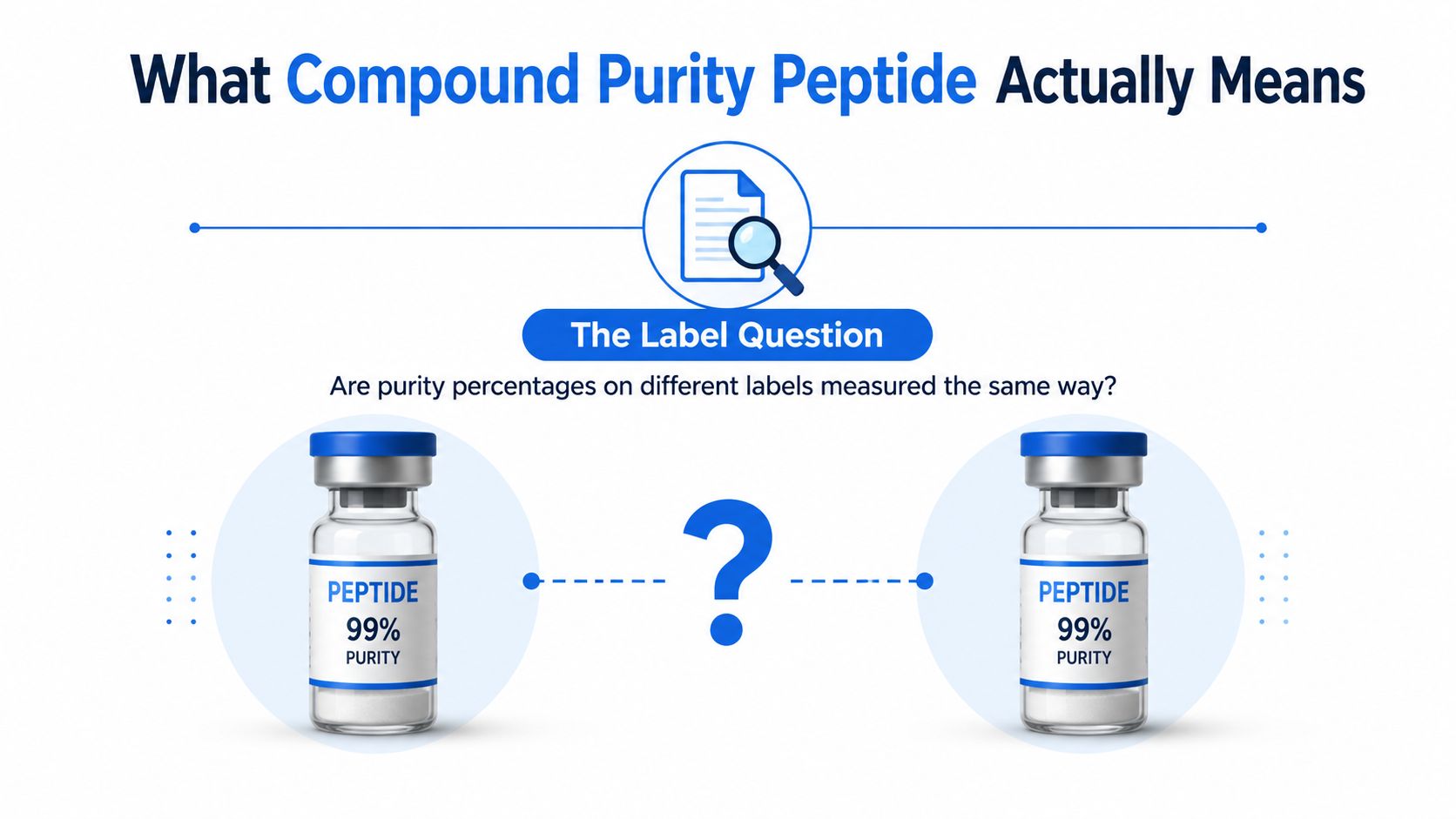
Does “98% pure” mean the same thing on every peptide label? A bench researcher comparing two vials of the same sequence needs a more useful answer than a headline percentage. Purity is important, but it's only one measurement in a chain that also includes identity, net peptide content, impurity characterization, storage history, and batch documentation.
For compound purity peptides, the practical question isn't whether a certificate reports 98% or 99% by HPLC. The question is what that percentage measures, what it leaves out, and whether the material can support the specific assay being planned. A peptide can show a strong chromatographic result while still requiring confirmation by mass spectrometry, content testing, and stability controls.
What Compound Purity Peptides Actually Means
The plain-language definition is straightforward. Peptide purity is the proportion of the detectable chromatographic material attributed to the intended peptide relative to other detectable components in a synthesized lot. Those other components can include deletion sequences, truncated products, oxidation products, and additional synthesis-related species. The most common reported method is reversed-phase HPLC, but an HPLC percentage isn't a complete structural guarantee.
A researcher should separate three material descriptions that often appear on product pages:
- Crude material contains the synthesized target alongside a broader mixture of by-products and incomplete sequences.
- Desalted material has had some salts and small-molecule components removed, but it isn't necessarily highly purified.
- Purified peptide has undergone a separation process intended to enrich the target sequence, with the result reported through an analytical method such as HPLC.
A lot number matters because purification results can vary from one production run to another. Two vials carrying the same sequence name may have different chromatograms, different impurity profiles, or different net peptide content. A batch-linked document is therefore more informative than a generic product specification.
Why the percentage needs context
The ≥98% benchmark is widely treated as research-grade for synthetic peptides, while ≥95% is often acceptable for many laboratory assays and ≥99% is preferred for highly sensitive structural or analytical work, according to the peer-reviewed discussion of peptide purity reporting. These tiers are useful starting points, not universal release decisions.
A claim such as “98% by HPLC at 220 nm” means the principal product peak represents at least 98% of the UV-detected chromatographic signal. It doesn't automatically mean that 98% of the vial's gross powder weight is peptide, and it doesn't prove that every chemically distinct impurity has been resolved. That distinction becomes critical when a laboratory compares lots or calculates molar concentrations.
Practical rule: Treat the purity percentage as a question opener. Ask which method produced it, which batch it covers, and which independent measurements support the identity and actual peptide content.
How HPLC Purity Is Measured and Reported
Reversed-phase HPLC separates peptide components according to their interactions with the chromatographic column and mobile phase. The instrument records detector response over time, producing a chromatogram with peaks that represent compounds or separable species. The reported purity is generally calculated as the area of the assigned target peak divided by the total integrated area of detectable peaks under the stated conditions.
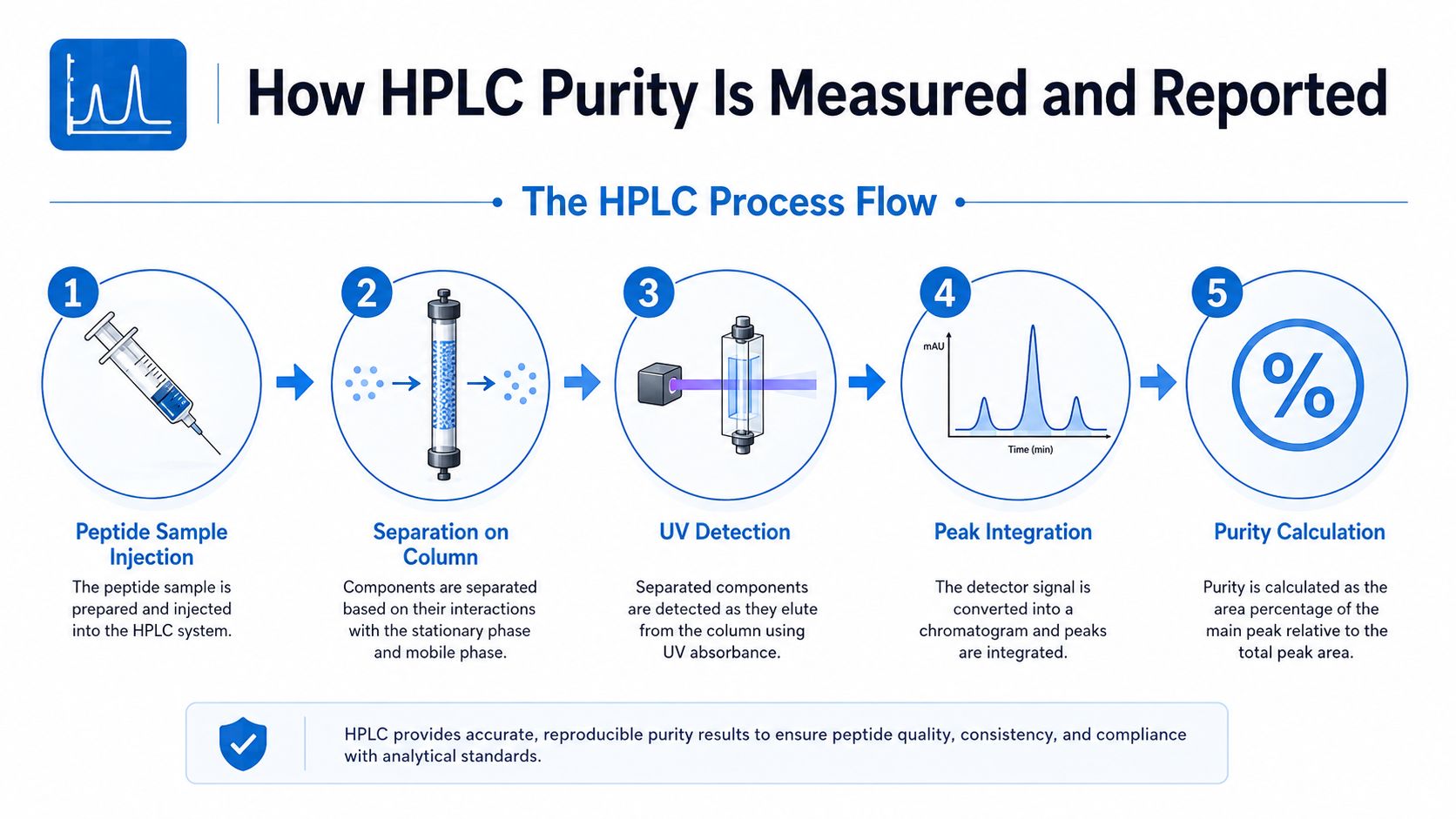
At a practical level, the calculation depends on several analytical choices:
- The laboratory injects a defined peptide sample.
- The column separates components according to their chemical behavior.
- A detector records UV-absorbing material.
- Software integrates the peaks within selected boundaries.
- The target peak area is compared with the total integrated area.
The analytical guide to peptide HPLC and LC–MS purity analysis explains the central limitation clearly: reversed-phase HPLC purity is a chromatographic area metric, not complete structural proof. A result reported at 220 nm describes the fraction of UV-detected signal assigned to the main peak under that method. It doesn't quantify every substance in the vial equally.
What integration can and cannot reveal
The number is influenced by the detection wavelength, baseline selection, integration limits, column chemistry, gradient, and separation quality. A peak that is poorly resolved from a nearby impurity may be integrated as one broad target peak. In that case, the apparent purity can look stronger than the chemical purity of the isolated sequence.
Co-elution is the quiet failure mode. A chemically distinct impurity can travel with the target and remain hidden beneath its signal. Related species may include truncated sequences, oxidation products, stereoisomers, or other compounds with similar chromatographic behavior. HPLC can expose separated peaks, but it can't reliably identify every species concealed within the main peak.
A credible review of HPLC data should therefore include the actual chromatogram, not just the percentage. The reviewer should look for the target peak, shoulders, secondary peaks, baseline quality, and the stated integration range. Method details should identify the column and detection conditions so the result has interpretable context.
The following video provides a visual introduction to the chromatographic workflow and peak-based reporting:
A clean-looking trace is useful evidence, but it remains evidence from one method. LC–MS or another orthogonal technique is needed when identity, hidden related species, and assay reproducibility carry significant weight.
Why Purity Alone Is Not the Whole Story
What does 98% purity tell you about a peptide? Usually, it describes the proportion of integrated UV signal assigned to peptide-related material in a stated HPLC method. It does not necessarily tell you how much of the vial's powder is the intended peptide.
Water, counterions, salts, and fillers may contribute to the gross powder weight without appearing as target peptide in that calculation. HPLC purity and net peptide content therefore answer different questions. One describes the chromatographic signal. The other estimates the peptide mass available for preparing an experiment.
Counterion correction is part of that distinction. Trifluoroacetate, acetate, or hydrochloride may be part of the supplied chemical form, yet still affect mass-based calculations and comparisons between lots. A vial can meet a strong HPLC specification while requiring a different weighing adjustment than its label suggests.
| Reported Metric | Value | What It Tells You |
|---|---|---|
| HPLC purity | ≥98% by HPLC | The main peptide-related peak accounts for at least 98% of the integrated UV signal under the stated method |
| Net peptide content | Batch-specific result | The actual peptide mass after accounting for non-peptide material such as water and counterions |
| Identity confirmation | LC–MS or another orthogonal method | Whether the material matches the intended molecular identity |
| Stability information | Storage and handling record | Whether temperature, moisture, air exposure, and freeze-thaw history may have altered the material |
A 2026 report described vials reading 99% pure by HPLC while containing only 70% to 85% actual peptide by weight. The same report's independent testing set found close to 30% of vials mislabeled, incorrectly quantified, or contaminated. Those results apply to that report and its testing context, not automatically to every supplier or lot. They do show why a purity headline should start a verification process rather than end it. The source is the 2026 report on the peptide verification gap.
The calculation problem in the laboratory
If a protocol depends on molar concentration, gross powder mass is not enough. Check the molecular form, formula weight, net peptide content, and any documented correction for water or counterions before calculating the amount to weigh. Without those fields, two lots with similar HPLC values may deliver different amounts of the intended sequence.
Review purity as one part of a batch decision:
- Chromatographic purity describes detected peak-area distribution.
- Net content estimates the actual peptide mass in the supplied material.
- Identity testing supports the intended sequence or molecular species.
- Stability controls indicate whether storage and handling may have changed the material.
A batch-specific COA should let you connect each result to the lot in hand, including the method or result type used. That record supports reproducible weighing and interpretation far better than one prominent percentage.
Identity Confirmation Beyond a Single Purity Number
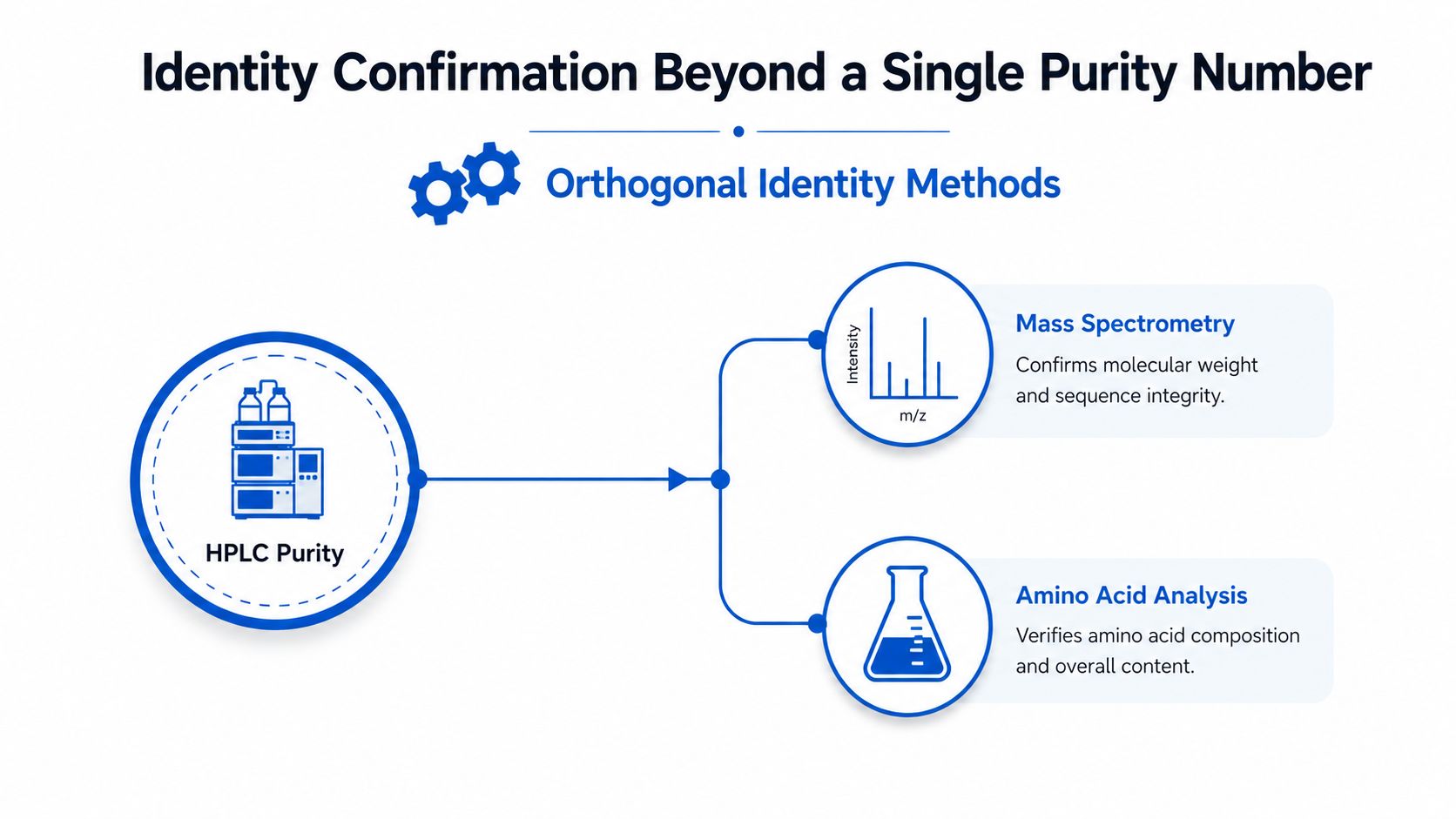
HPLC can show that a dominant peak exists. It can't, by itself, establish that the dominant peak is the sequence named on the vial. That's why laboratories pair chromatographic purity with orthogonal identity methods, meaning methods that measure a different property and can reveal failure modes hidden by the first test.
Mass spectrometry answers the identity question
LC–MS compares the observed mass-to-charge pattern with the expected molecular mass for the intended peptide. A suitable result supports the claimed identity and can flag substantial differences associated with truncation, oxidation, or other modifications. It doesn't replace HPLC because a mass result doesn't describe the entire chromatographic impurity distribution.
For more demanding characterization, LC–MS/MS can fragment the peptide and provide sequence-related evidence. Peptide mapping adds another layer by enzymatically or chemically producing fragments that can be compared with expected sequence coverage. That approach can reveal sequence changes that a single intact-mass result may not resolve clearly.
Independent methods reveal different weaknesses
Amino-acid analysis provides a composition-based cross-check and can support quantification that isn't dependent on the same UV response used in HPLC. NMR can help characterize molecular structure and counterions, while peptide mapping can provide sequence-level information. Recent analytical guidance recommends at least two orthogonal methods for higher-confidence identification and lists LC–MS, LC–MS/MS, peptide mapping, amino-acid analysis, and NMR among appropriate options. The analytical review of orthogonal peptide characterization also notes that impurity classes can include deletion and insertion errors, racemization, oxidation, counterions, and unrelated peptide contamination.
The methods work best as a layered system:
- HPLC separates detectable components and estimates area-based purity.
- LC–MS checks intact molecular identity and related mass shifts.
- Peptide mapping examines sequence coverage and localized changes.
- Amino-acid analysis supports composition and net-content evaluation.
- NMR can contribute structural and counterion information where appropriate.
Identity is not inferred from a high percentage. It is supported when independent measurements converge on the same molecular description.
A laboratory doesn't need every possible method for every exploratory experiment. The appropriate combination depends on assay sensitivity, sequence complexity, modification risk, and the consequences of a misidentified or degraded material. For publication-grade or quantitative work, a single HPLC number is a weak foundation.
Reading a Batch-Specific Certificate of Analysis
A Certificate of Analysis should be treated as a record for one physical lot, not as a brochure. The World Health Organization model Certificate of Analysis states that a batch document should identify the tests performed on the specific sample, the results obtained, the acceptance criteria, and the compliance decision. It also includes fields for batch identification, manufacture information when available, expiry or retest information, and packaging details.
Field-by-field review
The lot number should match the vial label exactly. Manufacturing and retest or expiry information should be present where applicable, and the document should identify the sample or product form being tested.
Identity should include an MS result, trace, or another suitable sequence-confirming method. HPLC purity should state the percentage, detection wavelength, and method context, with the chromatogram available for review. A bare number without a trace or method detail leaves too much room for interpretation.
Net peptide content deserves separate attention. The batch-specific COA guidance from an independent peptide-testing resource identifies identity by mass spectrometry, HPLC purity, net peptide content, endotoxin, sterility, and heavy metals among the core elements of a credible research-grade certificate. It also gives a typical endotoxin benchmark of less than 0.25 EU/mg and describes sterility screening over 14 days. Those are benchmarks to verify against the stated specification and assay context, not universal substitutes for institutional requirements.
| COA Field | What It Confirms | Acceptable Benchmark |
|---|---|---|
| Lot or batch number | The document belongs to the vial being evaluated | Exact match to the vial label |
| Identity | The molecular material matches the claimed compound | MS or another orthogonal identity method reported |
| HPLC purity | Area-based chromatographic purity | Stated result with method and chromatogram |
| Net peptide content | Actual peptide mass rather than gross powder mass | Batch-specific quantitative result |
| Counterion and formulation | Chemical form and associated mass | Explicit disclosure of salt or counterion |
| Endotoxin | Bacterial endotoxin burden | Typically <0.25 EU/mg, where that specification fits the research context |
| Sterility | Microbial growth assessment | Reported method and stated observation period where relevant |
| Heavy metals | Elemental contamination screening | Reported result with acceptance criterion |
| Conformity | Overall pass or fail against specifications | Clear compliance decision for the tested lot |
Red flags that should stop procurement
A generic or “typical” COA doesn't establish what's in the shipped vial. Missing net content, counterion information, identity data, chromatogram, method parameters, or acceptance criteria also weakens the document substantially. An unnamed testing laboratory makes independent verification difficult, while a certificate that reports only a purity number cannot address sterility, endotoxin, heavy metals, or chemical identity.
A laboratory should request the missing records before committing material to a sensitive experiment. If the supplier can't provide batch-linked documentation, the uncertainty belongs in the purchasing decision, not in the methods section after results have already been generated.
How Purity Affects Experimental Reproducibility
A small impurity can matter when it shares structural features with the target peptide. Deletion sequences, oxidation products, or incompletely removed synthesis residues may interact differently with receptors, bind nonspecifically, alter matrix behavior, or affect cell-based readouts. The outcome isn't always an obvious assay failure. More often, the impurity adds unexplained variation to a binding curve or shifts the apparent response.
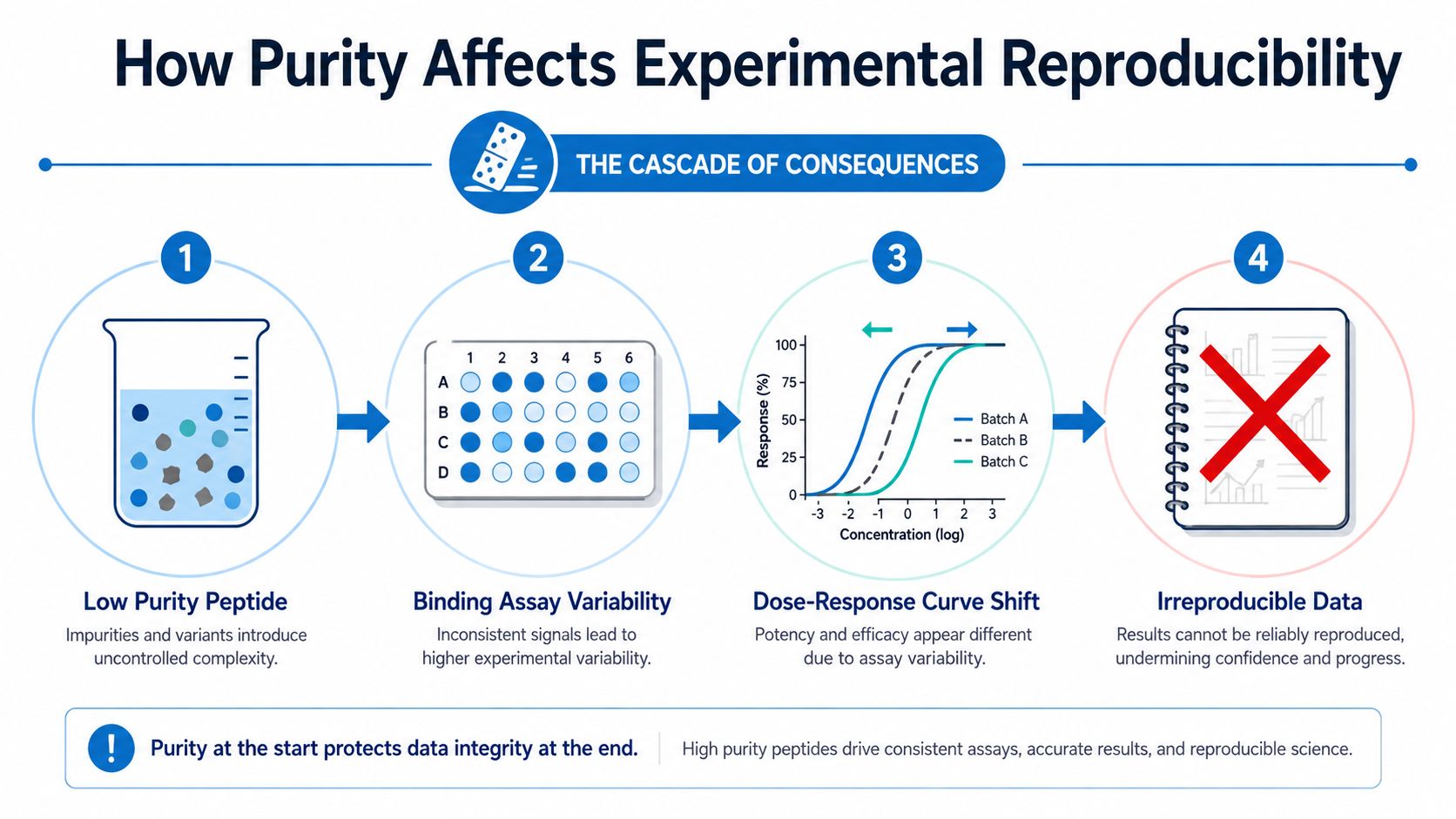
The risk rises when an experiment relies on small concentration differences. The peer-reviewed purity reference explains that even a few percent impurity can distort binding, cell-based, or dose-response results because peptide assays often depend on small concentration differences. A material that looks acceptable in a broad screen may be unsuitable for a sensitive quantitative workflow.
Degradation starts after the certificate
The COA describes a tested sample at a particular point in time. It doesn't automatically describe the vial after temperature excursions, moisture exposure, air contact, or repeated opening. Solution-phase peptides are particularly vulnerable to evaporation, adsorption, microbial degradation, chemical modification, and concentration drift.
Common chemical changes include oxidation in susceptible residues, deamidation, disulfide-related changes, and aggregation. The exact pathway depends on the sequence and formulation, so the laboratory should avoid assuming that all peptides behave the same way.
Practical controls include:
- Cold storage: Maintain lyophilized samples at -20 to -80 °C for long-term stability, consistent with the peptide storage guidance.
- Aliquoting: Divide material on receipt when the workflow requires repeated access, reducing unnecessary opening and freeze-thaw exposure.
- Air and light control: Minimize exposure and use inert or dark containers for sequences known to be sensitive.
- Transport review: Consider cold-chain handling for temperature-sensitive materials and document arrival conditions.
- Rapid re-freezing: Return retained material to the appropriate storage state promptly after preparation.
The purity number has a timeline. A batch can meet its release specification and still require careful handling to preserve that profile through the final assay replicate.
Reproducibility depends on recording the lot, preparation history, storage state, and any reanalysis performed after arrival. Those records help separate biological variation from material-related variation.
Evaluating Purity Specs Against Your Research Needs
Is 98% purity enough for your experiment? Treat that figure as a starting question, not a finished answer. The appropriate specification depends on how strongly the assay responds to concentration error, related sequences, endotoxin, structural heterogeneity, and small changes in binding behavior.
For receptor-binding or cell-based screening, ≥95% HPLC purity with MS-confirmed identity can serve as a practical baseline when the impurity profile is understood and the assay can tolerate it. Signaling assays affected by innate immune activation should pair ≥97% purity with low endotoxin. Quantitative biophysics, including SPR, ITC, or AUC, generally warrants ≥98% purity with full impurity profiling, because exact molar concentration and molecular homogeneity influence the measurement.
| Assay Class | Recommended HPLC Purity | Identity Confirmation | Key COA Fields Required |
|---|---|---|---|
| Exploratory screening | ≥95% | MS preferred | Lot match, HPLC result, identity, formulation |
| Receptor-binding studies | ≥95% | MS-confirmed identity | HPLC trace, identity, net content, lot number |
| Cell-based work | ≥95% | MS-confirmed identity | Endotoxin, sterility where relevant, net content, storage |
| Sensitive signaling assays | ≥97% | MS plus relevant impurity review | Low endotoxin, HPLC trace, identity, net content |
| Quantitative biophysics | ≥98% | Orthogonal identity and impurity profiling | HPLC integration, MS, net content, counterion, stability data |
A short procurement decision flow
- Define assay sensitivity. Identify whether the experiment measures receptor occupancy, signaling, cell response, molecular binding, or structural behavior.
- Set the minimum purity tier. Base the threshold on tolerance for related species and concentration error, rather than on the headline number alone.
- Verify identity. Require MS, and consider peptide mapping, amino-acid analysis, or another orthogonal method when the experiment requires greater confidence.
- Inspect the batch-specific COA. Confirm the lot number, HPLC trace, integration details, net peptide content, formulation, and relevant contamination tests.
- Recheck on arrival when results depend on the material. Compare the received sample with the supplied documentation, then repeat characterization when shipping history or assay sensitivity justifies it.
Before approving an order, request the lot number matching the vial, an HPLC trace with integration, net peptide content rather than gross weight, a residual-solvent panel, and endotoxin data for cell-based work. A certificate missing these fields may still support preliminary review, but it does not provide complete evidence for a sensitive experiment.
Supplier records can also be compared for product-level specifications, batch-linked documentation, storage information, and testing categories covering identity, purity, net content, sterility, endotoxins, heavy metals, and conformity. Some suppliers, such as Pro Tec Pep, publish records that address these categories, allowing laboratories to compare the documentation with their internal acceptance criteria at Pro Tec Pep.
Request the chromatogram, not just the percentage. A defensible compound purity peptides workflow connects the label, lot, analytical trace, actual peptide content, and conditions used to preserve the sample.
Before procurement, research teams should confirm that the available batch records support the measurements their protocol depends on. A single purity number cannot replace identity evidence, net-content data, or a traceable COA.