10 Cold Chain Shipping Solutions for Research
Compare 10 cold chain shipping solutions for research compounds, from passive packaging to active logistics, with guidance on stability, transit, and vendors.

A temperature-sensitive research compound arrives at the receiving dock with its identity, integrity, and chain-of-custody records expected to remain intact. The package may look undamaged, yet the laboratory still needs evidence that the material stayed within its documented temperature range, that the shipment followed the qualified lane, and that any deviation was detected and managed.
The right cold chain shipping solutions depend on more than the carrier name. The required band may be refrigerated at 2°C to 8°C, controlled room temperature at 15°C to 25°C, frozen at approximately -15°C to -25°C, or cryogenic, depending on the compound's labeled stability data. CASRAI's cold-chain guidance emphasizes that the exact range belongs to the product and its stability profile, not to a generic “refrigerated” label.
Hold time, payload, lane, seasonal conditions, monitoring requirements, and available batch documentation also shape the decision. Parcel integrators can simplify routine shipments, specialist couriers can manage high-risk handoffs, freight networks can support palletized international movements, and packaging providers can standardize thermal performance without controlling the entire transport chain.
The options below are organized by shipment complexity and temperature requirement. Each one is assessed across thermal capability, monitoring, qualification, and practical fit for research laboratories, biotechnology teams, CROs, and purchasing departments.
1. UPS Healthcare Temperature Controlled Logistics
UPS Healthcare combines parcel, freight, and third-party logistics services within a healthcare-focused offering. Its Temperature-True service tiers address controlled room temperature, 2°C to 8°C refrigerated, frozen, and deep-frozen requirements, while UPS Premier adds sensor-based visibility and shipment prioritization.
Best fit for integrated domestic movements
The practical advantage is consolidation. A laboratory can arrange pickup, transportation, and final-mile delivery through one provider on many US lanes, rather than coordinating separate packaging, freight, and courier contracts. Healthcare-dedicated facilities and quality systems are relevant when research compounds need more controlled handling than a standard parcel service provides.
UPS also identifies air and ocean options for regulated products. That makes the platform more adaptable when a shipment moves from a small parcel into a broader supply-chain program. However, the thermal tier still needs qualification against the compound, payload, lane, and expected dwell time.
Practical rule: Sensor visibility matters only when a receiving or logistics team has a documented response for an alert.
UPS Premier may provide stronger shipment-level awareness, but premium monitoring and priority handling affect the commercial model. Service selection also requires advance qualification. A purchasing team comparing a routine domestic shipment with a high-value cross-border movement shouldn't assume that the same service tier suits both. Product documentation and optional handling requirements should be reviewed alongside shipping and returns information, not after dispatch.
2. FedEx Cold Chain Solutions
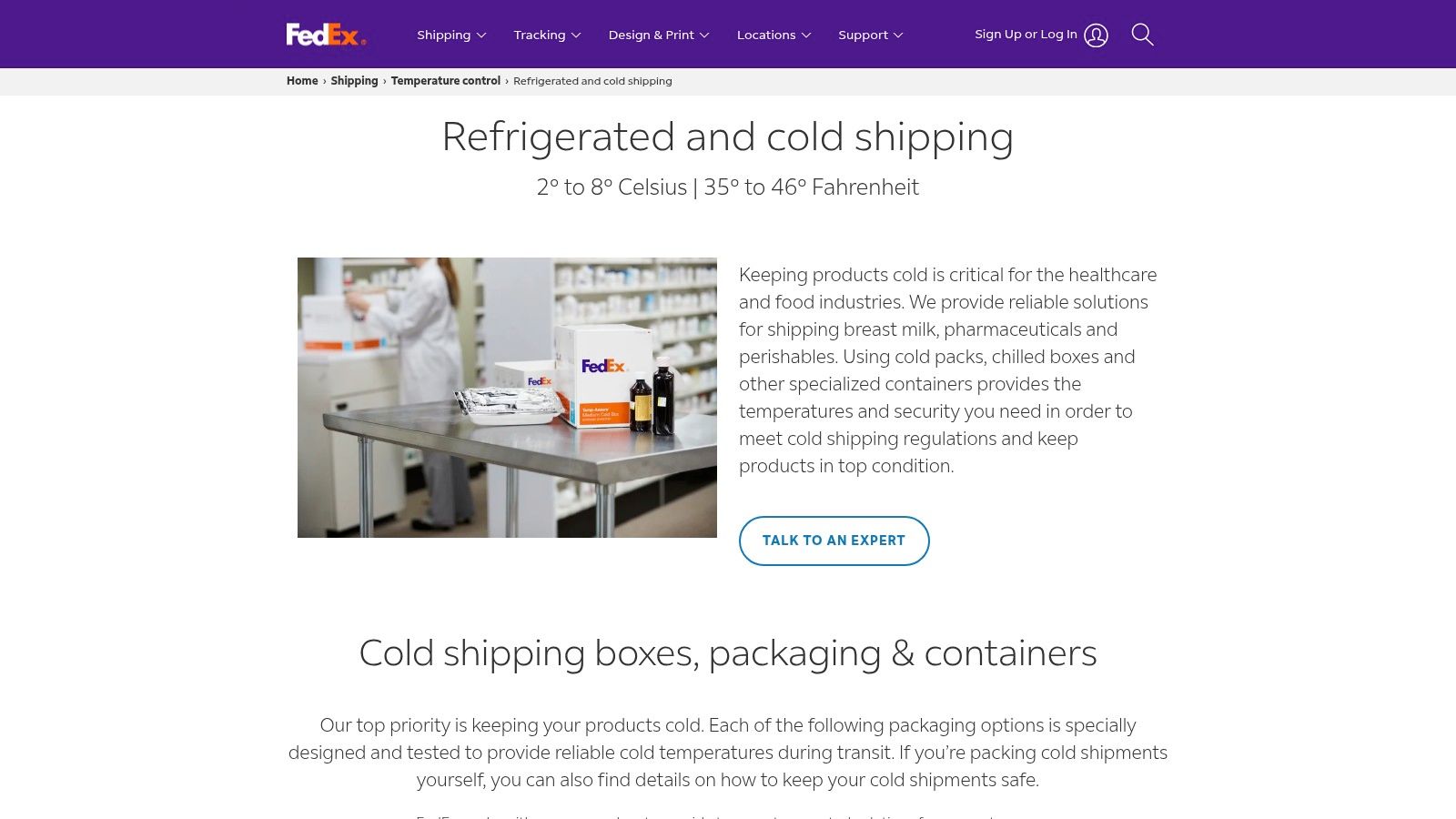
FedEx Cold Chain Solutions fits research shipments that can remain within a defined parcel workflow. The offering combines pre-qualified cold packaging, Cold Chain Centers, parcel transportation, and FedEx Custom Critical for movements requiring closer management. The appropriate choice depends on shipment complexity, thermal requirement, lane evidence, and the laboratory's receiving process.
Packaging for defined parcel lanes
Ready-to-use cold boxes support 2°C to 8°C shipments with stated durations of 48 to 96 hours, according to FedEx cold-shipping service information. That format can simplify procurement for a laboratory shipping a small payload through a familiar parcel process. Published packaging options and parcel rates may also support preliminary budgeting.
The stated duration describes packaging capability, not guaranteed performance on every route. Ambient conditions, pack-out practice, pickup timing, delivery timing, and unexpected dwell can reduce the available thermal margin. Stability documentation should therefore be reviewed with the intended payload, and the lane should be qualified when the material has a narrow operating range.
Higher-control movements
FedEx Custom Critical is suited to escorted, monitored, validated, or otherwise managed shipments, including frozen and deep-frozen cargo. It addresses requirements that a standard parcel box cannot, although customization is quote-based and requires more planning.
For routine domestic work, parcel packaging may suit predictable lanes with documented handling steps. For sensitive compounds, the laboratory should request pack-out instructions, temperature evidence, contingency procedures, and deviation records before selection. Custom Critical becomes more appropriate when dwell, handoffs, or stability limits create operational risk. The practical workflow is to match the service tier to the evidence required at receipt, not to treat one FedEx option as suitable for every sample.
3. DHL Life Sciences and Healthcare
DHL Life Sciences and Healthcare is designed for laboratories and life-sciences organizations that need international consistency rather than a one-off domestic parcel. Its offering includes validated corridors, packaging integrations, GxP and GDP processes, enterprise quality management, and LifeTrack and LifeConEx visibility tools.
A network choice for recurring international lanes
DHL's strongest differentiator is process continuity across import and export activity. A research organization moving temperature-sensitive materials between countries may need customs coordination, documented handoffs, exception management, and consistent packaging integration. Those requirements are difficult to maintain when every shipment is booked as an isolated parcel.
LifeTrack and LifeConEx provide visibility and exception-management functions, but visibility alone doesn't qualify a lane. Qualification still needs to address origin conditions, airport or depot exposure, customs delays, delivery handoff, and receiving capacity. The shipment record should demonstrate what happened, not merely show a tracking location.
Where the trade-off appears
DHL's infrastructure is likely to make more sense for recurring or programmatic movements than for an occasional low-value parcel. Onboarding can take time because the shipper must align documentation, operating procedures, packaging, and lane expectations.
For research teams, this makes DHL particularly relevant when international movement is a normal part of the workflow. It may be less efficient when the only requirement is a single domestic package with a known, short transit and a qualified passive shipper. The analytical point is that global reach has value only when the laboratory can use the accompanying quality and exception-management processes.
4. World Courier from Cencora
World Courier occupies the specialist end of the market. The service supports custom packaging and validated routes across controlled room temperature, refrigerated, frozen, and cryogenic requirements, with chain-of-custody controls, monitoring, intervention support, and life-sciences logistics expertise.

A high-touch option for high-consequence shipments
World Courier is most relevant when a shipment cannot be treated as ordinary parcel freight. Critical research compounds, biologic materials, clinical trial materials, and cryogenic shipments may require coordinated handoffs, route validation, continuous oversight, and a clear intervention path. The specialist model is built around those operational demands rather than just adding insulation to a standard box.
A global depot and transport network can support complex origin-to-destination movements. The value lies in the combination of packaging, courier handling, monitoring, and documentation. A laboratory should still review the exact route and product stability requirements, because a specialist provider doesn't remove the need for material-specific qualification.
Cost follows control intensity
Premium pricing is an expected trade-off for white-glove coordination. Lane setup, documentation, permits, and receiving instructions also need to be prepared before the shipment moves. That lead time can be disproportionate for a routine 2°C to 8°C parcel.
For laboratories managing sensitive materials, testing and batch documentation should sit beside the shipping record. A temperature trace can show that a box stayed within range, but it cannot independently establish identity, purity, or lot conformity. Shipping evidence and analytical evidence answer different quality questions.
5. Marken from UPS Healthcare Precision Logistics
Marken supports clinical and advanced-therapy logistics through validated packaging, controlled environments, real-time monitoring, risk management, and origin-to-final-mile coordination. Its integration with UPS Healthcare provides access to broader network capacity while retaining a life-sciences-oriented operating model.
Designed around programs, not isolated orders
Marken fits sponsored research, clinical programs, and recurring flows where customs, regulatory documentation, site coordination, and risk management occur repeatedly. Its white-glove model can connect shipment preparation at the origin with delivery requirements at a research or clinical site.
Real-time tracking is useful, but the more consequential feature is the surrounding operating process. A monitoring alert needs an assigned owner, a decision threshold, and a receiving or intervention procedure. Without those controls, a dashboard can document deterioration without preventing it.
The operational fit
Marken is less attractive for a simple, occasional parcel because onboarding and program design add complexity. Higher costs may be justified when the shipment is part of a continuing study, involves several sites, or requires customs and regulatory coordination.
The comparison with a general integrator is therefore about workflow, not just temperature. A standard carrier may transport a qualified package successfully. Marken is intended for environments where shipment timing, site readiness, documentation, and exception handling must operate as one controlled process.
6. QuickSTAT from Kuehne+Nagel Group
QuickSTAT coordinates specialist courier movements for pharmaceutical and biotechnology shipments across controlled room temperature, refrigerated, frozen, deep-frozen, and cryogenic dry-vapor requirements. The QuickSTAT from Kuehne+Nagel Group offering includes active monitoring, exception management, clinical-trial support, and operational coordination.
Built for time-critical coordination
QuickSTAT suits site-to-site research transfers, urgent laboratory shipments, clinical-trial logistics, and other movements where timing and communication require active management. Its value depends on the workflow around the package: assigned contacts, escalation rules, receiving instructions, and responses to monitoring alerts.
Temperature capability must match the material and the packaging qualification. Cryogenic dry-vapor shippers extend the available range beyond conventional refrigerated systems. FedEx's overview of cold-chain logistics distinguishes frozen transport from cryogenic technologies, including dry-vapor or liquid-nitrogen systems for materials that cannot use standard refrigerated packaging.
A cryogenic label does not replace documented shipper qualification, replenishment planning, lane review, and receiving procedures.
Documentation can determine readiness
QuickSTAT's flexible coordination can require regulatory documents, permits, product details, and site contacts before dispatch. That preparation may delay an unplanned shipment, while reducing the risk of incomplete information entering transit.
For complex or time-sensitive research workflows, this control level can justify the administrative effort. Routine, lower-complexity shipments may fit a qualified passive box and parcel integrator more proportionately. The decision should reflect temperature requirement, lane qualification, monitoring needs, and the laboratory's receiving capacity.
7. Kuehne+Nagel Healthcare and Cold Chain
Kuehne+Nagel Healthcare and Cold Chain is a freight-forwarding choice for larger, heavier, palletized, and international research movements. Its healthcare network includes certified stations, controlled corridors, reefer air and ocean options, lane monitoring, and quality frameworks for temperature-sensitive cargo.
Better for freight than small parcels
A freight network offers choices that parcel integrators don't always provide. Air and ocean reefer options can support different balances of speed, cost, payload, and route structure. That matters when a research organization moves multiple containers, larger lots, or materials through import and export channels.
The trade-off is implementation. Freight forwarding requires contracting, SOP alignment, product classification, customs planning, and coordination between stations. A laboratory shipping a small vial in a qualified parcel box may find that process excessive. A biotechnology operation managing repeated palletized movements may find it necessary.
Lane design is central
Kuehne+Nagel's value depends on how well the lane is designed. The analysis should include origin conditioning, airport handling, transit mode, destination storage, customs exposure, and final delivery. Real-time lane monitoring can identify events, but it won't eliminate exposure created by long staging periods or unclear ownership at a handoff.
A forwarder is therefore best evaluated through a lane-specific operating plan. The key question isn't whether the provider offers cold chain service. It is whether the proposed route, modal combination, documentation, and escalation path match the compound's stability window and the laboratory's receiving capacity.
8. Cryoport Systems
Cryoport Systems serves life-sciences programs across cryogenic, ultra-cold, refrigerated, and controlled-room-temperature ranges. Its platform combines specialized shippers, logistics centers, biostorage, cryopreservation services, condition monitoring, intervention capabilities, and ISO 21973:2020-certified solutions for cell and gene therapy logistics.
The specialist for sub-zero complexity
Cryoport is over-specified for many routine 2°C to 8°C research parcels. Its relevance increases when material integrity depends on ultra-cold or cryogenic conditions, when biostorage is part of the workflow, or when a program needs an integrated logistics and preservation environment.
Cryogenic transport also changes the operational model. Dry-vapor systems, replenishment controls, specialized receiving, and condition monitoring must be aligned before dispatch. A laboratory cannot treat a cryogenic shipment as a colder version of a refrigerated box.
Where program qualification matters
Cryoport's strength is most visible in high-value biologic and advanced-therapy programs that require repeatable handling across multiple stages. Continuous monitoring and intervention capabilities can support deviation response, but the laboratory still needs defined acceptance criteria and a receiving team capable of reviewing the data.
The premium structure may not be appropriate for a small, predictable shipment. It becomes more defensible when the material is difficult to replace, the temperature range is extreme, or storage and transport must be managed as one connected workflow.
9. Peli BioThermal
Peli BioThermal supplies reusable passive parcel and bulk shippers, rental and lease programs, service-center support, and asset-tracking tools such as ProEnvision. Crēdo on Demand and related programs can help laboratories standardize pack-outs without purchasing every shipper outright.
Packaging can be the solution
Peli BioThermal is not a carrier replacement. It is a packaging and asset-management choice that can be combined with parcel integrators such as UPS or FedEx. That distinction matters because thermal capability, transport execution, and monitoring remain separate control layers.
Reusable systems can provide more predictable performance than improvised gel-pack kits when the laboratory follows the qualified pack-out. Rental and lease arrangements can reduce the need for capital ownership and support reverse logistics, while service centers can help with conditioning and refurbishment.
The hidden requirement is pack-out discipline
A reusable shipper only performs as qualified when the payload, coolant configuration, conditioning state, closure, and dispatch timing match the documented design. Larger dimensions and higher parcel weight may also affect transportation cost and handling.
For a laboratory sending repeat shipments on known lanes, standardization can improve consistency. For occasional shipments, the handling and return process may outweigh the thermal advantage. Product selection should therefore include the full workflow, including who conditions the shipper, who records the pack-out, and how the asset returns.
Research materials sourced through a research peptide catalog should still be matched to product-specific storage and stability documentation. Packaging doesn't establish stability by itself.
10. Sonoco ThermoSafe
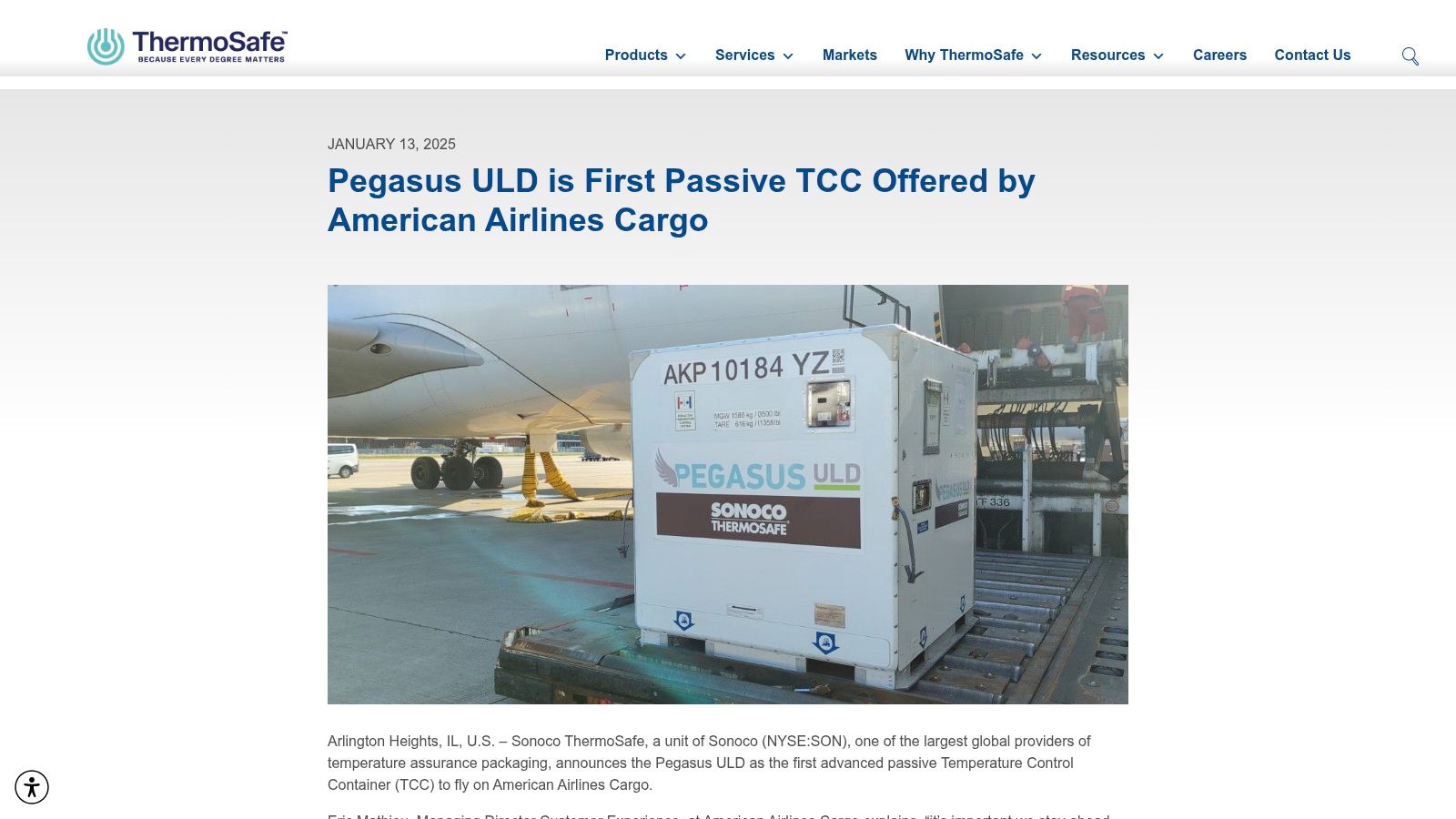
Sonoco ThermoSafe offers passive parcel and pallet systems across temperature bands, along with Pegasus ULD, a passive bulk aircraft container with airline approvals. Its ISC Labs services support design and qualification, while purchase, rental, and lease models provide different procurement paths.
A bridge from parcel to bulk air
ThermoSafe is useful when a research organization wants passive packaging but expects shipment scale to increase. Parcel and pallet systems can address different payloads and durations, while Pegasus ULD offers a passive bulk option for suitable air-cargo lanes.
Passive packaging can reduce dependence on powered active containers, but it remains sensitive to pack-out execution and qualified duration. The system must be matched to the product's temperature band, payload, route, ambient exposure, and handoff plan.
Qualification is the purchase decision
ISC Labs support can help translate a proposed package into a qualified design. That service is more valuable than choosing a box from a catalog without confirming the exact payload and lane. Airline access also affects Pegasus availability because the container depends on participating airlines and lease stations.
ThermoSafe fits laboratories that want packaging flexibility across shipment scales. It isn't necessarily the best choice for a shipment requiring specialist intervention, continuous courier coordination, or cryogenic handling. In those cases, a packaging provider may need to work alongside a specialist logistics operator rather than replace one.
Top 10 Cold Chain Shipping Providers, Comparison
| Provider | Core Temp & Services ✨ | Quality & Verification ★🏆 | Best for 👥 | Pricing & Complexity 💰 |
|---|---|---|---|---|
| UPS Healthcare (Temperature‑Controlled Logistics) | CRT, 2–8°C, frozen & deep‑frozen; UPS Premier sensor visibility ✨ | US healthcare‑dedicated facilities; mature compliance ★★★★🏆 | Domestic & cross‑border regulated research shipments 👥 | Quote‑based; surcharges for premium monitoring 💰 |
| FedEx Cold Chain Solutions (incl. Cold Shipping Packages & Custom Critical) | Ready‑to‑use 2–8°C boxes (48–96h); FedEx Custom Critical for escorted/frozen ✨ | Cold Chain Centers & parcel validation; predictable parcel options ★★★★ | Nationwide next‑day small research parcels 👥 | Published parcel rates + packaging; Custom Critical = quote 💰 |
| DHL Life Sciences & Healthcare (LifeConEx) | Validated corridors; LifeTrack visibility; GxP/GDP processes ✨ | Enterprise QMS, global lane validation ★★★★🏆 | Consistent international exports/imports of research materials 👥 | Best value on recurring higher‑volume lanes; onboarding time 💰 |
| World Courier (Cencora), Pharmaceutical Cold Chain | CRT → cryogenic; white‑glove, lane validation, 24/7 monitoring ✨ | Rigorous chain‑of‑custody & clinical logistics ★★★★★🏆 | High‑value peptides & clinical trial material 👥 | Premium pricing; lead time to set up lanes 💰 |
| Marken (UPS Healthcare Precision Logistics) | End‑to‑end validated temp control; real‑time monitoring & origin→final‑mile ✨ | Purpose‑built for life‑sciences; regulatory & customs expertise ★★★★★ | Sponsored research, clinical programs & complex regulatory flows 👥 | Higher cost & onboarding complexity; programmatic focus 💰 |
| QuickSTAT (Kuehne+Nagel), Life‑Sciences Logistics | CRT to cryogenic; active monitoring & 24/7 exception management ✨ | Clinical trial/sample logistics with around‑the‑clock ops ★★★★★ | Time‑critical research shipments needing intensive oversight 👥 | Premium handling/monitoring pricing; possible doc requirements 💰 |
| Kuehne+Nagel, Healthcare / Cold Chain (US) | Pharma/HealthChain stations; reefer air/ocean options; lane monitoring ✨ | Certified stations & global quality frameworks ★★★★ | Bulk/palletized freight, import/export of temperature‑sensitive loads 👥 | Optimized for larger shipments; contracting & SOP alignment 💰 |
| Cryoport Systems, Integrated Cryogenic to 2–8°C Logistics | Cryogenic (LN2) → ultra‑cold → refrigerated; Cryoport shippers & biostorage ✨ | ISO 21973:2020 CGT solutions; continuous condition monitoring ★★★★★🏆 | Ultra‑sensitive biologics & cell/gene therapy programs 👥 | Premium, program qualification required; over‑specified for routine 2–8°C 💰 |
| Peli BioThermal, Reusable Cold Chain Packaging (Crēdo) | High‑performance reusable passive shippers (120+ h); rental/lease programs ✨ | Predictable thermal performance & asset tracking (ProEnvision) ★★★★ | Standardizing pack‑outs, repeated moves, sustainability focus 👥 | Rental lowers CapEx; heavier parcel weights & SOPs needed 💰 |
| Sonoco ThermoSafe, Temperature‑Assured Packaging (Pegasus ULD) | Pre‑qualified parcel & pallet systems; Pegasus ULD passive bulk option ✨ | Lab qualification services; airline‑approved passive bulk ★★★★ | Scaling from parcel to bulk air moves while retaining passive simplicity 👥 | Purchase/rental options; tight pack‑out discipline required 💰 |
Choose the Control Level Your Samples Need
The first decision is the documented temperature band. Research teams should identify whether the material requires controlled room temperature, refrigerated 2°C to 8°C, frozen conditions, deep-frozen handling, or cryogenic transport. DHL's temperature-controlled logistics guidance describes 2°C to 8°C as a widely used pharmaceutical refrigerated range, while FedEx's cold-chain guidance distinguishes frozen and cryogenic transport technologies. The product's own stability data remains the controlling reference.
The second decision is the shipment profile. Payload size, expected transit duration, lane, customs exposure, weekend risk, ambient conditions, and contingency margin determine whether a standard passive shipper is sufficient. A qualified passive package may suit a predictable domestic lane. A high-risk international movement, cryogenic shipment, or irreplaceable research material may justify specialist logistics, active monitoring, intervention support, or a freight-forwarding program.
The third decision is operational readiness. Staging, cross-docking, and response delay can create risk even when the selected container has strong thermal performance. A 2026 thermal reliability framework argues that excursion risk depends on event probability, cumulative excursion minutes, maximum duration, sensor uncertainty, and time-to-intervention, with staging and cross-docking exposure potentially driving upper-tail risk more than just lowering refrigeration setpoints. The published framework supports a practical conclusion: the best cold chain shipping solutions connect monitoring to a person, an escalation rule, and a receiving decision.
Batch documentation belongs in the same procurement workflow. A batch-specific Certificate of Analysis can help a laboratory verify the identity and specifications of the exact lot received, rather than relying on a generic product page. A neutral research-standards source describes lot-linked records as a mechanism for supporting traceability, audits, and reproducibility.
Where relevant, Pro Tec Pep provides product-level specifications, batch-linked COAs, and optional cold-chain handling for research-use-only compounds. Those records can support procurement and receiving review, but shipping alone doesn't establish compound stability, identity, purity, or suitability for a particular assay. The receiving laboratory still needs to compare the lot documentation with the order, inspect the package, review temperature evidence, and record any deviation.
A concise pre-dispatch review should confirm:
- COA access: The batch-specific record is available for the exact lot being shipped.
- Storage requirement: The product's documented temperature band and stability information are recorded.
- Packaging qualification: The pack-out matches the payload, lane, duration, and contingency margin.
- Delivery timing: Pickup, transit, weekends, customs exposure, and receiving hours are aligned.
- Monitoring plan: Sensor placement, alert thresholds, data access, and intervention ownership are defined.
- Receiving readiness: Staff can inspect the shipment, review records, quarantine a questionable package, and document acceptance or deviation.
The most suitable provider is the one whose control level matches the actual risk. Parcel integrators offer convenience, specialist couriers add coordination, freight networks support scale, and packaging providers add thermal standardization. A defensible selection joins all four questions, thermal capability, monitoring, qualification, and operational fit, to the compound and the laboratory's documented workflow.
Pro Tec Pep supplies research-use-only compounds with batch-specific documentation, product storage information, and optional cold-chain handling for temperature-sensitive materials. Research laboratories and biotechnology teams can review the available materials and logistics options by visiting Pro Tec Pep.