CJC-1295 Without DAC Explained for Lab Research
Learn what CJC-1295 without DAC is, how it differs from DAC, half-life implications, handling and documentation for lab research.
What changes more in a growth-hormone axis experiment: the peptide name on the vial, or the timing logic built around it? That question exposes why CJC-1295 Without DAC creates so much confusion in lab settings. Many researchers arrive expecting a simple shorter-acting version of CJC-1295 with DAC. The literature points to something more specific and more demanding: a pulsatile research tool whose value depends heavily on assay timing, sample handling, and documentation quality.
That difference matters in ordinary bench work. A lab planning receptor-interaction work, endocrine sampling, or peptide characterization may treat DAC and no-DAC forms as near equivalents because the naming is similar. In practice, the structural distinction changes the exposure pattern, and that changes what the experiment is measuring. A sustained signal and a short pulse don't ask the same question of a biological system.
Researchers sorting through peptide identities, synonyms, and product formats often start with a broader compound research library before narrowing to one exact form. That extra step helps prevent a common error: assuming that two compounds with similar naming conventions can share the same timing windows, downstream marker strategy, or interpretation model.
Introduction to CJC-1295 Without DAC in Research Context
A typical point of confusion starts with a purchasing sheet that lists CJC-1295, CJC-1295 DAC, and Modified GRF(1-29) as if they were interchangeable labels. They aren't. For a research group studying endocrine signaling, receptor response, or analytical behavior, the distinction affects nearly every part of the protocol, from sample collection windows to repeatability across lots.
CJC-1295 Without DAC belongs in a laboratory conversation, not a consumer one. The useful questions aren't about personal outcomes. They're about identity, kinetics, signal shape, and whether the literature supporting one form applies to the other. Those points become especially important when a project depends on short-lived endocrine changes rather than longer downstream readouts.
Why the no-DAC form draws so much attention
The search interest is easy to understand. Many peptide pages reduce the topic to one sentence: no DAC means short half-life, DAC means long half-life. That's true in broad terms, but it leaves out the practical issue. A short-acting GHRH analog doesn't just disappear faster. It may create an experimental environment where tiny differences in timing can reshape the dataset.
Practical rule: In pulse-based peptide work, timing isn't a background detail. Timing is part of the reagent definition.
Three issues tend to drive the confusion:
- Naming overlap: "CJC-1295 without DAC" is often discussed alongside Modified GRF(1-29), which leads some teams to wonder whether they're looking at a distinct compound, a synonym, or a commercial naming habit.
- Evidence asymmetry: The DAC form has recognizable human clinical discussion. The no-DAC form is often discussed with more certainty than the direct evidence supports.
- Workflow mismatch: Many labs standardize around broad collection windows. Pulsatile compounds punish that kind of loose timing.
What matters most in a research setting
For a lab audience, the key questions are straightforward:
| Research question | Why it matters |
|---|---|
| What exactly is the compound? | Identity determines whether published findings can be mapped to the material under study. |
| How brief is the active window? | Short exposure changes endocrine sampling, receptor readout timing, and reproducibility. |
| What documentation exists for the lot? | Batch-specific verification supports cleaner interpretation and procurement records. |
The rest of the discussion makes the central point plain: CJC-1295 Without DAC is best understood not merely as a shorter version of CJC-1295, but as a peptide research tool whose usefulness depends on pulse-aware design and careful skepticism about overstated claims.
What CJC-1295 Without DAC Is and How It Works
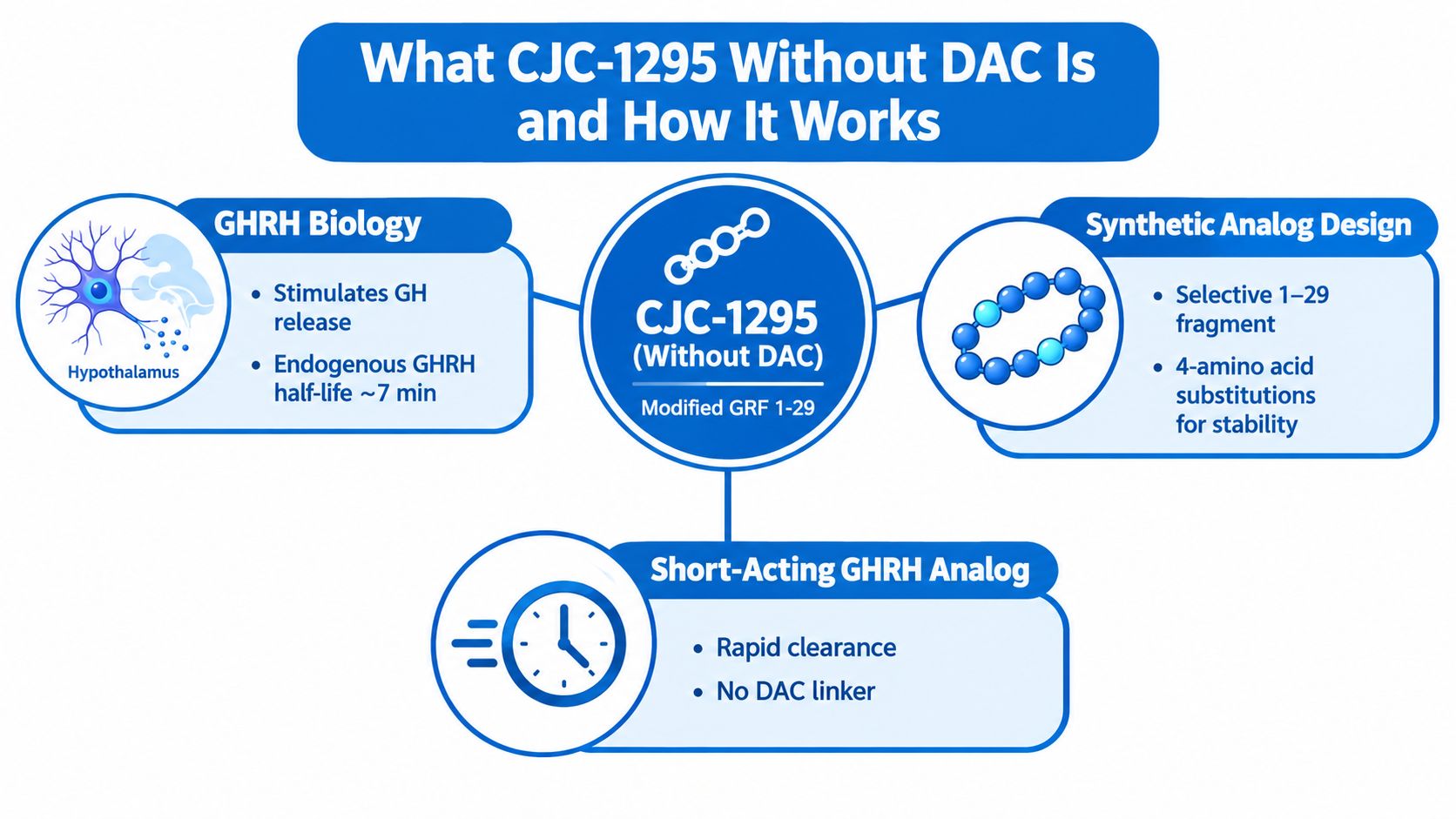
At the mechanistic level, CJC-1295 Without DAC is discussed as a growth hormone-releasing hormone analog. In the literature and independent summaries, it is commonly described as Modified GRF(1-29), a short-acting form that lacks the DAC linker found in the longer-acting version, as noted by Superpower's CJC-1295 guide.
From endogenous signal to synthetic analog
The easiest way to understand the compound is to start with the native signal. Growth hormone-releasing hormone is part of the upstream signaling that stimulates growth-hormone release. A synthetic analog keeps that signaling concept but alters the molecular design enough to change how the signal behaves in a research system.
A useful analogy is a doorbell press versus a light switch left on. Endogenous and short-acting analog signaling looks more like a brief press. The signal arrives, triggers a response, and fades. A longer-acting modification changes the shape of exposure, so the system is dealing with persistence rather than a brief trigger.
Why the no-DAC identity matters
For researchers, the phrase without DAC isn't a minor label. It identifies a form that doesn't bind serum albumin through the linker strategy used in the DAC version. That lack of albumin binding is what underlies the short-exposure profile commonly associated with Modified GRF(1-29).
That changes the experimental question. Instead of asking how a prolonged analog sustains endocrine signaling over days, the no-DAC form is more relevant when a lab wants to examine acute signaling, pulse-sensitive responses, or time-locked assay outputs. The compound has been studied for its effect on the growth-hormone axis in clinical and research discussions, but interpretation should stay narrow and literature-based.
A short pulse and a sustained exposure may activate related pathways, but they do not create identical datasets.
What researchers usually need to keep straight
A simple distinction helps prevent category errors:
- Compound class: It is a synthetic peptide analog, not a general wellness product.
- Literature role: It has been discussed for its effect on growth-hormone axis signaling in research contexts.
- Naming reality: Many sources treat CJC-1295 Without DAC and Modified GRF(1-29) as the same short-acting analog.
- Design implication: The lack of DAC is not cosmetic. It changes exposure behavior, which changes assay planning.
That last point sets up the comparison that most researchers are trying to make: not whether one label sounds better, but whether DAC and no-DAC are the same experimental tool. They aren't.
CJC-1295 Without DAC Versus DAC Key Differences
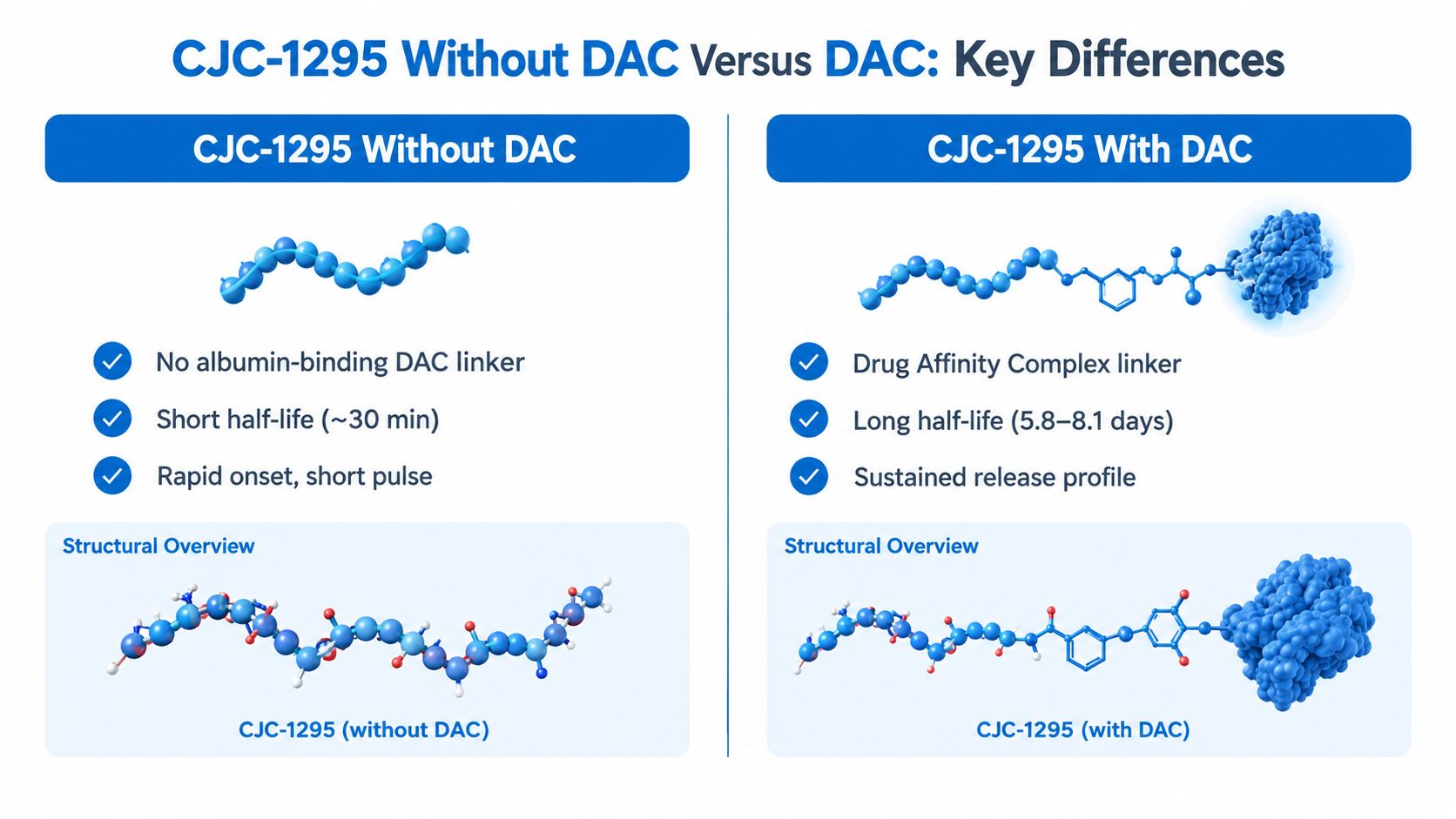
The cleanest way to compare the two forms is to focus on structure first, then consequences. The major difference is the Drug Affinity Complex linker. The DAC form includes the albumin-binding feature. The no-DAC form does not. That one structural change alters how long the peptide remains in circulation and what kind of signal pattern a study can observe.
Researchers looking at the longer-acting form can compare specifications or product-level context on the CJC-1295 DAC page. That kind of side-by-side review helps prevent an easy procurement mistake: ordering one form while designing the study around the other.
Structural distinction and what it changes
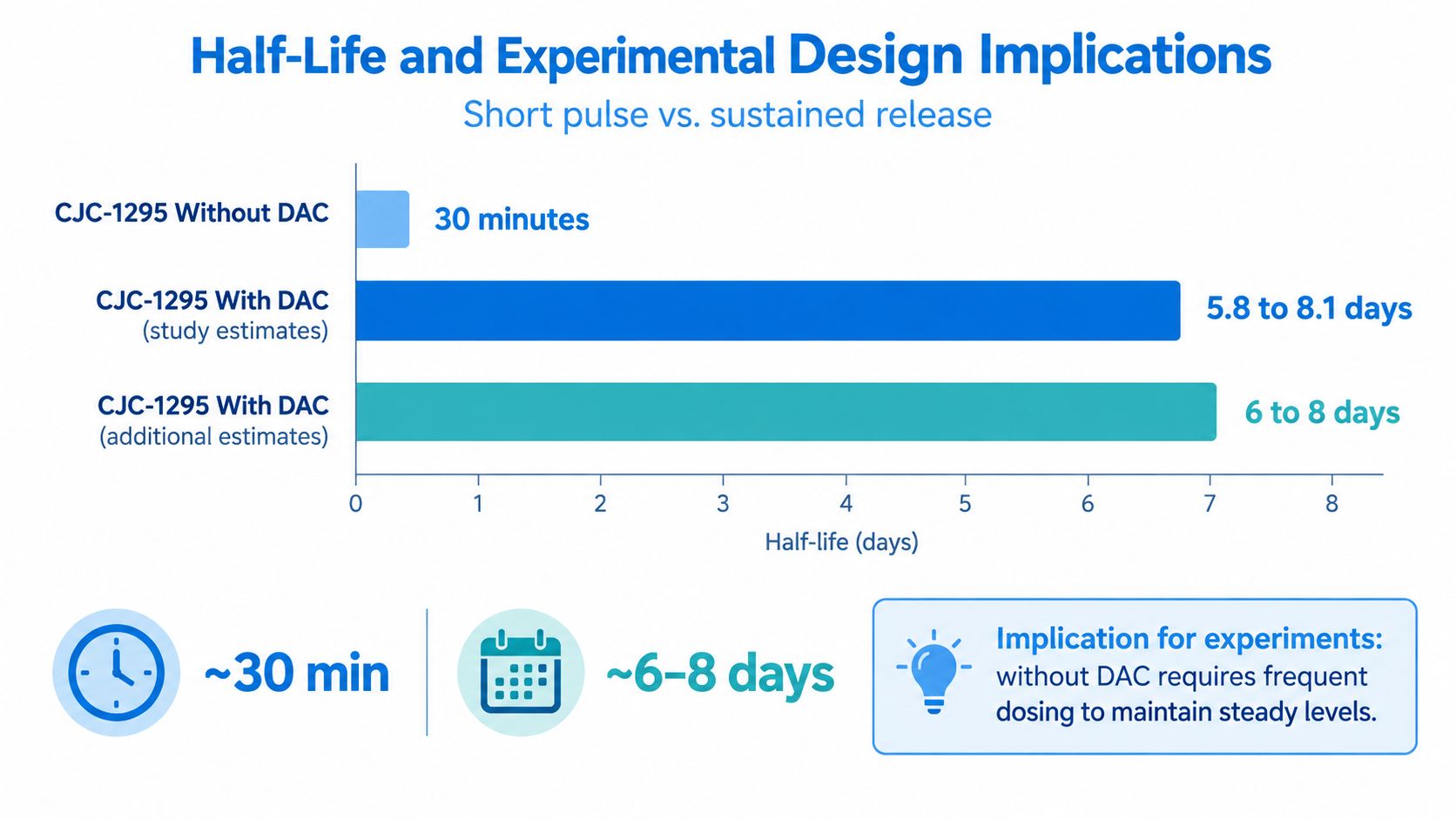
Independent pharmacokinetic discussion describes CJC-1295 without DAC as the short-acting GHRH analog commonly described as Modified GRF(1-29). Unlike the DAC form, it does not bind serum albumin, and its plasma half-life is typically cited at about 30 minutes, while the DAC form is estimated at roughly 6 to 8 days in human studies, according to 22Exo's DAC vs no-DAC pharmacokinetic review.
That means the forms shouldn't be treated as interchangeable variables in the same protocol template. One behaves like a brief trigger. The other behaves more like an extended exposure system.
Side-by-side comparison
| Feature | CJC-1295 Without DAC | CJC-1295 With DAC |
|---|---|---|
| Common identity | Commonly described as Modified GRF(1-29) | Longer-acting DAC-modified form |
| Albumin binding | No albumin-binding DAC linker | Albumin-binding linker present |
| Exposure profile | Brief, pulse-like | Sustained over days |
| Best matched assay logic | Tight timing around acute effects | Broader windows for cumulative endocrine response |
Why the label alone can mislead
A naming similarity can hide an experimental mismatch. Two vials may both contain a CJC-labeled analog, but the project may be asking for either a pulsatile model or a sustained model. The peptide name doesn't answer that by itself. The kinetic design does.
Many online descriptions oversimplify the issue. They frame the choice as convenience versus inconvenience. In research terms, the better framing is pulse versus persistence. That's a methodological choice, not just a packaging difference.
- For acute signaling work: no-DAC logic fits better because the system sees a short-lived stimulus.
- For prolonged endocrine tracking: DAC logic fits better because the signal persists.
- For cross-study comparisons: mixing the two forms under one umbrella name makes interpretation weaker.
Researchers don't just choose a peptide. They choose a time pattern.
That pattern becomes most important when half-life claims are translated into actual collection schedules, downstream markers, and reproducibility controls.
Half Life and Experimental Design Implications
The practical question isn't whether CJC-1295 Without DAC is short-acting. It is. The practical question is what that short exposure forces a lab to change. Assay timing, sample collection windows, and interpretation of downstream markers all need a tighter framework when the signal behaves like a brief pulse.
What the half-life numbers actually mean in practice
Secondary and semi-neutral reviews in current research discussions consistently describe the no-DAC form as a brief pulse lasting roughly 25 to 30 minutes or about 30 minutes, contrasted with DAC versions that persist for days, while also noting that there is no validated human half-life for ipamorelin and no published randomized human trial of the common no-DAC plus ipamorelin pairing at typical online-use doses, according to Peptides Research Hub's half-life and pharmacokinetics review.
That one paragraph from the literature has two consequences. First, a short pulse means a broad sampling window can miss the event being studied. Second, common pairing assumptions may sound standardized online while still resting on a thin direct evidence base.
A video summary can help visualize the timing contrast before protocol design starts.
What human clinical data actually established
The best-known human milestone belongs to the long-acting CJC-1295 research lineage, not to a dedicated peer-reviewed no-DAC human PK study. In a Phase 1 study published in 2006, healthy adult volunteers received single subcutaneous doses of 30, 60, 125, or 250 μg/kg, producing dose-dependent growth-hormone increases of roughly 2- to 10-fold for 6 days or more, while IGF-I rose 1.5- to 3-fold for 9 to 11 days. The same study estimated a half-life of 5.8 to 8.1 days, and after multiple doses mean IGF-I remained above baseline for up to 28 days, as summarized in Real Peptides' review of the 2006 clinical evidence.
Those data explain why the DAC-associated lineage became a landmark in long-acting GHRH analog research. They do not automatically settle the kinetics of the exact no-DAC formulation.
Design consequences for pulse-based work
Short exposure changes how a lab should think about readouts:
- Sampling windows become narrow. If the target effect is acute endocrine movement, delayed collection can flatten or miss the signal.
- Reproducibility depends on timing discipline. A protocol that says "collect later" is much weaker than one that defines tightly controlled post-exposure intervals.
- Downstream markers may outlast the pulse. A brief upstream signal can still affect later markers, so investigators need to separate acute from cumulative endpoints.
- Pairing logic needs scrutiny. Common co-administration discussions may be widespread, but they aren't the same thing as validated human trial structure.
Key distinction: Half-life is not just a pharmacokinetic fact. It is a scheduling constraint built into the experiment.
A lab studying acute receptor or endocrine dynamics may prefer the no-DAC concept precisely because it preserves pulsatility. The tradeoff is that pulsatility is harder to standardize. In short, CJC-1295 Without DAC isn't just a shorter version of the DAC form. It requires a different timing philosophy.
Stability Handling and Storage Considerations for Lab Samples
Short-acting compounds create one kind of timing pressure in the assay. Sample handling creates another. Even a well-designed protocol can drift if the material arriving at the bench wasn't stored, prepared, or tracked consistently across lots.
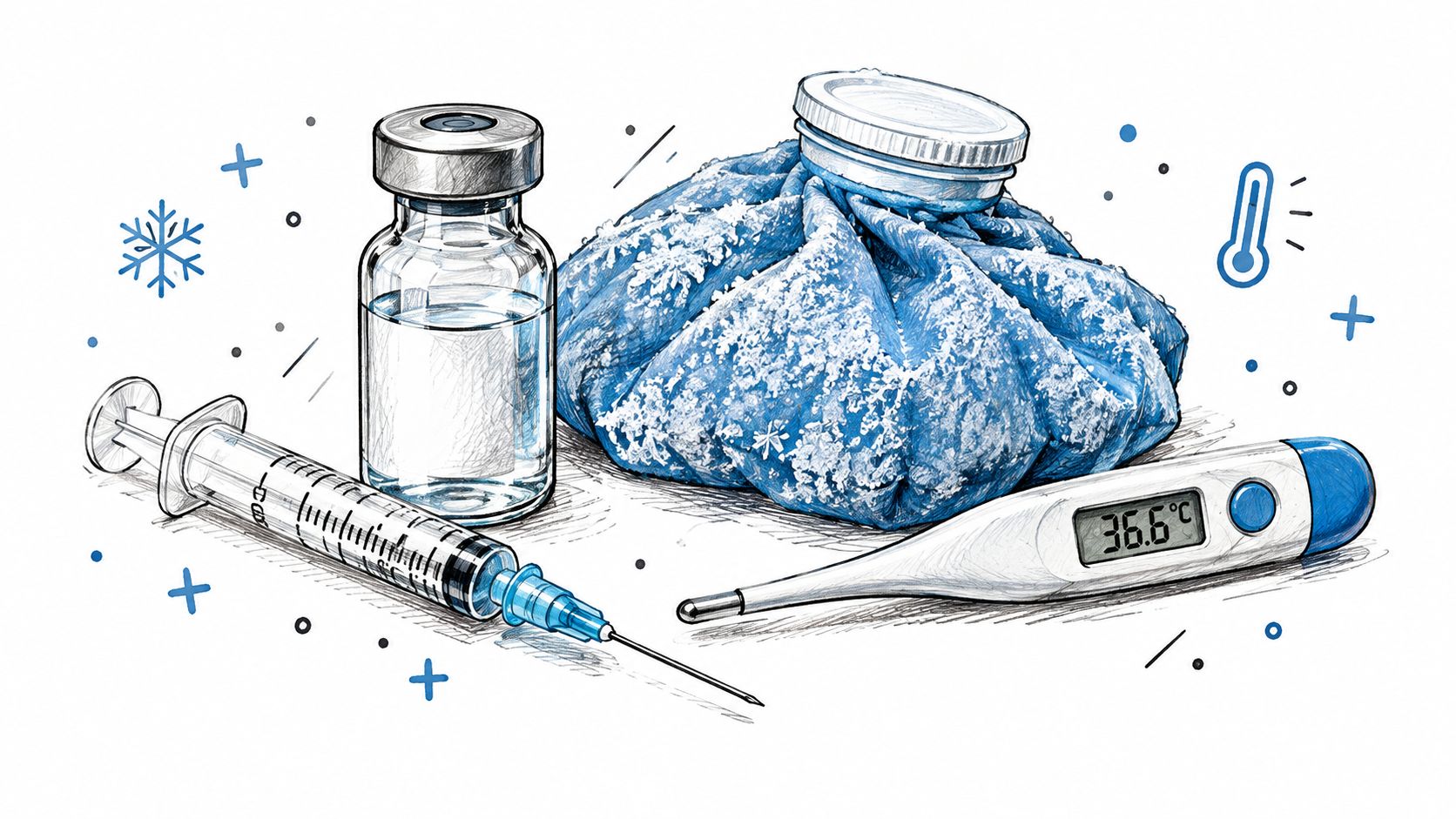
Product-level handling details matter most when they come from batch-linked specifications and testing records such as those collected on testing and verification resources. For a peptide with pulse-sensitive research applications, clean paperwork and consistent storage are part of data quality control.
A lab-first way to think about handling
This topic should stay in the frame of laboratory sample preparation, not human administration. The useful questions are practical ones. What formulation state is being supplied? What solubility guidance is attached to that lot? What storage condition is listed on the product detail page? What stability timeframe is documented for the material before and after sample prep?
A lab that standardizes these variables reduces ambiguity later. If one technician prepares samples immediately on receipt while another leaves materials at room temperature during setup, the study may gain avoidable variance before the first assay runs.
Handling points that support reproducibility
- Check the listed storage condition first. Product detail pages often include recommended storage such as -20°C, along with formulation and stability notes.
- Match prep workflow to the assay calendar. Short-lived signaling studies work better when sample preparation and experiment timing are planned together.
- Control temperature exposure during transit and receipt. Cold-chain options and rapid processing can help protect integrity for temperature-sensitive materials.
- Keep lot records attached to the experiment file. If a result shifts across repeat runs, batch documentation is often the first place a lab should look.
Why consistency matters more than speed
Researchers sometimes focus on getting material into an experiment quickly. For pulse-oriented peptide work, consistency usually matters more than raw speed. A slower but standardized intake process is often better than fast but variable handling.
One factual point is especially important here. High-quality research peptide documentation commonly includes batch-specific certificates of analysis with identity, purity, net content, sterility, endotoxins, heavy metals, and conformity testing, and independent guidance notes that HPLC purity and mass spectrometry alone do not establish sterility or endotoxin status, as explained in Loti Labs' guide to reading peptide certificates of analysis.
That means a purity figure by itself doesn't answer the full quality question. For reproducible work, storage conditions, shipping controls, and broader lot documentation matter alongside analytical identity.
Documentation to Review Before Starting Research
The fastest way to weaken a peptide study is to start with vague paperwork. A clean pre-experiment review should confirm not only what the compound is called, but what exact lot was received, how it was tested, and whether the documentation covers more than identity and purity.
What should appear in the technical record
A strong product record usually includes the core identifiers:
| Documentation item | Why researchers check it |
|---|---|
| Formal name and synonyms | Confirms whether the material aligns with the literature naming used in protocols and purchasing records |
| CAS number and peptide sequence | Supports procurement accuracy and cross-checking across vendors or internal databases |
| Molecular formula and formula weight | Helps with analytical verification and reporting |
| Formulation state, solubility, storage, stability | Guides sample prep workflow and inventory management |
For compounds discussed under multiple names, this matters more than usual. CJC-1295 Without DAC, CJC-1295 no DAC, and Modified GRF(1-29) may appear in overlapping contexts. The lot paperwork should remove ambiguity rather than add to it.
Why batch linkage matters
A generic certificate isn't enough if it isn't tied to the purchased lot. Batch-linked records make it possible to verify the exact material used in the experiment and defend that choice during internal review, partner audits, or manuscript preparation.
One market example is Pro Tec Pep, which states that each batch is evaluated across identity, purity, net content, sterility, endotoxins, heavy metals, and conformity, and links batch-specific COAs at the product level alongside specification details such as sequence, CAS, solubility, storage, and stability. That kind of documentation model is useful because it connects procurement, handling, and assay records without leaving the lot identity vague.
A peptide study becomes easier to trust when the lot number, test panel, storage record, and assay file all point to the same material.
A practical review checklist before assay launch
Before work begins, many labs benefit from a short verification pass:
- Confirm identity terms. Make sure the synonym on the invoice matches the name used in the protocol.
- Review the full COA panel. Don't stop at chromatographic purity if the project also depends on sterility or endotoxin-sensitive systems.
- Check storage notes against internal SOPs. Product-page guidance and laboratory handling practice should not conflict.
- Archive the lot documents with the raw data plan. That saves time when a repeat run or audit asks what exact material was used.
Documentation doesn't make the biology clearer on its own. It does remove avoidable uncertainty. With a compound that already carries naming overlap and evidence gaps, that's a major advantage.
Understanding the Evidence Gap and How to Interpret Claims
Many pages talk about CJC-1295 Without DAC as though its human pharmacology has been mapped with the same confidence as the DAC-linked clinical lineage. That isn't what the best neutral summaries say. A major overlooked point is that direct pharmacokinetic and pharmacodynamic evidence for the exact no-DAC form remains limited, and a 2026 evidence review characterizes it as uncharacterized with no peer-reviewed human studies, according to MyPep's 2026 review of CJC-1295.
That doesn't mean the no-DAC concept is meaningless. It means the confidence level should match the evidence. Even the commonly repeated ~30-minute figure is often treated as settled fact when it may be an extrapolated value rather than one anchored in dedicated human PK work for the exact formulation.
How researchers can read these claims more carefully
A few habits help:
- Separate human clinical data from secondary extrapolation. A repeated half-life estimate may still rest on indirect reasoning.
- Distinguish the DAC evidence base from the no-DAC evidence base. Similar names can hide a real gap in direct data.
- Treat commercial repetition with caution. A claim can be widespread without becoming better supported.
- Define the experiment around uncertainty. If the exact human PK profile isn't firmly established, timing assumptions should be tested, not assumed.
The contrarian but useful conclusion is this: CJC-1295 Without DAC may be most valuable when treated as a pulse-oriented research tool with a documentation and evidence burden, not as a fully characterized shortcut label. That framing is less flashy, but it's much more defensible.
Researchers comparing pulse-oriented peptide formats need lot-level documentation, storage guidance, and testing records that are easy to verify before assay work begins. Pro Tec Pep provides research-use-only compounds with batch-linked COAs, specification details, and fulfillment options built around laboratory workflows. For CJC-1295-related projects, that kind of documentation-first approach helps align compound identity, handling, and timing-sensitive study design.
"For laboratory research use only. Not for human or veterinary use. Not a drug, food, or cosmetic. Not evaluated by the FDA. Not intended to diagnose, treat, cure, or prevent any disease. By purchasing, you certify you are a qualified researcher and agree to use this product solely for in-vitro laboratory research."