A 2026 Guide to Cjc 1295 with or Without Dac
Compare cjc 1295 with or without dac in research settings. Explore its structure, stability, pharmacokinetics, specifications, and COA documentation for 2026.

The most common advice about CJC-1295 with or without DAC is also the least useful: choose the long-acting version for convenience, or choose the short-acting version for pulsatility. That framing treats pharmacokinetics as a preference instead of an experimental variable. A longer exposure isn't automatically better, and a short exposure isn't automatically more physiologic for every assay.
CJC-1295 is a synthetic growth hormone-releasing hormone, or GHRH, analog. The DAC modification changes how the molecule persists in biological systems, which in turn changes the timing of growth hormone, or GH, and IGF-1 readouts. Researchers selecting between variants should therefore begin with the endpoint, the required exposure profile, and the quality controls needed to distinguish one molecular form from the other.
Introduction to CJC-1295 Variants
The useful distinction is not merely long acting versus short acting. CJC-1295 with DAC is suited to experiments requiring extended exposure, whereas CJC-1295 without DAC is associated with faster clearance and a more temporally limited GHRH receptor signal. Variant selection should follow the endpoint: sustained endocrine response, acute secretory dynamics, receptor recovery, or feedback behavior.
The best-established human evidence concerns the DAC form. In a 2006 phase I/II study of healthy adults, single subcutaneous doses produced dose-dependent changes in GH and IGF-1 that persisted beyond an acute sampling window, as reported in the published human study. The detailed magnitude and duration of those responses belong with the pharmacokinetic comparison, where exposure profiles can be evaluated alongside sampling design.
DAC therefore offers more than dosing convenience. Persistent activity can support research questions about prolonged signaling, but it may confound assays designed to resolve pulse amplitude, somatostatin effects, receptor recovery, or feedback suppression. Conversely, a shorter exposure may preserve temporal resolution while providing less coverage for endpoints that depend on sustained stimulation.
Research principle: Select the variant whose exposure profile matches the biological question, not the one with the longest apparent activity.
Interpretation also depends on identity control. “CJC-1295” may describe different molecular forms across commercial and research settings. Laboratories should verify the stated variant, molecular identity, and batch documentation instead of inferring composition from the product name. This check supports reproducibility, improves cross-study comparison, and gives GH or IGF-1 measurements a clearer experimental meaning. A certificate of analysis should therefore be read as evidence about the tested batch, not as a substitute for confirming which variant the study requires.
Structural Overview of CJC-1295 Variants
CJC-1295 is built around a synthetic GHRH analog structure. Both forms are intended to interact with the GHRH receptor, but the DAC form carries an added Drug Affinity Complex that changes the molecule's disposition after it enters a biological matrix. The important analytical point is that the modification is not merely a labeling difference. It creates a distinct pharmacokinetic entity.
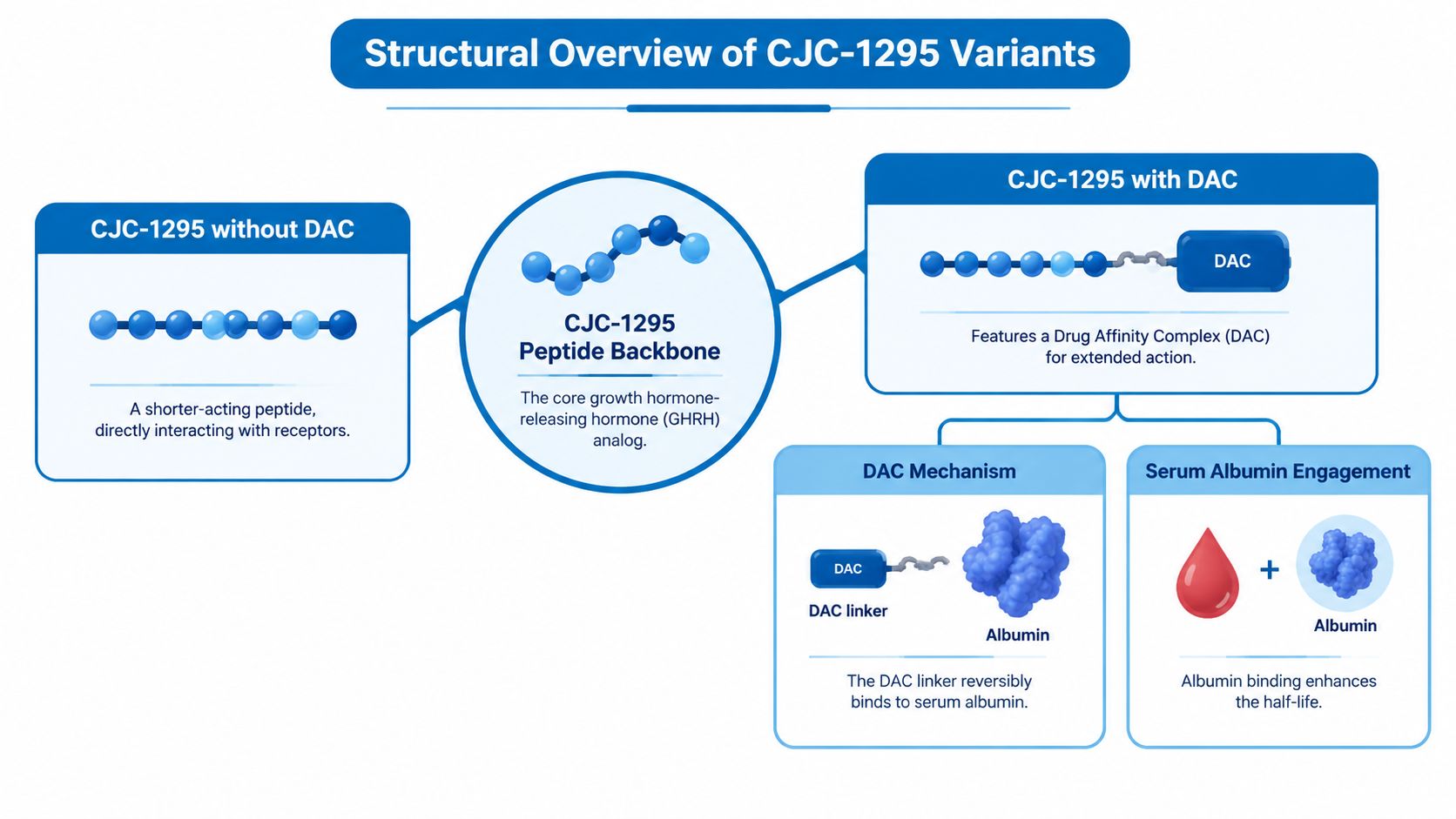
The shared GHRH analog backbone
The peptide backbone supplies the GHRH-like receptor interaction. That shared core is why the two variants are often discussed together, but shared receptor targeting doesn't make their experimental outputs interchangeable. The no-DAC form lacks the albumin-engaging modification, so its exposure depends primarily on the properties of the unmodified peptide and its clearance from the experimental system.
The DAC form adds a linker-based functionality that engages circulating serum albumin. Regulatory material describes CJC-1295 as a synthetic GHRH analog that binds endogenous albumin after injection, with an estimated half-life of about 8 days in that material and stimulation of GH and IGF-I secretion in animal species and normal human subjects, as detailed in the FDA docket document.
Albumin binding changes the exposure reservoir
Albumin binding is the defining mechanistic difference. Rather than behaving only as a freely circulating peptide, the DAC-associated form gains access to an albumin-linked reservoir that prolongs its effective presence. The structural and pharmacological overview of CJC-1295 identifies albumin binding as the key mechanism behind the prolonged pharmacokinetic profile, with DAC half-life estimates around 6 to 8 days rather than minutes for short-acting GHRH analogs.
This modification changes the relationship between receptor occupancy and clock time. A short-lived peptide can produce a concentrated exposure window that is easier to resolve in an acute assay. The albumin-bound form can maintain a lower, prolonged availability of peptide, which may be preferable for longitudinal endocrine observations but less suitable when the protocol depends on clean separation between stimulation and recovery.
For peptide stability assays, the distinction also affects the analytical target. The laboratory must establish whether it is measuring intact parent material, albumin-associated material, released peptide, or functional endocrine activity. A result that appears stable by one method might not represent the same biologically available fraction in another matrix.
Pharmacokinetics and Stability Comparisons
The useful distinction is not merely long acting versus short acting. Each profile creates a different experimental window, so the appropriate variant depends on whether the endpoint requires sustained downstream signaling, a defined stimulation period, or separation between exposure and recovery.
In the 2006 phase I/II human trial, the DAC form showed a reported half-life of approximately 5.8 to 8.1 days. GH remained at an increased level for 6 days or more, while IGF-1 stayed above baseline for 9 to 11 days after a single administration, according to the PubMed-indexed clinical report. The longer IGF-1 response matters when IGF-1, rather than the initial GH signal, is the primary endpoint.
Comparative pharmacokinetic summaries place the DAC form at roughly 12 to 16 times longer in effective half-life than the non-DAC form. They describe the no-DAC form as having a half-life of about 30 minutes, shifting the experiment toward transient exposure rather than sustained circulating availability, as described in CJC-1295 pharmacokinetic analysis.
Pharmacokinetic Comparison of CJC-1295 Variants
| Variant | Half-Life | Albumin Binding | Exposure Profile |
|---|---|---|---|
| CJC-1295 with DAC | About 5.8 to 8.1 days in humans | Present through the DAC modification | Sustained exposure, with GH effects lasting 6 days or more and IGF-1 elevations lasting 9 to 11 days |
| CJC-1295 without DAC | Approximately 30 minutes in comparative summaries | Absent | Short, transient exposure that better supports time-resolved stimulation studies |
The no-DAC estimate requires more caution than the DAC result because available summaries emphasize clearance rather than an equivalent body of controlled human endocrine data. The comparative no-DAC research summary describes the variant as lacking the albumin-binding modification and places its plasma half-life commonly around 20 to 30 minutes.
Stability is not the same as functional persistence
Chemical integrity does not establish that free peptide concentration, receptor presentation, or endocrine activity has remained constant. Albumin-associated DAC material may prolong functional exposure, while also making the measured fraction dependent on the assay matrix. A stability protocol should therefore specify whether it measures total peptide, free peptide, receptor activation, GH release, or IGF-1 generation.
Endpoint selection follows from that distinction. A sustained DAC profile may support longitudinal endocrine observations, but it can blur the boundary between the initiating stimulus and later feedback adaptation. Rapid clearance from the no-DAC form provides a narrower timing window for stimulation studies, although biological responses may persist after the peptide itself has declined.
Typical Specifications and Quality Criteria
Quality control begins before a peptide enters an assay. A laboratory comparing CJC-1295 variants should expect the supplier's documentation to identify the exact form, formulation state, analytical identity, purity result, and handling conditions. The DAC linker changes the molecular composition, so a generic label that says only “CJC-1295” doesn't provide enough information for variant-specific work.
The available research material describes approximate molecular masses of 3,647 daltons for the DAC form and 3,367 daltons for the no-DAC form in a comparative product-research table. Those values should be treated as identity checks tied to the stated material and confirmed against the batch documentation, rather than as universal substitutes for a lot-specific mass spectrum.
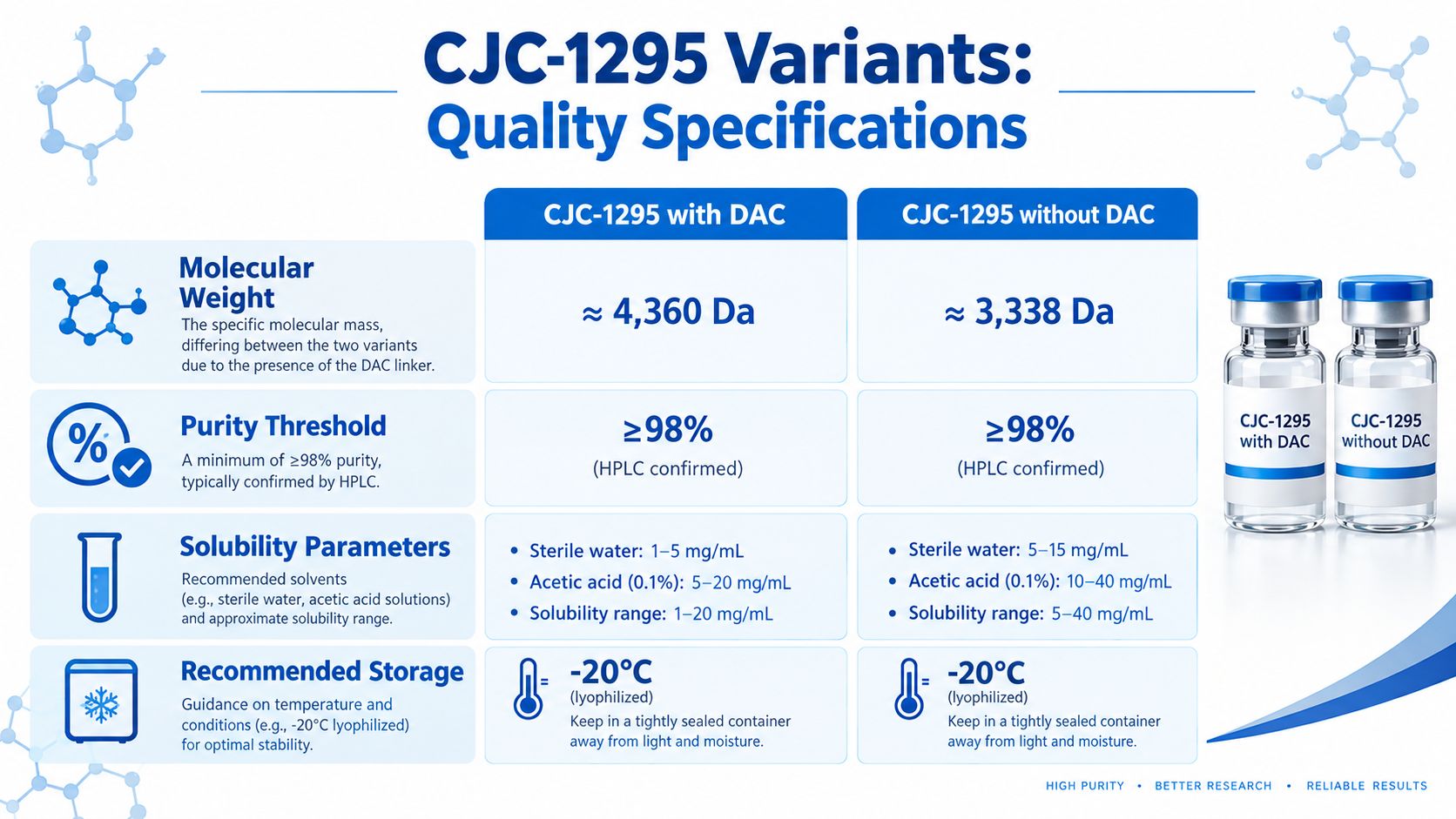
What a specification sheet should identify
A useful specification sheet separates identity from purity. HPLC can indicate the proportion of chromatographic material assigned to the principal peak, while mass spectrometry can help confirm whether the observed molecular mass matches the DAC or no-DAC form. Neither result, considered alone, answers every question about aggregation, degradation products, endotoxin, or biological activity.
Researchers should examine the following fields:
- Variant identity: The document should state whether the material is CJC-1295 with DAC or the non-DAC form, with nomenclature that doesn't leave the modification ambiguous.
- Molecular mass: The reported value should be consistent with the claimed structure and supported by mass spectrometry or another appropriate identity method.
- Purity method: A stated HPLC method is more informative than an unsupported purity label. A threshold of ≥98% may appear in research product specifications, but the lot-specific chromatogram and calculation remain important.
- Solubility guidance: The supplier should identify the tested or recommended laboratory solvent system rather than provide an unqualified claim that the material is soluble.
- Storage state: Lyophilized and prepared solutions should be documented separately, because formulation state changes the relevant stability question.
Handling affects interpretation
DAC chemistry deserves special attention during sample preparation. Buffers containing reactive thiols can interfere with maleimide-based albumin-binding chemistry, so the laboratory should review buffer composition before preparing experiments involving the DAC form. This is a chemical compatibility issue, not a matter of choosing one variant based on convenience.
A consistent workflow should also control preparation order, container type, temperature exposure, mixing conditions, and time between preparation and assay. If a laboratory changes the solvent or buffer between lots, the resulting signal may reflect formulation differences rather than biology. Quality criteria therefore extend beyond the headline purity value.
How to Interpret Certificates of Analysis
A Certificate of Analysis, or COA, is useful only when it identifies the exact material under review. A generic document that lacks a lot number, test date, analytical method, or connection to the purchased batch can't support strong conclusions about experimental suitability.
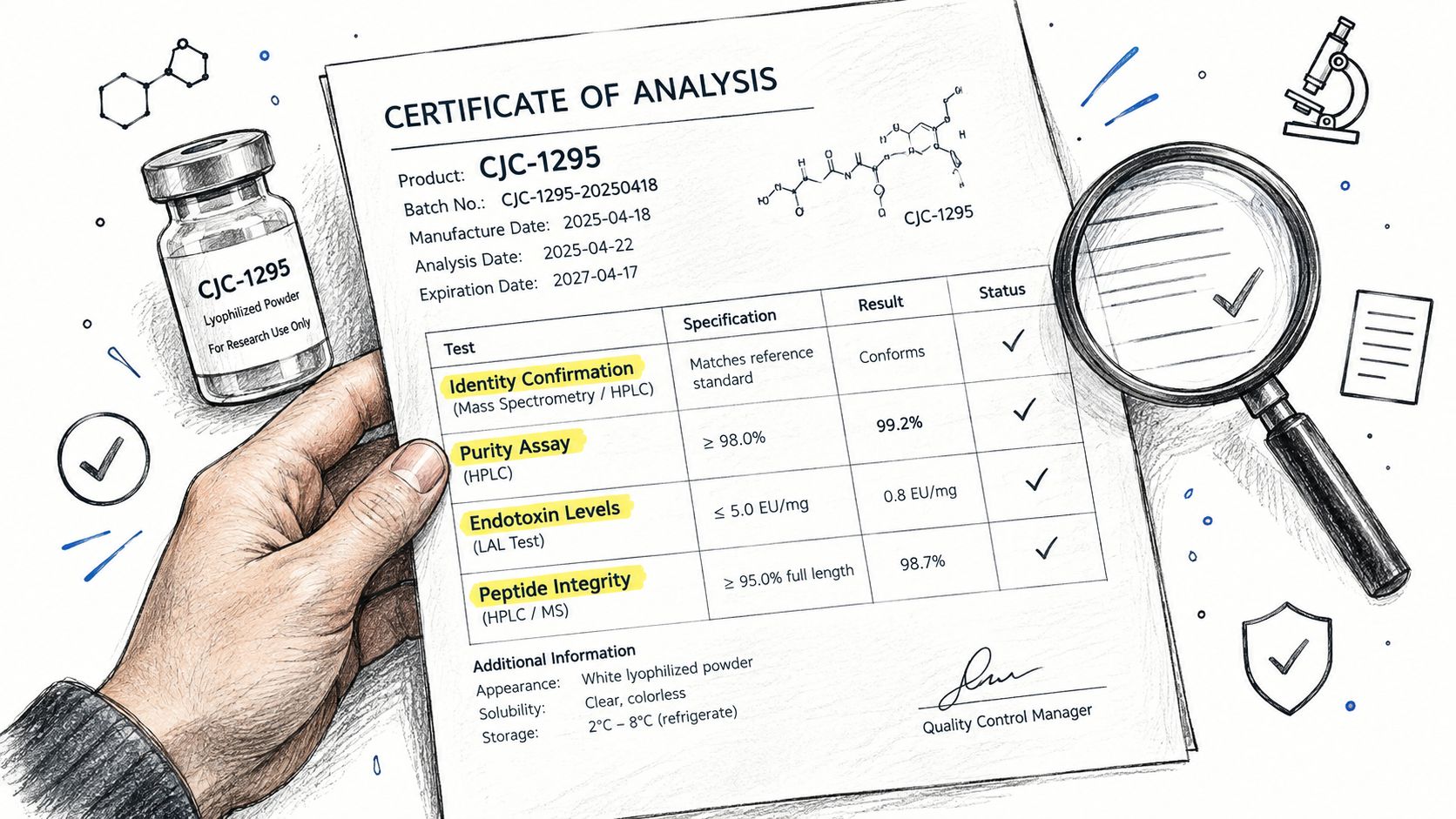
Start with identity, not purity
The first review should establish what the vial contains. For CJC-1295 with or without DAC, the COA should make the variant explicit, because the DAC modification changes both molecular mass and albumin-binding behavior. A mass spectrometry result that matches only the shared peptide backbone may not be sufficient to verify the modification.
The identity review should include:
- Lot linkage: The lot number on the COA should match the product container and purchasing record.
- Method description: Mass spectrometry should identify the observed molecular species, while HPLC should describe chromatographic purity.
- Variant designation: The document should distinguish DAC from no-DAC rather than grouping both under a broad product name.
- Appearance and formulation: The report should state whether the sample was tested as a lyophilized powder or another formulation state.
Read the chromatogram critically
A purity percentage without a chromatogram leaves important context missing. The principal peak may dominate the trace while smaller peaks indicate truncated sequences, oxidation, aggregation, or other related substances. Those impurities can matter more in a receptor assay than in a simple analytical screen because low-level variants may alter apparent potency or matrix behavior.
Endotoxin and sterility results also require separate interpretation. A peptide can meet a stated chemical purity threshold and still require additional evaluation for biological assay compatibility. Researchers should check whether the COA reports endotoxin testing, sterility testing, net content, and any relevant residual-solvent or heavy-metal information.
COA rule: A high purity number doesn't replace identity confirmation, lot traceability, or evidence that the material remained within specification during storage and transport.
Stability documentation should be read as a defined claim with conditions attached. The laboratory should record storage state, temperature, light exposure, preparation solvent, and elapsed time before the assay. If those conditions differ from the COA or supplier's stated framework, the laboratory should treat the result as a new stability question rather than assume equivalence.
Research Use Case Scenarios
The choice between variants becomes clearer when the endpoint is stated before the compound is selected. An acute receptor-stimulation assay may need a short, well-defined exposure window. A longitudinal endocrine model may instead require persistent signaling that doesn't depend on repeated handling events.
For studies focused on pulsatile GH release, the no-DAC form is generally the more defensible starting point because its rapid clearance supports transient stimulation and clearer separation between exposure and recovery. That doesn't prove that every no-DAC experiment reproduces endogenous physiology. It means the pharmacokinetic profile is better aligned with assays that need temporal resolution.
The DAC form fits a different question. Its albumin-associated persistence supports sustained GH-axis observations and extended IGF-1 tracking, but researchers must account for the possibility that continuous signaling changes feedback, receptor responsiveness, and the interpretation of later time points.
Matching the variant to the endpoint
| Experimental endpoint | More aligned profile | Main interpretive concern |
|---|---|---|
| Acute GHRH receptor response | No-DAC | Rapid clearance can make sampling windows critical |
| Pulse timing and recovery | No-DAC | The assay must resolve short-lived changes |
| Sustained GH-axis activity | DAC | Persistent exposure can alter feedback dynamics |
| Extended IGF-1 observation | DAC | IGF-1 may remain elevated after the initial GH response |
| Direct variant comparison | Both, in separate arms | Different exposure profiles prevent simple equivalence |
Independent commentary describes the DAC form as maintaining GH signaling for roughly 6 to 8 days, while no-DAC clearance is described as occurring over 30 minutes to 2 hours. The same analysis emphasizes that continuous DAC exposure may be less physiologic than pulse-mimicking no-DAC exposure because feedback suppression, somatostatin interaction, and receptor dynamics can influence downstream readouts, as discussed in this CJC-1295 pharmacology explainer.
A useful design separates pharmacokinetic effects from receptor biology. Parallel sampling of peptide exposure, GH, and IGF-1 can show whether a late signal reflects persistent compound availability, delayed downstream signaling, or endocrine adaptation. Without that separation, a laboratory may attribute a timing effect to receptor potency when exposure duration is the actual cause.
Choosing Between DAC and Non-DAC in Practice
A practical selection framework begins with five questions:
- What must the assay resolve? Choose the short-lived profile when pulse timing, acute receptor response, or recovery is central.
- Is sustained signaling part of the model? Choose the DAC profile only when multi-day exposure is an intentional experimental variable.
- Could receptor adaptation confound the endpoint? Treat prolonged exposure as a possible source of desensitization or feedback-related interpretation problems.
- Can the laboratory verify the variant? Require lot-specific identity, mass spectrometry, HPLC, and relevant contamination data.
- Can preparation conditions remain consistent? Control buffer composition, formulation state, storage, and assay timing across all experimental arms.
The key conclusion is contrarian but practical. DAC isn't a superior version of no-DAC, and no-DAC isn't merely a cheaper short-acting substitute. They answer different pharmacology questions. The research-focused comparison of DAC and no-DAC profiles likewise emphasizes that DAC extends action over days, while no-DAC preserves a more pulse-oriented exposure pattern that matters in assays sensitive to receptor feedback and timing.
For preclinical GH stimulation assays, the no-DAC form may provide cleaner temporal resolution. For sustained endocrine models, DAC may be more appropriate, provided feedback and exposure persistence are built into the design. For comparative pharmacology, both forms should be tested as distinct compounds with separate controls, not treated as interchangeable versions of one reagent.
Pro Tec Pep provides research-use-only CJC-1295 options, including DAC and no-DAC materials, with batch-linked documentation intended to support identity and quality review. Laboratories evaluating these variants can review the available specifications and Certificates of Analysis at Pro Tec Pep before selecting material for a defined assay.