CJC 1295 Ipamorelin Research Guide for Lab Studies
Learn how CJC 1295 ipamorelin is studied in lab research, key differences, stability notes and what documentation to verify before purchase.
A common mistake shapes most discussion around CJC-1295 and ipamorelin. The pair is often treated like one studied product, as if a single mechanism, a single kinetic profile, and a single evidence base already exist for the blend.
That shortcut creates avoidable confusion in laboratory work. A researcher reviewing a vial label, a sequence sheet, or a batch-specific certificate needs to separate compound identity, receptor pharmacology, and published human data before drawing any conclusion about the pair.
In practice, that means treating CJC-1295 and ipamorelin as two distinct research compounds that are often grouped together for convenience, not as one unified molecule. A useful starting point for related materials and compound references is a structured compound research library, but the core job still falls to the lab team: verify what the material is, what has been studied, and what remains untested.
Core principle: In a research setting, the phrase “CJC 1295 ipamorelin” is only a label of convenience until the two components are documented separately.
Introduction to CJC 1295 and Ipamorelin in Research Context
A typical lab confusion starts with a simple procurement question. Someone sees “CJC 1295 ipamorelin blend” on a supplier page and assumes the literature must describe that exact paired material in the same way it describes each individual peptide. That assumption usually doesn't hold.
CJC-1295 and ipamorelin sit on the same broad endocrine axis, but they enter that system through different receptors and with different timing profiles. One is commonly framed in the literature as a long-acting growth hormone-releasing hormone analog, while the other is described as a selective ghrelin or GHSR-1a receptor agonist. Those are related ideas, not identical ones.
What a research audience should keep separate
Three questions help prevent category errors:
- Identity question: What exactly is in the vial or blend, by sequence, mass, and formal name?
- Mechanism question: Which receptor does each compound interact with in the literature?
- Evidence question: Has the pair itself been tested in the same rigorous way as the components alone?
Those questions sound basic, but they stop a surprising amount of bad documentation. A lab notebook entry that says “studied CJC 1295 ipamorelin mechanism” is too vague. A stronger entry separates CJC-1295 from ipamorelin and records each one's characterized properties before discussing any combined experimental rationale.
What this topic usually gets wrong
The most repeated error is to talk about the blend as if one paper established all major claims for the pair. The available literature doesn't support that shortcut. Some claims belong to CJC-1295 alone. Others belong to ipamorelin alone. The blend should be described as a two-component research format unless a specific publication tested the combination itself.
That distinction matters for assay planning, interpretation, and supplier review. It also keeps research language clinical rather than consumer-facing. The relevant frame isn't personal outcome language. It's whether the compounds have been studied for their effect on GH-axis signaling, IGF-1 response, and receptor selectivity in clearly defined models.
How Each Compound Is Studied at the Receptor Level
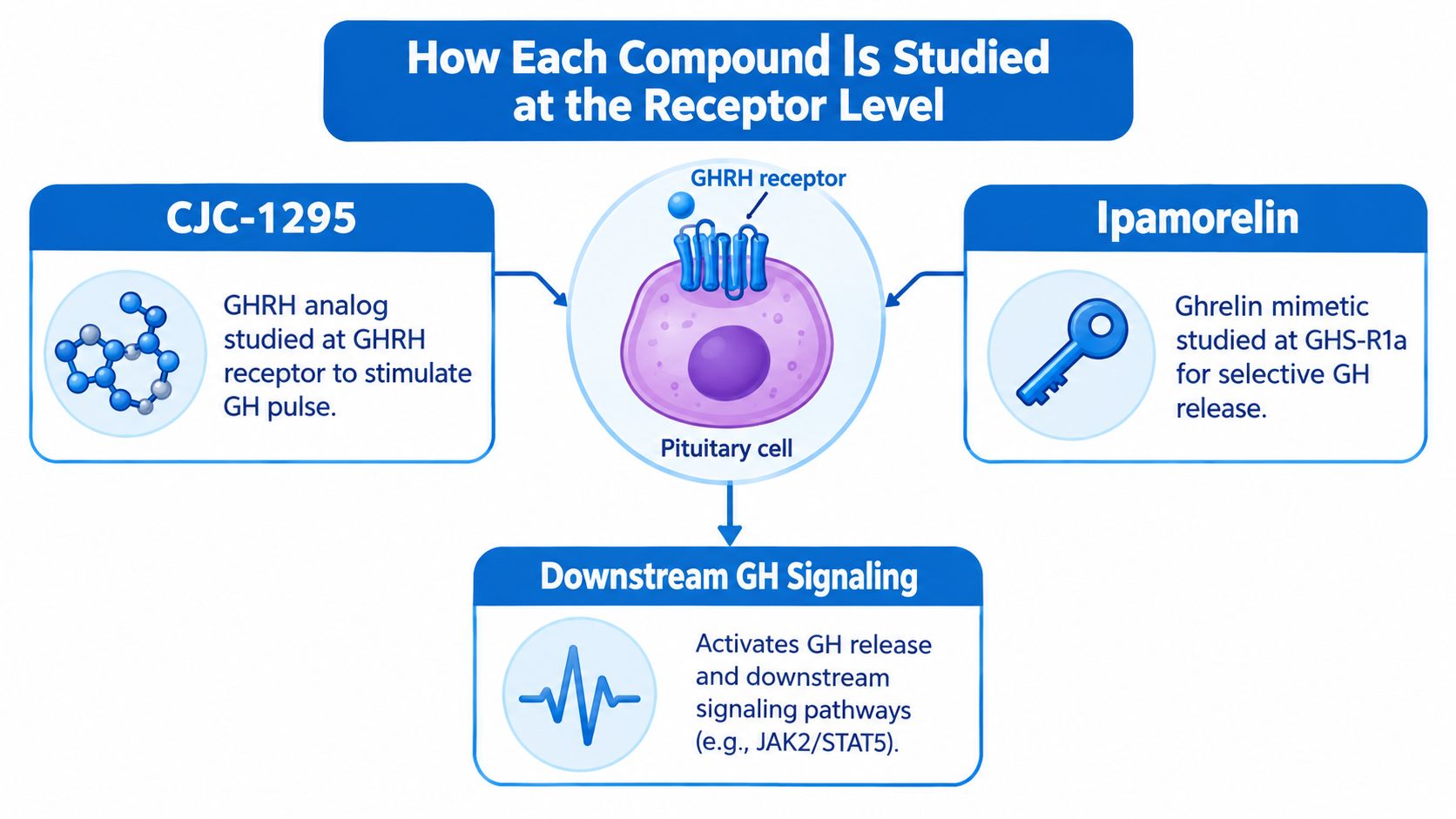
The cleanest way to understand CJC 1295 ipamorelin is to stop thinking in terms of “stack” first and think in terms of receptor entry points.
One useful analogy is a building with two different doors leading into the same control room. The control room is the growth hormone axis. CJC-1295 has been studied as one door. Ipamorelin has been studied as another.
CJC-1295 and the GHRH receptor
CJC-1295 has been described in the literature as a synthetic growth hormone-releasing hormone analog acting at the GHRH receptor on pituitary somatotroph cells, and a randomized, placebo-controlled human study reported that single doses of 30 to 60 mcg/kg produced sustained growth hormone and IGF-1 elevation for 6 to 14 days (clinical summary with study details).
That description matters because it is more precise than broad claims about “growth support.” In research language, the compound has been studied for receptor-mediated amplification of endogenous GH signaling. That helps a lab team phrase its objective correctly. The target isn't a vague wellness endpoint. It is a specific endocrine signaling pathway.
A supplier page such as CJC-1295 DAC can help a team confirm naming and format, but receptor-level interpretation still needs to stay tied to the literature rather than product shorthand.
Ipamorelin and the GHSR-1a receptor
Ipamorelin is described in research summaries as a selective agonist at the ghrelin or GHSR-1a receptor, with reported GH release while not significantly affecting cortisol, prolactin, or ACTH (research summary on receptor selectivity).
That selectivity is one reason ipamorelin is often singled out in assay discussions. A researcher studying endocrine discrimination doesn't just ask whether a peptide triggers GH-related output. The sharper question is whether it appears to do so without broad activation across other endocrine markers that can complicate interpretation.
A short visual explainer can help anchor that distinction before moving into lab notes and specifications.
Why the pair should not be given one unified mechanism
Researchers often speak casually and say that the blend “works on GH release.” That phrase is too compressed to be useful in formal documentation.
A better way to write it is:
- CJC-1295 has been studied at the GHRH receptor
- Ipamorelin has been studied at the GHSR-1a receptor
- The blend is a combined presentation of two separately characterized compounds
A blend name is not a mechanism. Mechanism belongs to the individual compounds unless a specific combination study demonstrates otherwise.
That wording keeps the science straight and prevents a common reporting error. The pair may be discussed together, but the literature-based mechanisms belong to each peptide individually.
Key Differences Between CJC 1295 and Ipamorelin
How should a lab distinguish two peptides that are often bundled under one shorthand name? Start with the features that remain stable across catalogs, assay notes, and batch records: molecular identity, receptor class, and kinetic profile.
Those three categories reduce a common documentation problem. A combined label can make two separate research compounds look like one unified agent, even though they differ in size, structure, and how they are described in pharmacology literature.
CJC-1295 vs ipamorelin laboratory profile comparison
| Attribute | CJC-1295 | Ipamorelin |
|---|---|---|
| Compound type | Synthetic GHRH analog | Selective ghrelin or GHSR-1a agonist |
| Primary receptor described in literature | GHRH receptor on pituitary somatotroph cells | Ghrelin or GHSR-1a receptor |
| Peptide length | 29 amino acids in noDAC CJC-1295 (identity guide) | Pentapeptide with sequence Aib-His-D-2-Nal-D-Phe-Lys-NH2 |
| Molecular weight | About 3367.9 g/mol for noDAC CJC-1295 | 711.86 g/mol |
| Kinetic impression in literature | Long-acting profile is central to DAC-containing CJC-1295 | Often described in summaries as a shorter-acting secretagogue profile |
| Common documentation issue | Confusion between DAC and noDAC formats | Confusion between compact structure and broad endocrine claims |
Identity differences affect record quality
Structure is not a minor specification. It is the first checkpoint that tells a researcher whether the vial label, certificate, and study notes are describing one material correctly.
Ipamorelin is a five-residue peptide with a much smaller molecular mass than noDAC CJC-1295, which is commonly listed as a 29-amino-acid peptide. In practical terms, that difference is like comparing a short lab code to a full protocol title. Both are legible, but they should never be treated as interchangeable identifiers.
This matters most in blend documentation. If a record lists one sequence, one formula, or one molecular weight for the pair, the entry is incomplete.
Kinetic differences affect interpretation
The second major distinction is temporal. CJC-1295 is discussed in the literature with a longer-acting profile, especially in DAC-containing form, while ipamorelin is usually described as shorter acting in research summaries.
That difference shapes experimental planning. Sampling windows, endpoint timing, and washout assumptions can become misleading if the blend is treated as though both components share one exposure pattern. A mixed preparation may be convenient for storage or procurement, but convenience does not create a single kinetic identity.
For procurement review, a standalone ipamorelin product listing with formal identifier details can help teams cross-check names, specifications, and internal inventory records against blend paperwork.
Documentation habit: Record CJC-1295 and ipamorelin as separate entries first, then note the shared blend name used for the experiment.
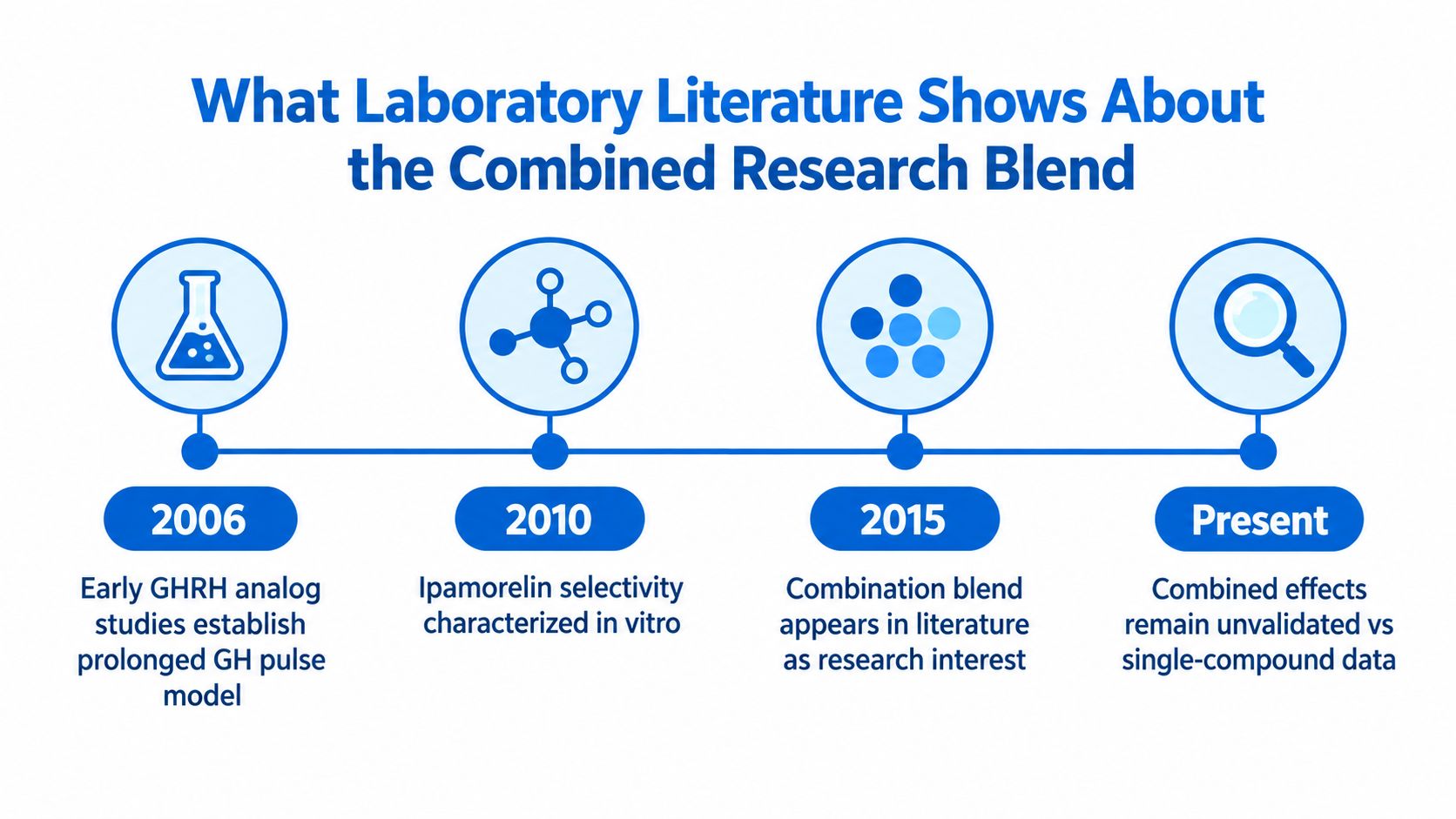
What Laboratory Literature Shows About the Combined Research Blend
What should a researcher conclude when two peptides are sold under one blend name, but the published literature mostly describes them separately?
The clearest reading of the record starts with a simple distinction. There is literature on CJC-1295 as its own research compound. There is literature on ipamorelin as its own research compound. The evidence for the premixed pair is much thinner, so the blend should be evaluated as a combined laboratory presentation rather than as a single, fully characterized intervention.
CJC-1295 has a clearer published pharmacology trail
A useful anchor in the literature is the early human work on CJC-1295. A commonly cited milestone is the published Phase I/II study in healthy adults, summarized here with its identifier details: 2006 milestone summary with PMID 16352683.
Why does that matter for interpreting a blend? Because it gives CJC-1295 an independent pharmacology record. Researchers are not starting from a blank page when they see that name on a label. They can trace a defined line of inquiry around growth hormone axis effects and duration of action, particularly in discussions of DAC-containing material.
Ipamorelin enters the literature through a different channel
Ipamorelin is also documented, but its research history is not parallel in depth or format. The compound is usually discussed through receptor-level selectivity, early pharmacology, and narrower clinical development rather than through a mature body of published combination studies with CJC-1295.
That difference matters for interpretation. If one component has a better mapped clinical pharmacology trail and the other is better known through selective secretagogue research, a blended vial does not erase that asymmetry. It combines two evidence histories. It does not merge them into one.
The combination literature leaves a real gap
As noted earlier, published summaries have pointed out the absence of a randomized controlled trial directly testing the specific CJC-1295 plus ipamorelin pair.
For laboratory readers, that gap has practical consequences. It limits what can be said about the pair as a defined research system, especially if the question involves interaction rather than simple co-presence. A mixed sample may suggest complementarity at the receptor or signaling level, but suggestion is not the same as direct combination evidence.
Three questions usually remain open in the published record:
- How the pair was selected as a fixed blend, if no controlled trial established a preferred relationship between the two compounds
- Whether observed effects in a mixed preparation should be attributed to additive timing, receptor complementarity, or the behavior of one dominant component
- How safety interpretation should be handled for the pair itself rather than inferred from each peptide separately
A useful analogy is a two-reagent assay kit assembled from well-known ingredients. If each reagent has its own specification sheet, that helps. It still does not replace validation data for the finished kit.
The most accurate description is a research blend made from two separately characterized peptides with different receptors and kinetic profiles.
That is why documentation matters so much in this section of the literature review. If a supplier presents the blend as one unified mechanism, one evidence base, or one established trial-backed protocol, the wording is overstating what the published record supports. The cleaner approach is to cite CJC-1295 and ipamorelin separately unless a study directly tested the exact pair.
Common Laboratory Applications and Study Models
What does a lab study when a vial contains CJC-1295 and ipamorelin together?
A clear answer starts by separating the compounds before combining the question. CJC-1295 is usually examined in models centered on GHRH-pathway stimulation and longer endocrine persistence. Ipamorelin is usually examined in models centered on GHSR-1a activity and a more selective secretagogue profile. When both appear in one research plan, the strongest study design asks what each peptide contributes, then asks whether the mixed preparation changes timing, amplitude, or interpretation.
In vitro and receptor-focused work
Cell-based work often begins with mechanism. The point is not to confirm that both compounds relate to growth hormone signaling. The point is to identify which receptor system is being engaged, how the signal is initiated, and which downstream markers are worth following beyond the first readout.

Useful assay setups include:
- Receptor-specific comparison. Test whether observed signaling fits better with a GHRH receptor model, a GHSR-1a model, or a sequence in which both pathways are active within the same experiment.
- Selectivity panels. Record GH-related responses while also checking markers such as prolactin, cortisol, or ACTH, so the readout is not reduced to a single headline signal.
- Time-course sampling. Separate early receptor activity from later endocrine follow-through, especially where one compound may act as a short trigger and the other may support a longer signal window.
- Blend-versus-component controls. Run the mixed preparation alongside each peptide alone. That simple control helps prevent a common error. Attributing every observed effect to the combination when one component may account for most of the result.
A practical analogy helps here. Testing the blend without single-compound controls is like evaluating a two-reagent assay after mixing both bottles first. You can observe the output, but you lose resolution about which reagent drove it.
Animal models and translational study logic
In vivo models usually ask a timing question as much as a pharmacology question. Researchers may examine pulse behavior, persistence of endocrine effects, or whether sequential pathway engagement produces a pattern different from either compound studied alone.
That framing is more precise than broad statements about "synergy." In laboratory writing, synergy is not a label to assume. It is a relationship to test. For this pair, that means defining sampling windows carefully, documenting the model used, and separating immediate secretagogue activity from later downstream markers such as IGF-1-related changes.
Study descriptions also need disciplined wording. Appropriate notebook language names the model and the measured variable, such as GH-axis output in an animal study or receptor-linked signaling in a cell assay. It should not drift into lifestyle, performance, or recovery claims.
Human research questions and documentation-based evaluation
Published human data can inform how a lab frames questions, but it does not convert the blend into a single validated entity. A better method is to assign each peptide its own documentation trail, then evaluate the mixed sample as a handling and study object built from two known components.
That approach usually separates questions into three lanes:
CJC-1295 Is the protocol examining prolonged endocrine exposure, extended activity, or later downstream markers?
Ipamorelin Is the protocol examining selective ghrelin-receptor agonism and a narrower off-target endocrine profile?
Combined sample Is the research team studying co-administration behavior in a model system, or procuring a convenience blend that still needs component-level interpretation?
Practical wording: A mixed sample can be evaluated for combined signaling behavior in a laboratory model, but claims about the pair should be tied to direct blend data where available and to component-specific literature where blend data are absent.
For that reason, common laboratory application is not just about the assay type. It is also about record quality. Sample identity, lot-linked documentation, formulation details, and model-specific controls determine whether a study of CJC-1295 and ipamorelin produces interpretable results or only a blended signal with unclear attribution.
Stability Reconstitution and Handling Notes for Laboratory Samples
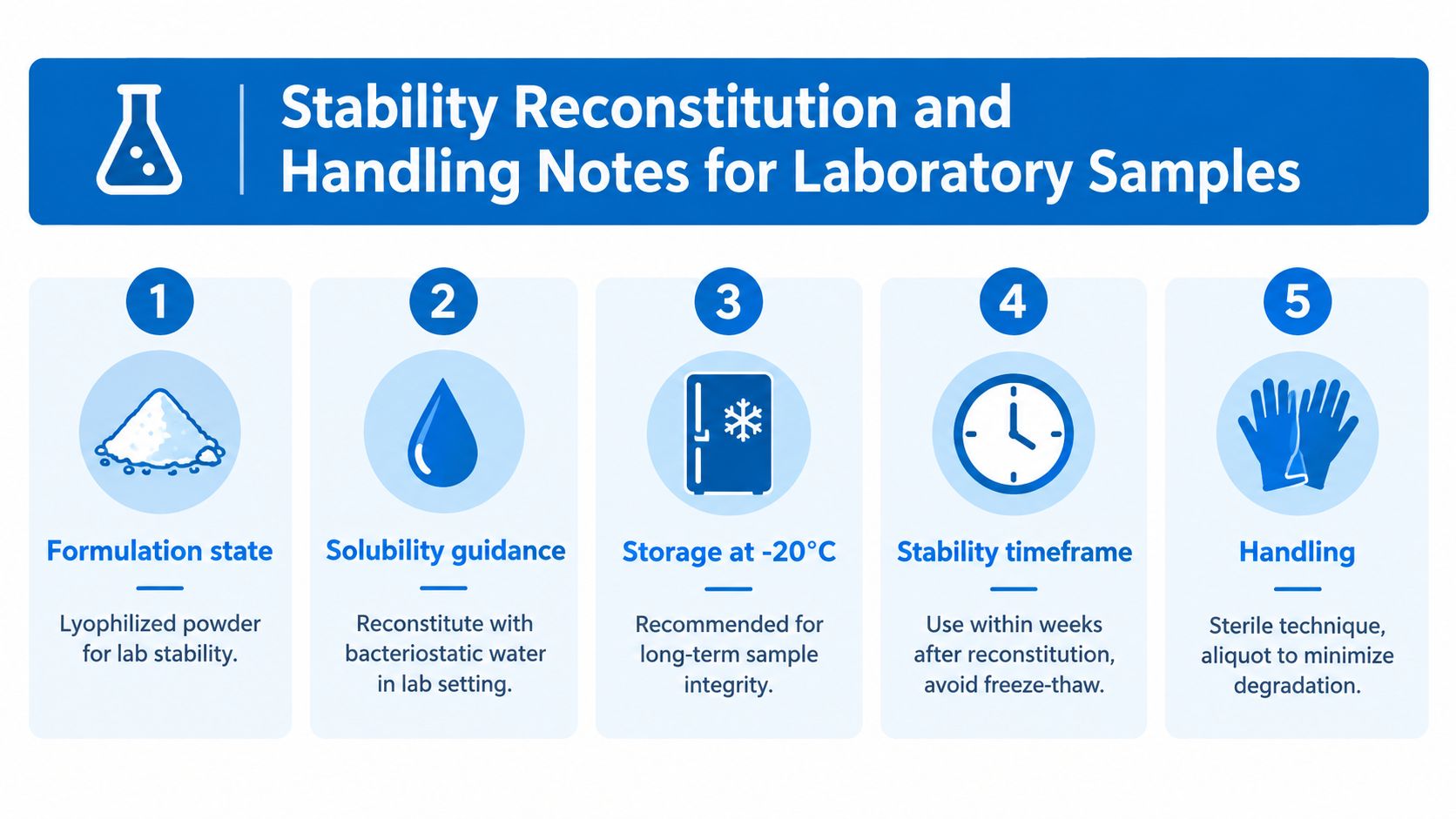
For laboratory teams, reconstitution and storage are documentation tasks before they are workflow tasks. Poor handling doesn't just reduce material quality. It weakens reproducibility.
What to record before sample preparation
Product pages for research materials often include the practical fields a lab needs: formulation state, solubility guidance, recommended storage such as -20°C, and stability timeframes. Those details matter because they define how a sample should be logged, prepared, and staged for an experiment.
Before any preparation step, a lab record should capture:
- Formal compound name
- Lot or batch reference
- Formulation state, such as lyophilized powder
- Storage recommendation, including long-term frozen storage where specified
- Supplier documentation availability, especially batch-linked COAs
Why cold handling matters
Peptide materials can be sensitive to time and temperature. That's why research procurement often emphasizes rapid processing and, where relevant, cold-chain support. The issue isn't convenience. The issue is preserving sample integrity between fulfillment, receiving, and assay use.
A lab that receives a peptide without documenting transit condition, intake date, and immediate storage placement loses part of its audit trail. That becomes a problem when an experiment later shows drift and the team needs to trace whether the cause was biological variability or handling variability.
Reading specifications the right way
Handling notes should never be read as personal-use directions. In a research setting, they are sample integrity instructions.
The most useful interpretation framework is simple:
- Solubility guidance tells the lab how the sample may be prepared for in vitro use
- Storage guidance tells the lab how to protect material quality over time
- Stability timeframe helps schedule assays to avoid unnecessary degradation risk
- Aliquot planning helps reduce repeated freeze-thaw exposure when the workflow allows it
Sample prep notes belong in the assay record. They aren't background details. They are part of the experiment.
When a supplier provides these fields clearly, the lab can align procurement, receipt, storage, and bench work under the same documentation standard.
Documentation to Check Before Purchase and Final Research Checklist
Most errors around CJC 1295 ipamorelin happen before the package arrives. They start with weak verification.
A lab that buys on shorthand product names alone may miss critical distinctions between DAC-containing CJC-1295, noDAC CJC-1295, and a CJC-1295 plus ipamorelin blend. The fix is a pre-purchase review process built around identity and batch documentation.
The minimum document set
Before procurement, a research team should confirm:
Formal names and synonyms
“CJC-1295” is not enough on its own if the DAC status isn't explicit.Peptide sequence where applicable
This is especially useful for ipamorelin because the published sequence identifies the compound directly.Molecular weight and formula fields
These help catch labeling mismatches between blend pages and single-compound pages.Batch-specific Certificate of Analysis
Generic certificates don't answer lot-level questions.Purity specification and testing scope
A transparent supplier should state what was checked for the exact batch.
What a strong supplier record looks like
For procurement review, some teams use suppliers that publish batch-linked COAs, compound specifications, and handling notes at the product level. Pro Tec Pep is one example of a research-use-only supplier that states batch-specific COAs, seven-category third-party testing, and logistics built around rapid processing and optional cold-chain handling, which are the kinds of details a lab can use in its verification file.
That doesn't remove the need for internal review. It gives the lab more to verify.
Final checklist for a CJC-1295 and ipamorelin research file
A concise audit-ready checklist can look like this:
- Confirm whether the material is CJC-1295 DAC, noDAC CJC-1295, ipamorelin, or a blend.
- Match the product page identity fields to the COA for the exact batch.
- Record sequence, molecular weight, and formulation state where listed.
- Save storage and stability guidance in the same file as the assay plan.
- Cite literature for each component separately unless a direct combination paper supports the exact pair.
- Keep all records under a research-use-only framework.
A team that follows those steps will usually avoid the biggest mistake in this category, which is confusing a popular pairing with a fully validated single research entity.
Pro Tec Pep supplies research-use-only compounds relevant to this topic, including individual CJC-1295 and ipamorelin formats as well as broader documentation support such as batch-linked COAs, storage notes, and fulfillment options for temperature-sensitive materials. For laboratories building a cleaner verification workflow around peptide identity and handling, the most practical next step is to review the available specifications directly at Pro Tec Pep.
"For laboratory research use only. Not for human or veterinary use. Not a drug, food, or cosmetic. Not evaluated by the FDA. Not intended to diagnose, treat, cure, or prevent any disease. By purchasing, you certify you are a qualified researcher and agree to use this product solely for in-vitro laboratory research."