Buy Tirzepatide Peptide Online for Lab Research
Learn how to buy tirzepatide peptide online for laboratory research. Verify COAs, ensure RUO compliance, and manage cold-chain shipping for your assays.
A laboratory manager searching for buy tirzepatide peptide online may find a product page in minutes, but a defensible procurement decision takes more work. The key questions aren't price or availability alone. They concern molecular identity, lot traceability, analytical methods, transport conditions, and whether the seller clearly separates research-use-only material from products positioned for human administration.
Tirzepatide entered the U.S. market as Mounjaro on May 13, 2022, after FDA approval for adults with type 2 diabetes alongside diet and exercise. It later received approval as Zepbound on November 8, 2023, for chronic weight management in adults with obesity or overweight plus at least one weight-related condition, with the obesity label defining eligibility through BMI thresholds and a weight-related comorbidity framework. The regulatory sequence explains why demand expanded rapidly across pharmaceutical and online markets, but it doesn't make every online listing suitable for laboratory work. (Lilly's FDA approval announcement)
Navigating the Post-Shortage Research Landscape
A procurement manager reviewing tirzepatide after the major supply disruption faces a different market from the one that existed when demand first surged. The FDA documented a tirzepatide injection shortage, then reported that the shortage was resolved on October 2, 2024, with further clarification on December 19, 2024 that the shortage remained resolved. (FDA supply and compounding clarification)
That history matters even when the laboratory isn't purchasing an approved medicine. Shortage conditions can push buyers toward informal marketplaces, while later resolution can shift demand toward research suppliers, compounding channels, and sellers that use pharmaceutical language without offering pharmaceutical accountability. A lab manager may therefore see three superficially similar listings: an approved medicine, a compounded preparation, and a synthetic research material. They belong to different procurement categories and require different documentation.
The procurement decision starts with intended use
A compliant laboratory purchase should begin with the study plan, not the vendor's claims. The purchasing record should identify the compound as a research material, state whether the work is in vitro or involves an approved animal model, and define the documentation required before receiving the vial. Human-use language, administration guidance, or treatment positioning should stop the review.
The product page should state the compound name, formulation state, quantity, storage requirements, and research-only status. It should also provide a route to batch-specific documentation before payment. A generic statement that a product is “tested” doesn't establish what was tested, which lot was examined, or whether the document belongs to the material being offered.
Practical rule: If a supplier makes the laboratory prove its identity and intended use, that can be a positive compliance signal. If the supplier avoids asking about intended use while discussing clinical outcomes, it deserves deeper scrutiny.
Availability isn't the same as suitability
The shortage timeline explains why researchers may still encounter aggressive online marketing around tirzepatide, but it doesn't validate those channels. The strongest purchasing position is to reject undocumented availability rather than compensate for it with a lower price or faster dispatch.
A useful shortlist records the supplier's legal identity, product identifier, lot availability, analytical methods, storage instructions, shipping terms, and research-use policy. That record gives purchasing teams something concrete to defend during an internal review. It also prevents a rushed order from becoming an undocumented reagent in an otherwise controlled experiment.
Molecular Characteristics and Assay Sensitivity
Tirzepatide is a synthetic 39-amino-acid peptide with a C20 fatty diacid modification that increases albumin binding. The structural modification contributes to an elimination half-life of about 5 days, maximum plasma concentrations within 8–72 hours after subcutaneous dosing, and approximately 80% absolute bioavailability, according to a peer-reviewed review of its pharmacology. (Pharmacology review in PMC)
Those values are not a handling protocol for laboratory personnel. They show why a procurement team must treat molecular identity and structural integrity as experimental variables. A sequence error, incomplete modification, oxidation event, aggregation, or contaminant can alter receptor binding, matrix behavior, and assay readouts even when a supplier advertises a high headline purity.
Receptor activity requires intact material
The compound is a dual agonist of the GLP-1 and GIP receptors. Literature describes selective binding and activation at both receptors, while preclinical and clinical evidence has studied appetite regulation, food intake, and lipid metabolism. For a laboratory audience, the relevant question is how the material behaves in the selected system, whether that system is an in-vitro receptor assay, a cell-based experiment, or an in-vivo animal model. (Research overview and peptide documentation)
A purity result alone can't answer that question. RP-HPLC can help quantify chromatographic purity, while mass spectrometry can support identity confirmation. Neither method, considered in isolation, proves that the vial has preserved every property required by a particular assay. Researchers should connect the certificate to the exact lot and then define acceptance criteria appropriate to the experiment.
Procurement questions should reflect assay risk
A thorough technical review asks:
- What is the stated sequence and modification? The listing should identify tirzepatide precisely rather than rely on a marketing nickname.
- Which identity method was used? Mass spectrometry should appear as a named method with a result, not merely as a badge.
- Which purity method was used? RP-HPLC should be accompanied by a lot-specific result and, where available, chromatographic evidence.
- Which contaminants were assessed? Endotoxin, heavy metals, sterility, and net content may matter differently depending on the assay.
- How was the material stored? The documentation should state storage conditions and formulation state.
A research team can use the compound research library as one reference point when assembling compound records, but the supplier's current lot documentation still controls the receiving decision.
The following video provides additional background for teams reviewing peptide research workflows.
Evaluating Batch-Specific Certificates of Analysis
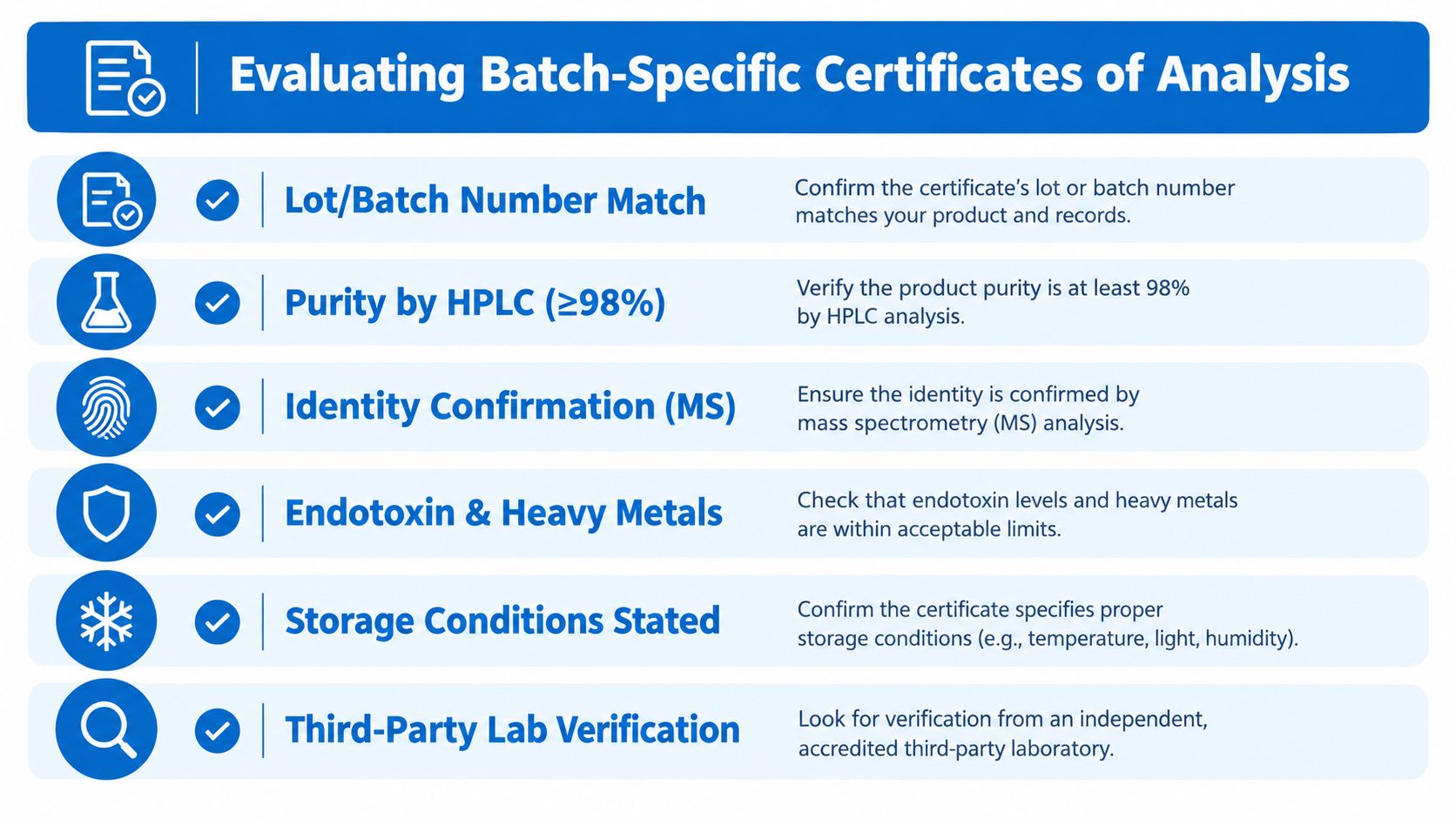
A certificate of analysis is useful only when it describes the material being received. Independent standards documents describe a COA as a laboratory record that can include a batch identifier, purity analysis, and analytical methodology such as HPLC. That traceability separates a controlled reagent record from a generic product claim. (Independent COA standards guidance)
Read the document in a fixed order
First, match the lot. The batch or lot number on the COA should match the identifier on the vial and the order record. A certificate for another lot may demonstrate that a supplier tested something at some point, but it doesn't establish the identity or purity of the material in the current shipment.
Next, confirm the compound description. The document should name tirzepatide clearly and identify the relevant formulation state. Generic labels such as “GLP-1 peptide” aren't sufficient for a study that requires a defined GLP-1/GIP dual agonist.
Then examine the methods. Look for RP-HPLC or HPLC purity testing, mass spectrometry for identity, and a stated testing laboratory. A result without a method is difficult to interpret, while a method without a lot-specific result is equally weak.
Separate purity from identity
A certificate may report a purity value while providing limited identity evidence. Those are different questions. HPLC can show the proportion of chromatographic material associated with the target peak, but mass spectrometry helps assess whether the detected material corresponds to the expected molecular identity.
One independent tirzepatide COA example reports at least 99.0% purity by RP-HPLC and includes mass spectrometry and LAL endotoxin screening. It illustrates the level of specificity researchers should expect from lot-level documentation, not a universal acceptance threshold for every assay. (Example tirzepatide COA)
A downloadable PDF isn't automatically reliable. The document must connect the vial, batch, method, laboratory, and result in one traceable record.
Look for evidence beyond the headline result
The receiving file should preserve the COA, order confirmation, product description, lot identifier, storage instructions, and any supplementary test reports. If the supplier provides only a generic purity statement, the laboratory should record the gap and decide whether its quality system permits purchase.
A review can use the following matrix:
| COA element | What it establishes |
|---|---|
| Batch or lot number | Links the report to a defined production group |
| Compound name | Identifies the material under review |
| RP-HPLC result | Reports chromatographic purity |
| Mass spectrometry result | Supports molecular identity |
| Testing date | Places the result in a defined time frame |
| Laboratory identity | Creates a path for independent verification |
| Endotoxin or contaminant testing | Addresses risks beyond target-compound purity |
| Storage statement | Connects documentation to stability control |
The testing and verification information can help a procurement team compare the kinds of documentation a supplier makes available. It shouldn't replace the review of the exact COA attached to the lot being purchased.
Identifying Red Flags in Unverified Supply Channels
The most dangerous procurement assumption is that a high purity number proves the entire transaction is legitimate. It doesn't. Purity addresses one analytical question, while lawful positioning, chain of custody, contamination control, labeling, and route claims create separate risk categories.
Manufacturers and regulators have warned that thousands of websites promote illegal GLP-1 sales and counterfeit or unapproved tirzepatide formats. Lilly specifically warns about counterfeit products and online sellers that present unapproved materials as legitimate medicines. (Lilly counterfeit medicine guidance)
Route-of-administration claims deserve immediate attention
There is no FDA-approved oral tirzepatide tablet. Oral, sublingual, and nasal tirzepatide claims should therefore be treated as red flags during research procurement, especially when the listing uses those formats to imply convenience or human suitability. Such products may be unapproved, counterfeit, or compounded materials that haven't received review for safety, quality, or efficacy.
A laboratory shouldn't infer legitimacy from packaging, a familiar brand reference, or a claimed analytical result. The question is whether the seller can document what the material is, how it entered the supply chain, and why it is being sold as research material rather than an unapproved human product.
Purity doesn't repair provenance
Reuters reported analytical testing of online samples with purity values between 99.78% and 99.85%, but those findings don't resolve chain-of-custody, contamination, labeling, or legal-status questions. (Medscape report on counterfeit GLP-1 enforcement)
That distinction is central to risk triage. A material can contain analytically confirmed tirzepatide and still be unsuitable for an institution because the seller cannot establish provenance or intended-use controls. Conversely, a transparent research supplier should make it possible to evaluate identity, batch records, handling, and compliance before the order moves forward.
A procurement manager should remove a seller from consideration when the page:
- Promotes human outcomes: Weight management, glucose control, treatment language, and before-and-after content signal a human-use market.
- Offers unapproved formats: Oral, nasal, or sublingual claims require a documented scientific and regulatory explanation, not a convenience claim.
- Hides the legal entity: An untraceable operator leaves the laboratory without a meaningful quality or returns contact.
- Uses generic documentation: A certificate without a lot number doesn't establish what the vial contains.
- Pairs the product with administration supplies: Bundled syringes, diluents, or human-oriented calculators undermine research-only positioning.
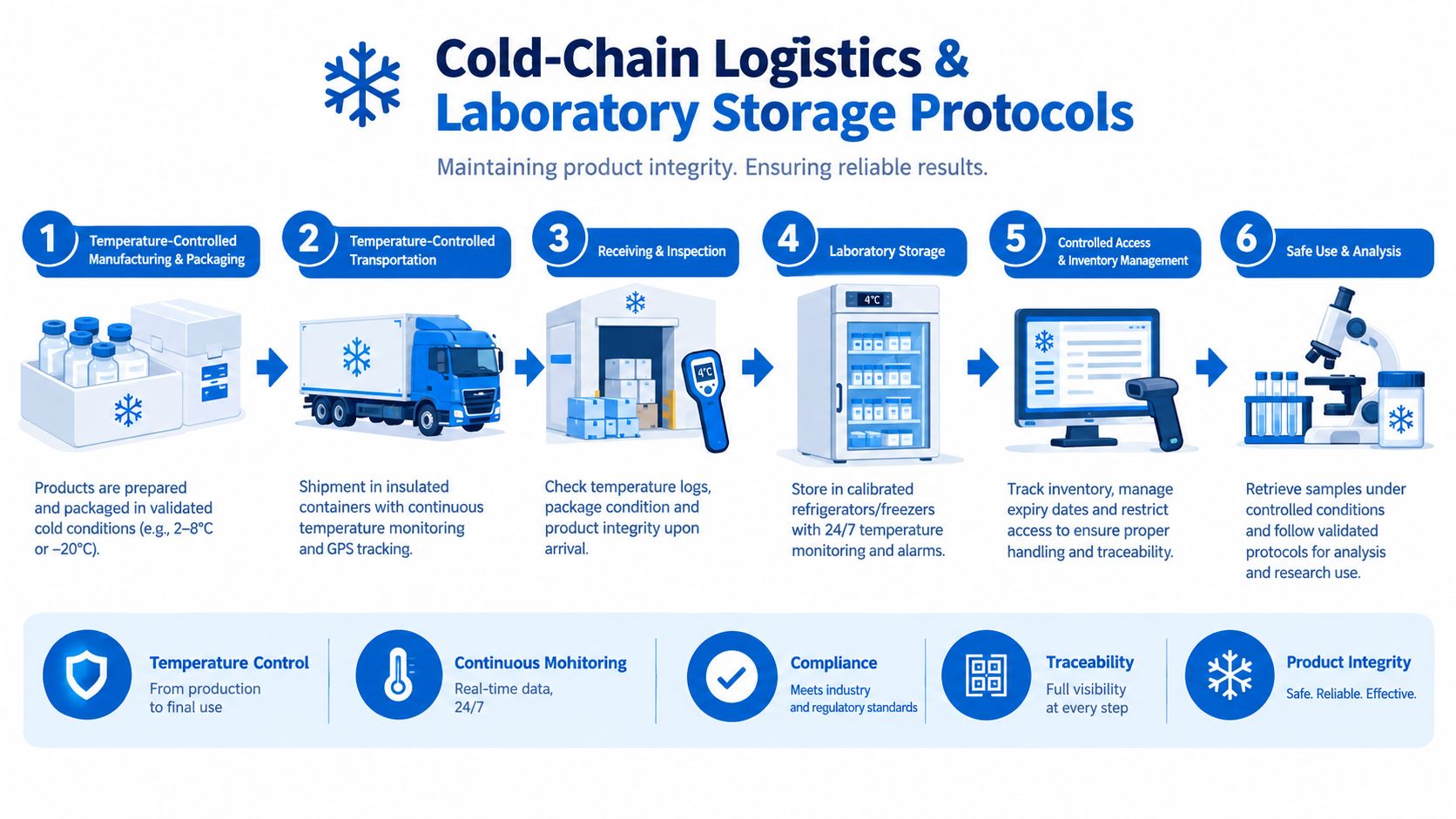
Cold-Chain Logistics and Laboratory Storage Protocols
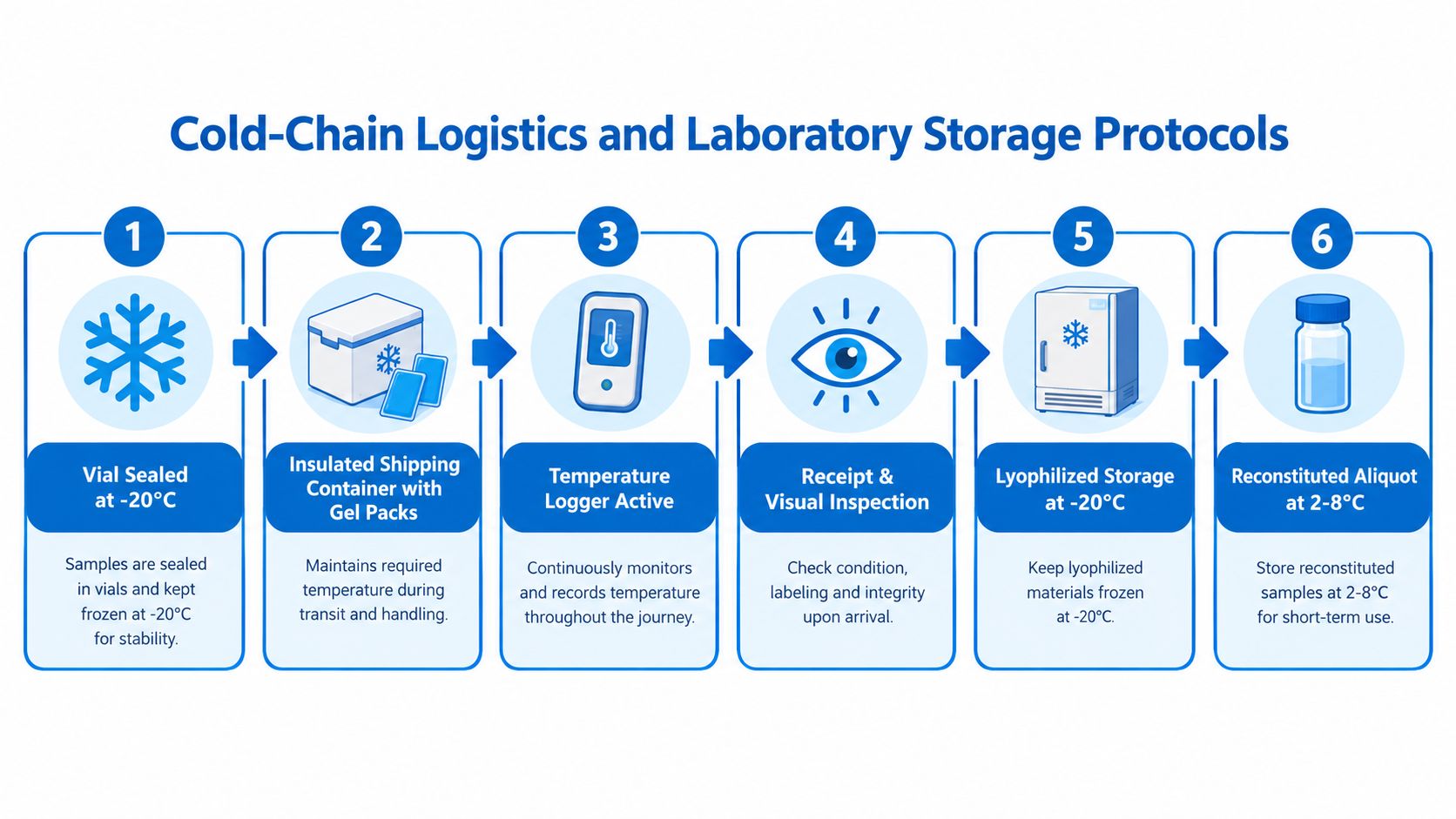
A verified COA doesn't preserve a peptide during transit. The shipping record becomes part of the quality record because temperature excursions, damaged seals, light exposure, and poor receiving practices can compromise the material before the assay begins.
The vendor should state the formulation state, storage temperature, packaging approach, and available temperature-controlled shipping option. Lyophilized material is easier to transport than a reconstituted sample, but that doesn't remove the need for documented handling. The laboratory should decide its shipping requirement before checkout rather than after a package has already entered transit.
Receiving should be treated as a controlled event
At delivery, the receiving technician should photograph the outer packaging, inspect the vial and seal, record the lot number, compare the shipment with the order, and retrieve the corresponding COA. A temperature logger, when supplied, should be reviewed and filed with the receiving record.
The following sequence keeps logistics connected to analytical traceability:
- Confirm the shipment identity. Match the product name, vial quantity, lot, and order record.
- Inspect the container. Record broken seals, visible damage, moisture, discoloration, or labeling discrepancies.
- Review temperature evidence. File logger output or shipping-condition information where available.
- Move the material into approved storage. Follow the supplier's documented conditions and the institution's chemical inventory procedures.
- Restrict access to authorized personnel. The container should remain clearly marked for laboratory research.
- Record deviations before release. A questionable shipment should be quarantined pending quality review.
Sample preparation needs documented controls
Reconstitution and aliquoting belong in the laboratory's sample-preparation SOP, not in consumer-facing instructions. The SOP should identify the approved solvent, container compatibility, aseptic controls, labeling convention, storage condition, and freeze-thaw policy for the planned assay.
Supplier documentation may specify lyophilized storage at -20°C and 2–8°C storage for a reconstituted aliquot, but those conditions must be assessed against the study design and institutional stability requirements. The team should avoid inventing an expiry period when the vendor hasn't supplied one. It should also document preparation date, operator, concentration, container, and disposition.
Receiving principle: A cold-chain option reduces transit risk, but it doesn't compensate for an undocumented lot or an unverified identity result.
Institutional Compliance and Purchasing Frameworks
A laboratory can receive a technically convincing material and still fail an institutional audit if the purchasing file doesn't establish lawful research intent. Procurement, biosafety, quality, and principal-investigator records should tell the same story. The product is a research reagent, the project is defined, and the supplier's terms don't imply human or veterinary administration.
Build the approval record before checkout
The file should include the project or purchase justification, intended study type, supplier identity, product page, batch-specific COA, storage requirements, shipping selection, and the applicable research-use-only policy. It should also capture the buyer's acknowledgment of the supplier's terms and any required age or credential verification.
A transparent vendor framework can reduce administrative friction when it provides:
- Research-only terms: The supplier states that the material isn't for human or veterinary use.
- Age verification: The purchasing flow includes the required 21+ eligibility check where applicable.
- Accessible documentation: COAs and product specifications can be reviewed before ordering.
- Clear fulfillment records: The order, lot, shipment, and storage information remain connected.
- Defined policies: Shipping, returns, privacy, and research-use policies are available for institutional review.
The Research Use Only Policy gives purchasing teams a concrete example of the type of framework that should be reviewed alongside product documentation. A disclaimer alone isn't enough if surrounding pages make therapeutic claims.
Compliance is a supplier-selection criterion
A laboratory should evaluate the seller's website as part of its quality system. Product pages that provide formal names, CAS identifiers, formulation details, solubility guidance, storage information, and lot-linked COAs are easier to reconcile with a purchase order and study file. Pages that emphasize human outcomes while placing “research only” in a footer create a contradiction that an auditor may question.
Institutional buyers should also distinguish between in-vitro research, animal research under the relevant approval framework, and any activity that could be interpreted as human administration. The procurement record must not imply that the material is interchangeable with an approved pharmaceutical product. Human clinical decisions belong to licensed healthcare and regulatory systems, not research peptide purchasing pages.
Finalizing Your Research Procurement Strategy
The safest way to buy Tirzepatide peptide online for laboratory research is to treat the purchase as an extension of experimental design. Start with the intended assay, define the documentation threshold, and reject any supplier that can't connect its product to a specific lot and analytical record.
A practical final review should answer these questions:
- Identity: Does the listing clearly describe synthetic tirzepatide and its research-use category?
- Documentation: Is the COA available before purchase, with a matching batch number?
- Analytics: Does the record identify RP-HPLC or HPLC purity testing and mass spectrometry identity confirmation?
- Contaminants: Are endotoxin, heavy metals, sterility, or other relevant tests documented for the intended assay?
- Logistics: Are formulation, storage, packaging, and cold-chain options stated?
- Compliance: Does the supplier avoid therapeutic claims and require appropriate research-use acknowledgment?
- Traceability: Can the laboratory preserve the order, vial, lot, COA, shipment, and receiving records together?
Price should be evaluated only after those questions have satisfactory answers. A cheaper vial with missing identity evidence may create repeat experiments, delayed review, or unusable results. A transparent supplier may not eliminate every experimental risk, but it gives the laboratory evidence needed to manage that risk responsibly.
For laboratories comparing online sources, Pro Tec Pep provides research-use-only compounds, batch-linked documentation, third-party testing information, and optional cold-chain logistics designed around laboratory procurement workflows. Review the current tirzepatide records, storage information, and compliance terms before placing an order through Pro Tec Pep.
For laboratory research use only. Not for human or veterinary use. Not a drug, food, or cosmetic. Not evaluated by the FDA. Not intended to diagnose, treat, cure, or prevent any disease. By purchasing, you certify you are a qualified researcher and agree to use this product solely for in-vitro laboratory research.