Buy Selank Peptide for Research a Complete Guide
Learn how to buy Selank peptide for research with confidence. Check COAs, storage, shipping and compliance before you order.
A procurement request arrives with a familiar urgency: a laboratory needs Selank for a neuroscience assay, the supplier's price looks acceptable, and the product page appears complete. Then the purchasing manager asks for the lot-specific Certificate of Analysis, identity confirmation, purity method, shipping conditions, and documentation showing that the material belongs in a research workflow. A generic PDF or a persuasive product description won't answer those questions.
The decision to buy Selank peptide should therefore be treated as a documentation and compliance review, not a consumer shopping task. Selank has a distinctive Russian pharmaceutical history, but its Western evidence base remains limited. That combination makes supplier transparency, batch verification, and controlled laboratory handling especially important.
Introduction to Buying Selank Peptide for Research
A research manager evaluating Selank has to answer two separate questions. First, does the compound have a legitimate pharmacological and scientific precedent? Second, can the specific lot being considered be identified, tested, transported, and recorded well enough to support reproducible laboratory work?
Those questions aren't answered by purity language alone. A label that says “research grade” may still leave the laboratory without the lot number, analytical method, sequence confirmation, net-content result, or shipping record needed for internal review. A low price can become expensive if an unidentified or degraded sample produces ambiguous assay results and forces the team to repeat the work.
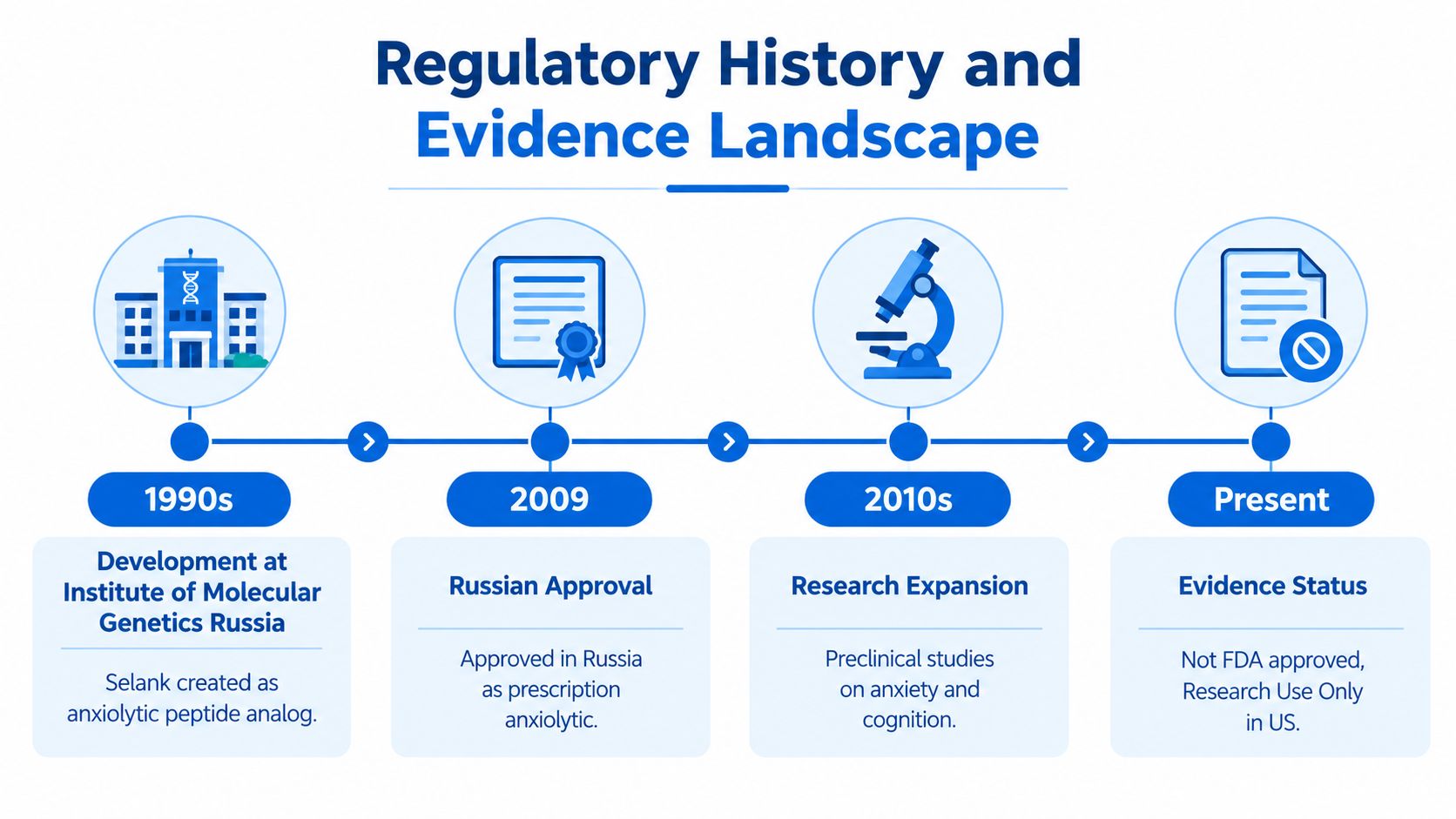
Selank is unusual because its history includes a documented Russian prescription approval, while it remains unapproved by the FDA and EMA in Western jurisdictions. It was developed in Russia during the 1990s at the Institute of Molecular Genetics in Moscow and registered in Russia in 2009 as a prescription anxiolytic nasal spray in a 0.15% formulation, according to the historical account documented by Biotech Research. That history is relevant background, not permission for personal or clinical administration.
Practical rule: A supplier's paperwork should allow a second researcher to identify what was purchased, which lot was tested, how it was handled, and whether the material matched the planned experiment.
The procurement file should connect four pieces: the scientific rationale, the exact product specification, the batch-level analytical record, and the institution's research-use controls. Product pages, COAs, storage instructions, shipping documentation, and purchasing approvals should tell one consistent story.
This guide follows that order. It begins with Selank's structure and research context, then examines its regulatory and clinical evidence, documentation standards, physical handling, and institutional checks. The purpose is not to make consumer-style promises. It is to help a qualified laboratory decide whether a proposed Selank purchase is sufficiently documented for lawful, controlled research.
What Selank Is and How It Is Studied
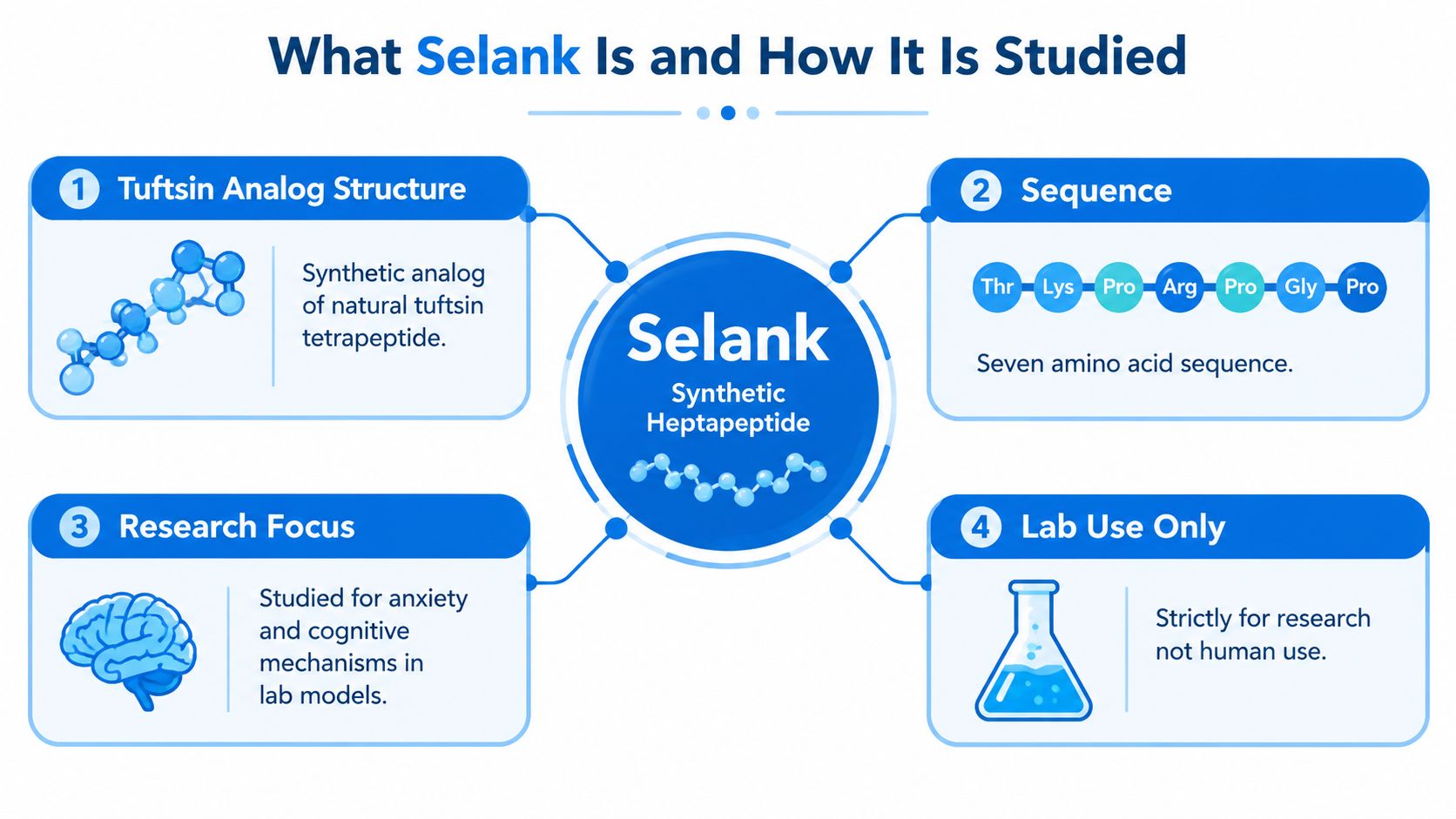
Selank is a synthetic tuftsin-analog heptapeptide. Its sequence is Thr-Lys-Pro-Arg-Pro-Gly-Pro, as described in the published clinical literature indexed by PubMed. “Heptapeptide” means that the molecule contains seven amino-acid residues. The tuftsin connection identifies its structural starting point, while the synthetic analog designation indicates that researchers work with a designed laboratory compound rather than an unmodified natural peptide.
A useful analogy is a key designed for a particular lock. A broad-acting compound might be compared with a tool that affects many doors at once. Selank is discussed in the literature as a more selective biological signal, with research focused on anxiolytic and neuropsychotropic properties rather than consumer claims about personal outcomes. Selectivity doesn't mean that every experiment will produce the same result. It means that researchers are asking which biological pathways respond under defined conditions.
Structure and research questions
The sequence matters because peptide identity is part of procurement verification. A supplier's product record should agree with the expected name, sequence, formulation state, and analytical documentation. If the product page identifies a different sequence or offers no way to connect the material to a defined lot, the laboratory has a traceability problem before the assay begins.
Published work places Selank across several evidence levels:
- In-vitro research has examined proposed receptor-level activity and molecular interactions.
- In-vivo animal studies have evaluated behavioral, cognitive, and neurochemical outcomes in controlled models.
- Clinical research has examined anxiety-related indications, although the human literature is limited and concentrated in Russian-language and Russian-regulatory pathways.
A review indexed by PubMed describes a proposed mechanism involving subtype-selective, concentration-dependent positive allosteric modulation of GABA receptor binding. That mechanism is based on in-vitro receptor-binding work and downstream animal studies, so it should be treated as a research hypothesis, not as proof of a clinical outcome.
Reading the literature without overstating it
The correct language is “Selank has been studied for its effect on” a pathway, model, or endpoint. It isn't appropriate to convert an animal finding into a promise about people, or to describe a laboratory sample as a treatment. For sample preparation, laboratories should follow their validated procedures for solvent selection, sterile technique, labeling, and analytical handling. Those procedures belong to laboratory operations, not personal administration.
The same distinction applies to cognition and stress research. A study can provide a mechanistic lead or model-specific observation without establishing broad efficacy or long-term safety. A careful buyer keeps the scientific question narrow and makes the product record precise.
Regulatory History and Evidence Base You Should Know
A procurement decision can look routine until the supplier asks what evidence supports the material. Selank's history helps define that question. The compound was developed in Russia during the 1990s at the Institute of Molecular Genetics in Moscow. In 2009, Russia registered it as a prescription anxiolytic nasal spray in a 0.15% formulation, a pharmaceutical milestone described in Biotech Research's Selank regulatory review.
That Russian precedent is different from authorization in the United States or European Union. Selank remains unapproved by the FDA and EMA in Western jurisdictions. A research buyer should therefore treat procurement as a documentation and compliance decision, not as a consumer purchase.
What the human evidence contains
One foundational Russian clinical study enrolled 62 patients with generalized anxiety disorder and neurasthenia. It assigned 30 patients to Selank and 32 patients to medazepam, then reported comparable anxiolytic effects across standard rating scales, according to the clinical summary indexed by Paragon Sports Medicine. The study involved patients and a comparator, rather than only cells or animals.
A comparator-controlled trial also reported rapid symptom improvement in a subset of patients with generalized anxiety disorder within 1 to 3 days, with about 40% classified as rapid responders, as recorded in the PubMed clinical record. The finding belongs to that study's design and setting. It does not support personal administration, therapeutic substitution, or broad claims about effectiveness.
Why evidence gaps affect procurement
Later summaries report that Selank has no interventional trials listed on ClinicalTrials.gov. The human literature therefore remains concentrated in Russian-language and Russian-regulatory pathways. It is small, short, and largely non-Western, without large placebo-controlled Western trials or a long-term safety record.
Short studies have described mild adverse effects and no serious events attributed to Selank in the clinical literature, but limited reporting cannot establish safety. For a laboratory buyer, the practical distinction is clear: regulatory history and published studies help frame a research question, while batch-level testing identifies the material that entered the experiment. The first is the map. The second is the chain of custody.
Key Documentation to Verify Before You Buy Selank Peptide
The strongest procurement file reads like an identity passport for the sample. It should connect the product name to the exact lot, the lot to analytical results, and the analytical results to the specification used in the protocol.
A batch-specific Certificate of Analysis is more useful than a generic document because it identifies the material supplied. The COA should include a lot or batch number, testing date, analytical methods, results, acceptance criteria, and the laboratory or testing organization responsible for the work. A purity statement without a lot reference doesn't allow the buyer to confirm that the document applies to the shipment.
A practical supplier comparison
| Documentation Element | What Strong Transparency Looks Like | Red Flag to Avoid |
|---|---|---|
| Identity | Sequence, product name, lot number, and an identity method are aligned | Product name appears without sequence or lot linkage |
| Purity | A declared specification, such as ≥98%, is paired with a reported result and method | “High purity” appears without an acceptance limit or test method |
| Net content | The COA reports the tested content for the relevant lot | The package size appears only as a marketing statement |
| Sterility | A clear result identifies whether sterility was tested and under what method | Sterility is implied without a result |
| Endotoxins | The report identifies endotoxin testing and its result | No endotoxin information is available for a sensitive assay |
| Heavy metals | The lot record includes heavy-metal testing or clearly states the applicable scope | Contaminant controls are absent |
| Conformity | The supplier confirms that the lot conforms to the listed specification | The COA is detached from the product specification |
The seven-category testing framework used by a transparent supplier should address identity, purity, net content, sterility, endotoxins, heavy metals, and conformity. Each category answers a different question. Identity asks whether the expected compound is present. Purity addresses related substances and impurities. Net content concerns what is in the container, while sterility and endotoxin information address laboratory contamination considerations.
Product-page fields that support reproducibility
Before ordering, the laboratory should also review the product record for the formal name, synonyms, CAS number, sequence, molecular formula, formula weight, formulation state, solubility guidance, storage conditions, and stability timeframe. A lyophilized powder requires a different receiving and preparation record from a liquid formulation, so the state of the material should never be assumed.
Procurement test: If a new team member can't match the product page, container label, COA, and purchase record without asking the supplier to clarify basic identity, the file isn't complete.
A strong review compares at least two suppliers using the same checklist. The buyer can then document why one vendor met the required specification while another failed to provide batch-linked evidence. That record supports repeat experiments, deviation reviews, and audits more effectively than a price comparison alone.
Storage Shipping and Handling for Laboratory Integrity
Documentation can't restore a sample that arrived warm, wet, unlabeled, or exposed to repeated temperature changes. Selank supplied as a lyophilized laboratory powder should be stored at -20°C in a dry, light-protected environment, following the supplier's stated stability information and the laboratory's approved sample-management procedures.
The receiving workflow should begin before the shipment arrives. The laboratory manager should confirm the formulation state, storage requirement, shipping method, and responsible person for intake. Optional cold-chain shipping and rapid processing can matter for temperature-sensitive materials, especially when delivery timing or ambient conditions create uncertainty.
The receiving sequence
- Inspect the package. Record visible damage, moisture, broken seals, or evidence that insulation or temperature-control materials failed.
- Match the identifiers. Compare the container label with the purchase order and COA, including product name and lot number.
- Log the condition. Record the arrival date, package condition, shipping documentation, and storage transfer.
- Move the material promptly. Place the lyophilized sample at the approved storage temperature without leaving it in an uncontrolled environment.
- Control access and preparation. Use the laboratory's validated procedures for sterile buffer selection, gentle handling, aliquoting, and post-preparation storage.
Repeated freeze-thaw cycles can complicate assay interpretation by contributing to peptide degradation or concentration variability. Aliquoting can reduce unnecessary exposure when the laboratory's protocol permits it. Every aliquot should retain the original lot identifier, preparation record, operator information, and storage conditions.
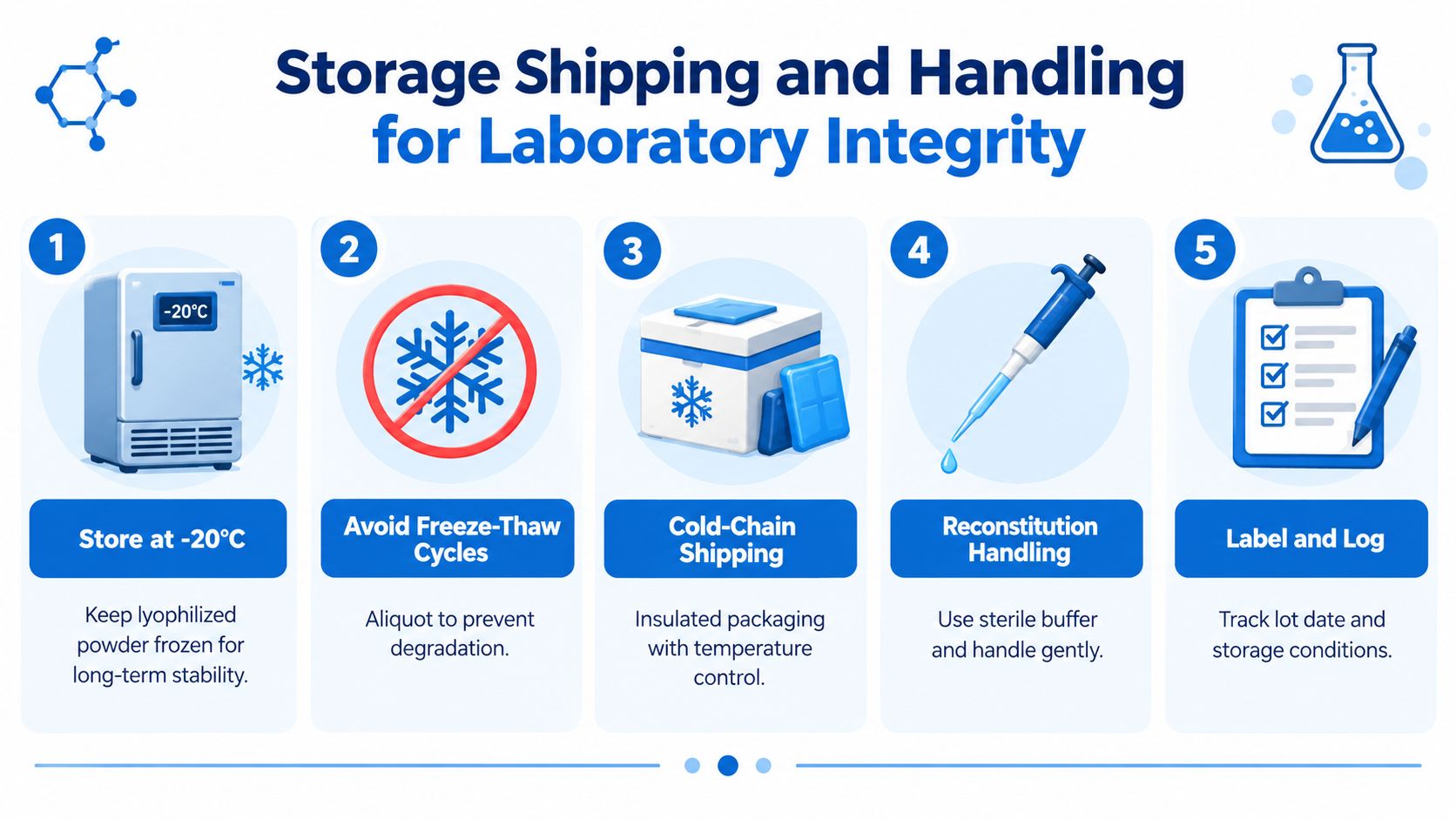
The preparation record should describe laboratory sample preparation only. It shouldn't provide human administration directions, and it shouldn't imply that a research material is suitable for clinical use. A clear chain of custody helps distinguish a failed assay caused by biological variability from one affected by storage or handling.
A short visual guide can reinforce the intake workflow:
Institutional Compliance Checks for Research Purchases
A compliant purchase begins with eligibility, not checkout. Academic laboratories, biotechnology teams, and CROs should confirm that the proposed work fits the institution's research-use policy and that the purchasing account belongs to a qualified researcher or approved organization.
The supplier's legal and operational documents should be reviewed alongside the scientific record. That includes the Research Use Only Policy, Terms of Service, Privacy Policy, shipping and returns information, and any age-verification requirement. Pro Tec Pep's stated framework includes 21+ age verification, research-use gating, and product documentation intended to support laboratory procurement.
A repeatable approval workflow
- Define the project scope. Record the assay, model, responsible laboratory, and reason the material is required.
- Confirm eligibility. Verify that the purchaser meets the supplier's requirements and that the institution permits the transaction.
- Review the product file. Match the sequence, formulation, storage conditions, and lot-specific COA to the planned experiment.
- Check shipping controls. Document whether temperature-controlled shipping is necessary and who will receive the package.
- Archive the records. Retain the purchase order, invoice, COA, lot details, shipping record, receiving inspection, and storage log.
This workflow gives procurement, laboratory operations, and principal investigators a shared record. It also reduces confusion during an audit because the institution can show why the material was purchased, what it was represented to be, and how the laboratory controlled it after arrival.
The required product disclaimer should remain visible in the purchasing record:
“For laboratory research use only. Not for human or veterinary use. Not a drug, food, or cosmetic. Not evaluated by the FDA. Not intended to diagnose, treat, cure, or prevent any disease. By purchasing, you certify you are a qualified researcher and agree to use this product solely for in-vitro laboratory research.”
That wording reinforces the boundary between laboratory investigation and personal or clinical application. Institutional buyers should preserve it with the rest of the procurement documentation.
Making a Confident and Compliant Selank Purchase Decision
A defensible decision to buy Selank peptide rests on four checks. The scientific rationale should identify the relevant in-vitro, animal-model, or clinical literature. The product record should identify the compound precisely, including its sequence and formulation state. The COA should apply to the exact lot and cover the testing categories required by the laboratory. The shipping and storage plan should protect the sample and document its condition on arrival.
Selank's Russian pharmaceutical precedent makes it more historically established than a compound supported only by early laboratory work. Its lack of FDA and EMA approval, limited Western clinical evidence, absence of interventional trials listed on ClinicalTrials.gov, and limited long-term safety record mean that the material still requires strict research-only controls.
A structured review also protects reproducibility. If an assay produces an unexpected result, the team can investigate identity, purity, net content, handling, storage, and protocol conditions instead of relying on an undocumented product description. That level of traceability is valuable whether the purchaser selects Pro Tec Pep or another supplier that can provide equivalent evidence.
Before approval, the laboratory should retain the lot-linked COA, product specifications, shipping record, receiving notes, and storage log. The purchase is ready only when those records align with the institution's research-use requirements and the planned experimental design.
Pro Tec Pep offers Selank as a research-use-only compound with product documentation, batch-specific COAs, and logistics options including cold-chain handling for temperature-sensitive materials. Qualified laboratories can review the available specifications and procurement information by visiting Pro Tec Pep.