Buy GHK-Cu Peptide: A Researcher Procurement Guide
Buy GHK-Cu peptide with confidence. Learn how to verify COAs, check purity, navigate RUO rules, and choose the right cold-chain fulfillment for your lab.
A lab manager has a purchase order ready, a wound-healing assay scheduled, and a supplier page showing “research-grade GHK-Cu.” The problem appears simple until procurement asks for the batch-specific Certificate of Analysis, copper-complex confirmation, shipment conditions, and a defensible record tying the vial to the exact lot. At that point, the buying decision stops being a product comparison and becomes a documentation exercise.
Researchers who buy GHK-Cu peptide should evaluate the paper trail before the price. A clean listing, a headline purity figure, and a fast checkout don't protect a study from an audit. Identity data, chromatographic evidence, copper verification, contamination controls, storage records, and traceable fulfillment do.
What GHK-Cu Actually Is and Why Labs Buy It
GHK-Cu is a copper(II) complex of the tripeptide glycyl-L-histidyl-L-lysine, commonly written as GHK-Cu. Loren Pickart first isolated GHK-Cu in 1973 from human plasma albumin, and the compound has since accumulated a publication record spanning tissue remodeling, wound healing, and skin regeneration research (historical overview of copper peptide GHK-Cu). That history matters to procurement teams because GHK-Cu isn't a recent trend molecule with a thin scientific record.
The molecule combines a short peptide sequence with copper coordination chemistry. Researchers aren't ordering only an amino-acid sequence. They're ordering a material whose experimental behavior can depend on peptide identity, copper association, counter-ion composition, hydration state, and degradation profile. A supplier that reports peptide purity without addressing the copper complex leaves a material-definition gap.
What the literature actually studies
Research has examined GHK-Cu in several settings:
- In vitro cellular assays, including work involving fibroblast and keratinocyte biology.
- In vivo animal models, where reviews describe wound-healing activity in rabbits, rats, mice, pigs, and dogs, including observations involving wound contraction, granulation tissue, blood vessel growth, antioxidant enzyme activity, collagen synthesis, and healing in diabetic or ischemic wounds (peer-reviewed review of GHK-Cu wound-healing activity).
- Clinical investigation, including a Phase 2 randomized, double-blind, vehicle-controlled, split-wound study of a topical GHK-Cu gel for re-epithelialization of standardized acute skin wounds in healthy adults (clinical trial registry record).
Those study types must stay separate. Animal-model findings don't establish a human therapeutic claim, and a registered clinical trial doesn't mean that a product is an approved treatment. The correct laboratory framing is that GHK-Cu has been studied for its effects on wound repair, tissue remodeling, inflammatory signaling, antioxidant activity, and skin-related cellular processes.
Why suppliers are often the practical route
Custom synthesis can make sense for unusual analogues, isotope-labeled material, or a project requiring a tightly controlled manufacturing specification. For routine assay development, however, a documented catalog lot can reduce lead time and administrative complexity. The supplier still needs to provide enough evidence for the lab to confirm that the purchased material matches the experimental requirement.
A procurement officer should therefore define the purchase as a qualified research material, not as a consumer product. The key question isn't whether a page makes GHK-Cu sound attractive. It's whether the lot can be identified, tested, received, stored, and defended in the study record.
Reading a Product Page Like a Procurement Officer
A product page is an initial screening document, not a substitute for a COA. Procurement staff should read every field as a promise that must eventually connect to a record in the purchasing file.
Start with the formal name and sequence. “GHK-Cu” should be accompanied by the peptide identity, complex description, and any relevant formulation or salt information. If the page lists only a marketing name, the buyer can't determine whether the material is the intended copper complex or a related peptide product.
Fields that deserve scrutiny
Sequence and molecular description should identify the tripeptide and copper association. A page that reports a sequence but says nothing about metallation is incomplete for this compound.
Formulation state should distinguish lyophilized material from a solution. It should also identify whether a counter-ion or salt form is present. Counter-ion information becomes important when the material enters assays sensitive to ionic composition.
Lot identification must connect the product page, vial label, packing slip, and COA. A generic PDF covering an unspecified batch doesn't provide the traceability required for a defensible purchase.
Storage language should be specific enough to support receiving and inventory decisions. “Store properly” isn't an operational instruction. The supplier should state the expected condition for unopened material and distinguish it from handling after reconstitution.
Purity reporting needs method context. “Research-grade” is a label, not an analytical method. A stated HPLC purity value becomes useful only when the supplier identifies the chromatographic method and provides the corresponding chromatogram or test record.
| Product Page Field | Procurement Question |
|---|---|
| Formal name and sequence | Does the listing identify the intended peptide and copper complex? |
| Salt or counter-ion | Is the formulation defined well enough for assay planning? |
| Lot number | Can the lot be matched across the vial, COA, invoice, and packing slip? |
| Purity claim | Is the value tied to HPLC data, or is it only marketing copy? |
| Identity method | Is mass spectrometry included for the specific batch? |
| Storage condition | Does the guidance distinguish lyophilized and reconstituted material? |
| COA link | Is the document batch-specific, dated, and attributable to a testing laboratory? |
Procurement rule: Every important line on a product page should map to a document that can be attached to the purchase order or study file.
The strongest listings provide formal specifications, batch-specific documentation, storage information, and testing details in one place. A page lacking those fields doesn't automatically prove that the material is unusable, but it does mean the buyer should pause and request the missing records before issuing a purchase order.
How to Verify a Certificate of Analysis Before You Buy
A Certificate of Analysis should be read as a chain of evidence. It doesn't need to be decorative, but it does need to identify the material, identify the lot, describe the tests, and show whether the results meet defined specifications.
Start with identity and lot traceability
The first review should confirm the product name, sequence, formulation, lot number, and manufacturing date. The lot number on the COA must match the vial label and packing slip exactly. A mismatch creates an avoidable custody problem, even if the product name is correct.
The document should identify the testing laboratory or responsible manufacturer. It should also show issue dates, specification limits, observed results, and an approval or authorization record. A branded PDF isn't automatically valid, but an unbranded template with no laboratory attribution deserves additional scrutiny.
Next, check molecular-weight confirmation by mass spectrometry. The observed intact mass should be consistent with the declared material, and the report should explain whether the result represents the peptide alone or the copper-associated complex. For GHK-Cu, copper-complex verification by UV-Vis or mass-spectrometric isotope-pattern review adds evidence that the material isn't merely an uncomplexed peptide.
Then inspect purity and contamination controls
HPLC should include more than a single purity number. The buyer should look for the chromatogram, retention time, integration method, and impurity profile. A summary statement can be useful, but the raw or full chromatographic record gives the laboratory a way to assess whether the reported result is plausible.
A practical COA review includes:
- Appearance and physical state, including whether the material is described as a lyophilized solid.
- Mass spectrometry, for identity and intact-mass confirmation.
- HPLC, for purity, retention time, and related impurities.
- Copper verification, using UV-Vis, ICP, or a comparable validated approach.
- Residual solvents, including relevant process solvents such as acetonitrile, TFA, or acetic acid.
- Heavy metals, with defined limits and observed results.
- Microbial limits, where applicable to the planned laboratory workflow.
- Endotoxin testing, when the experimental system requires it.
Independent guidance on research peptide testing documentation reflects the same principle: identity and purity should be treated as separate evidence streams. One assay shouldn't be expected to prove everything.
A defensible lot has both MS identity data and HPLC purity data. Buyers should request the underlying chromatogram if the supplier posts only a summary PDF. Missing MS data, absent lot numbers, unexplained specifications, inconsistent branding, and documents that appear copied from a generic template should pause the purchase until the supplier responds in writing.
Cold-Chain and Shipping Decisions That Protect Your Lot
A shipment can arrive looking normal and still lack the records needed to accept it. Before ordering GHK-Cu, define the material state, route, packout, temperature evidence, and receiving decision. Procurement should be able to connect each condition to a purchase record.
Lyophilized GHK-Cu usually presents the lower transit risk during routine shipping. Independent GHK-Cu supply and storage guidance describes unopened lyophilized material as generally suitable for standard 2–4 day ambient shipping. Use that guidance only for a dry, sealed vial on a documented route. Heat exposure, uncontrolled delays, and damaged packaging still require investigation.
Reconstituted material requires a different packout and receiving standard. Store it at 2–8°C, use an insulated shipper with validated coolant, and record the time between dispatch and receipt. Treat the stated 28-day working window as a planning limit after reconstitution, not as permission to hold solution indefinitely. Small aliquots, limited freeze-thaw exposure, and a dated preparation record protect the study file.
Match the shipment to the route
For domestic ground transport, a sealed lyophilized vial may use validated ambient packaging. Opened or reconstituted material should travel under refrigerated conditions. International airfreight adds customs delays and carrier handoffs, so require a packing list, tracking record, responsible contact, and contingency plan before dispatch.
Receiving staff should inspect the package before placing it in inventory. Record the vial, cap, label, pellet, insulation, condensation, coolant condition, and temperature indicator. Wet ice, damaged phase-change packs, missing logger data, or a broken seal belong in a deviation record. Do not accept appearance as a substitute for shipment evidence.
| Shipment State | Temperature Range | Packaging Required | Acceptance Check |
|---|---|---|---|
| Unopened lyophilized vial | Ambient may be acceptable for a validated short route | Dry, sealed vial with protective insulation and route-appropriate packout | Confirm intact seal, dry appearance, matching lot, and no transit damage |
| Opened vial | Refrigerated handling is preferred | Moisture control, resealing, and a refrigerated transit pack when shipped | Check cap integrity, label, condensation, and temperature evidence |
| Reconstituted solution | 2–8°C | Insulated cold-chain shipper, validated coolant, and temperature logger | Review logger data, solution condition, container integrity, and receipt time |
Peer-reviewed physicochemical work found GHK stable in water buffers from pH 4.5–7.4 for at least two weeks at 60°C, while also reporting hydrolytic cleavage under basic and oxidative stressors (physicochemical characterization study). That finding does not replace a validated storage procedure for reconstituted stock. Keep unopened material cold and dry, prepare only the volume needed, and document every preparation and transfer.
Require shipment tracking, packing lists, stability information, and any temperature record included with the order. The receiving file should identify the carrier leg associated with any deviation. Pro Tec Pep's research material shipping and returns information also sets out logistics and return documentation buyers should review before purchase.
Staying Compliant With RUO and Institutional Purchasing Rules
A GHK-Cu product sold through a research channel must remain a For Research Use Only material. It shouldn't be represented as a cosmetic, drug, supplement, or human-use product. The U.S. regulatory position remains unsettled for injectable GHK-Cu, with an NPR report dated September 7, 2026 describing it as not an approved drug and noting continuing review of injectable use (NPR report on copper peptides and regulatory status). That uncertainty strengthens the case for strict RUO controls.
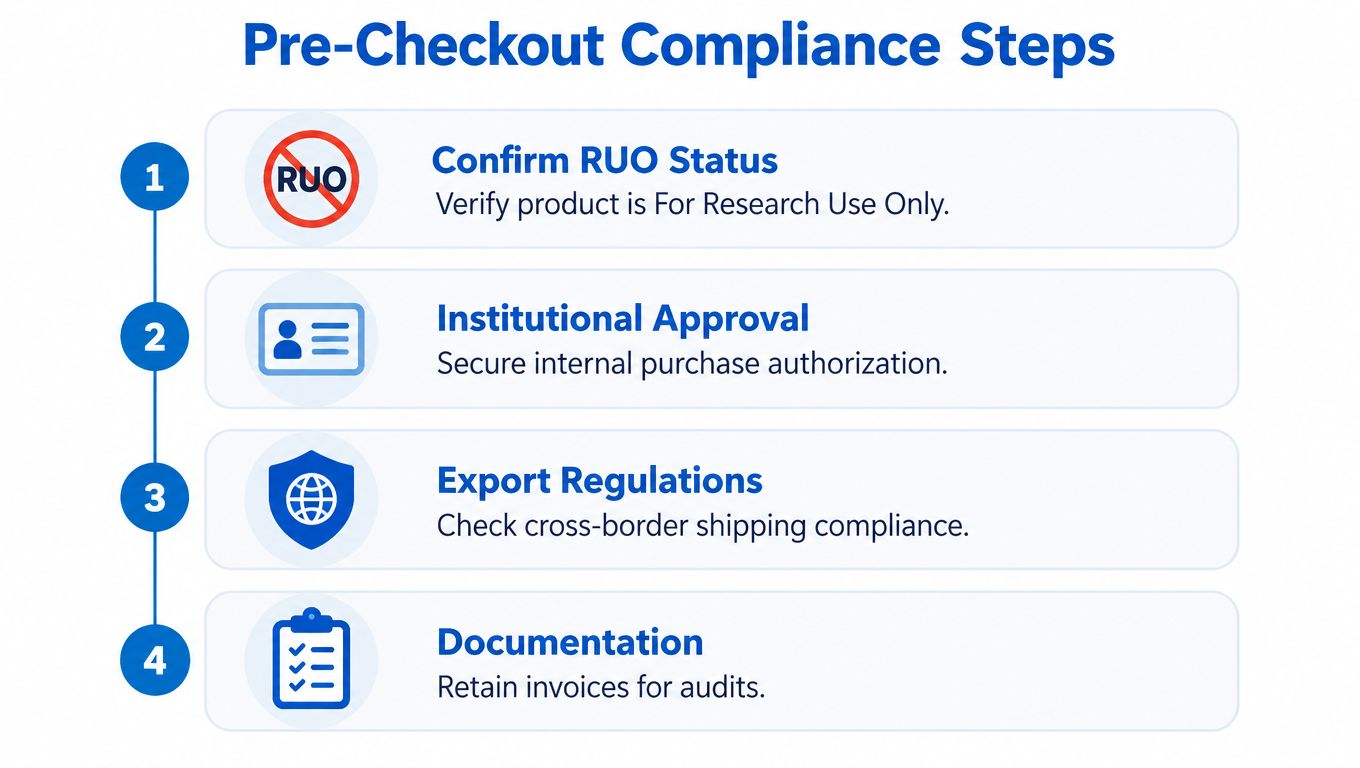
Before checkout, the laboratory should complete its internal review rather than relying on a website checkbox.
- Confirm the intended activity. The requisition should describe an in vitro, analytical, or other lawful laboratory purpose. It shouldn't contain clinical, cosmetic, or personal-use language.
- Verify the purchaser. Age verification and end-user affirmation prompts should be completed by the authorized buyer, not bypassed by a third party.
- Secure institutional approval. A purchase order, approved requisition, or accepted institutional payment process should identify the department and responsible investigator.
- Collect vendor records. Procurement may require a W-9, business license, RUO policy, SDS, batch COA, and proof of insurance.
- Check cross-border requirements. International orders should be reviewed for export, import, customs, and carrier restrictions before payment.
- Archive the attestation. The supplier's RUO statement, invoice, packing slip, COA, SDS, and receiving record should remain together in the procurement file.
A sole-source justification may be appropriate when the lab requires a traceable lot, a specific analytical package, or continuity with a validated supplier record. The justification should explain the technical requirement, not merely state that a preferred vendor is convenient.
Institutional buyers should also review the supplier's Research Use Only policy before checkout. RUO material cannot be administered to humans or moved into a clinical workflow, regardless of how complete the product page appears.
Buying Criteria Most Researchers Overlook
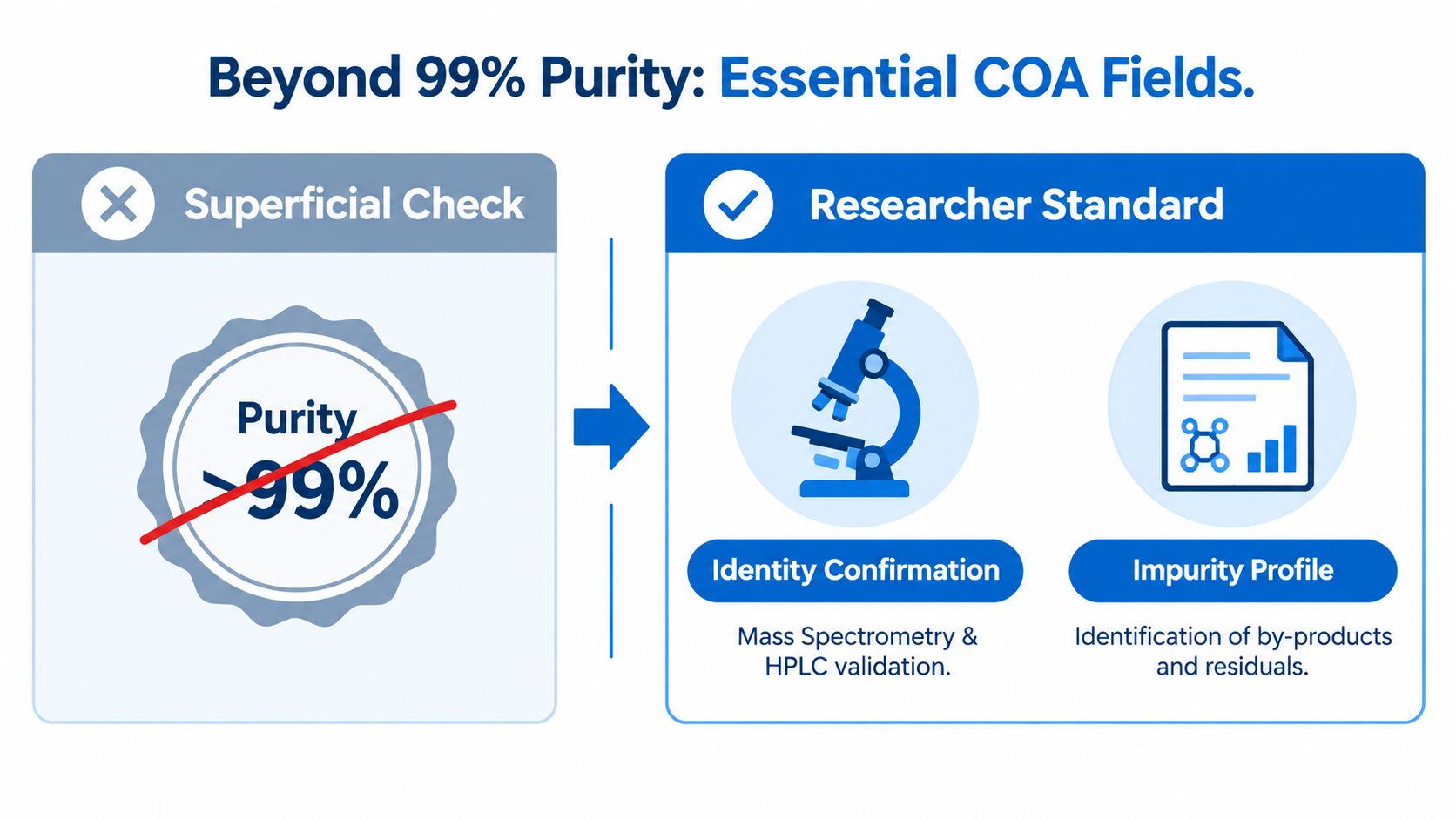
A buyer approves a lot based on its 99% purity claim, then discovers during assay review that identity, copper loading, counter-ion composition, or contaminants were never documented. That purchasing rule is inadequate for GHK-Cu. HPLC purity matters, but it cannot establish every property needed to defend a research lot.
Identity comes before the headline number
Mass spectrometry should confirm the intact material. HPLC should show the expected retention time and impurity profile. Copper loading requires its own evidence, so request verification against the theoretical copper-associated composition using UV-Vis, ICP, or an equivalent analytical method.
Counter-ion disclosure belongs in the same file. Trifluoroacetate content can affect ionic conditions and downstream assay behavior, especially when researchers compare lots or prepare material for sensitive biochemical systems. A report can show a strong purity result while leaving the formulation chemically underdefined if the counter-ion is absent.
Contamination panels protect the experiment
Review the substances that could distort results or create gaps in the study record, not only the size of the primary chromatographic peak.
- Residual solvents: The COA should identify and report relevant process residues, including acetonitrile, TFA, and acetic acid where applicable.
- Heavy metals: Limits and observed values should be recorded rather than implied.
- Endotoxins: Testing should match the requirements of the planned experimental system.
- Microbial load: The supplier should state the applicable method and specification when contamination could affect the work.
- Batch consistency: Comparing two consecutive COAs can reveal changes in retention time, impurity patterns, or reporting practices that one document cannot show.
A purity percentage is one field. Study defensibility is the complete identity, formulation, impurity, and traceability record.
Price comparisons should include operational exposure. A failed assay, repeated sample preparation, delayed data review, or audit finding can consume more laboratory time than the difference between material prices. Before comparing vial costs, procurement officers should weigh identity evidence, copper confirmation, lot continuity, and contamination controls.
A supplier that provides batch-specific COAs and describes independent testing gives the buyer a stronger starting record than a page with only a generic purity statement. Pro Tec Pep is one supplier option listing research-use-only compounds, batch-linked documentation, and optional cold-chain fulfillment. Apply the same documentation standard to that supplier and every alternative.
A Quick Procurement Checklist and Required Disclaimer
The purchase order should be treated as the first page of the study record. Before approval, the buyer should be able to answer each question below without searching through email threads.
- COA presence: Is a current, batch-specific Certificate of Analysis available?
- Identity confirmation: Does mass spectrometry support the declared GHK-Cu material?
- HPLC evidence: Is the chromatogram available, including retention time and impurity information?
- Copper verification: Does the documentation address copper association or loading?
- Purity specification: Does the lot meet the laboratory's defined peptide-purity threshold?
- Copper purity: Does the supplier identify the analytical basis for the copper result?
- Endotoxin and microbial controls: Are the applicable limits and observed results recorded?
- Lot traceability: Do the vial, invoice, packing slip, and COA carry the same lot number?
- Cold-chain verification: Does the shipment record support the state and storage condition received?
- Vendor file: Are the SDS, RUO policy, supplier attestation, and relevant business records archived?
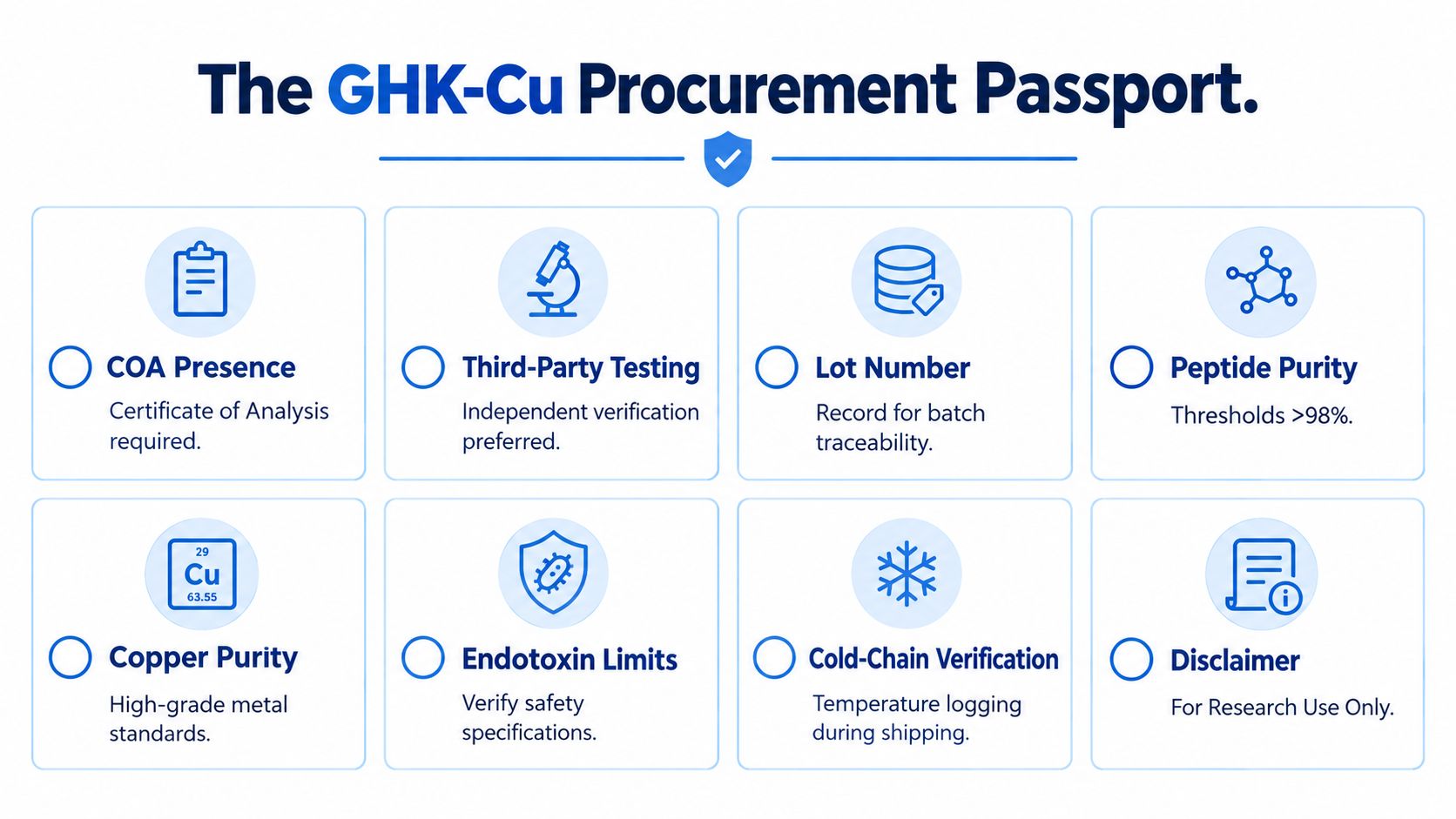
The lab should attach the COA, SDS, packing slip, invoice, shipment record, and chain-of-custody documentation to every order. That packet supports reproducibility and shows that the institution controlled the material from vendor selection through receipt and storage.
The required product disclaimer is:
"For laboratory research use only. Not for human or veterinary use. Not a drug, food, or cosmetic. Not evaluated by the FDA. Not intended to diagnose, treat, cure, or prevent any disease. By purchasing, you certify you are a qualified researcher and agree to use this product solely for in-vitro laboratory research."
Pro Tec Pep provides research-use-only GHK-Cu and related compounds with batch-specific documentation, product specifications, and optional cold-chain fulfillment for laboratory workflows. Researchers ready to evaluate a lot against this documentation-first checklist can visit Pro Tec Pep and request the records needed for institutional purchasing.