Bpc 157 and Tb500 Peptides
Bpc 157 and tb500 peptides. Compare BPC-157 and TB-500 research peptides, including mechanisms, evidence, laboratory handling, compatibility, stability, COAs

What can a laboratory responsibly compare when records for BPC 157 and TB500 peptides arrive together, but the supporting papers describe different molecular entities? A shared research theme doesn't establish a shared identity, and a matching product name doesn't establish that the purchased material matches the experiment.
Why a Two-Peptide Comparison Needs a Lab First
Consider a hypothetical procurement review. A laboratory researcher receives supplier records for BPC-157 and TB-500, then opens the publications selected to justify a cell-migration assay. The purchasing documents describe research materials, but some of the cited experiments concern full-length thymosin beta-4 rather than the TB-500 fragment.
The immediate question isn't which compound appears more promising. It's whether the proposed experiment, the cited molecule, and the material available for purchase match. That distinction should be resolved before a purchasing team compares packaging, availability, or price.
A name isn't an experimental specification
For academic laboratories, biotechnology teams, contract research organizations, and assay developers, a defensible comparison should connect several separate records:
- Compound identity: The molecular entity named in the protocol must match the entity characterized by the supplier.
- Literature relevance: The cited experiment must concern that entity, or the protocol must explicitly identify the extrapolation.
- Formulation: The experimental vehicle and sample state should be documented rather than inferred from a product name.
- Batch traceability: Analytical records should identify the actual material assigned to the study.
These are proposed procurement criteria, not claims that either compound produces a particular biological outcome. They help researchers distinguish a documented experiment from a hypothesis that still needs testing.
Practical rule: Procurement should approve a defined research material, not a collection of associations attached to its name.
The discussion concerns in-vitro and in-vivo research literature, not personal administration or therapeutic outcomes. An animal experiment can inform model selection without authorizing a clinical conclusion, and a research supplier's documentation can support material verification without establishing clinical suitability.
The laboratory-first approach also changes the purchasing decision. An unresolved identity question is a reason to request clarification before procurement, not an uncertainty to leave for the investigator after the material arrives.
BPC-157 and TB-500 Identity and Evidence
BPC-157 is an experimental synthetic pentadecapeptide containing 15 amino acids, with an origin historically traced to human gastric juice. The review of BPC-157's identity and evidence base also describes its predominantly preclinical research history and limited human investigation.
TB-500 is commonly described as the synthetic fragment corresponding to residues 17–23 of thymosin beta-4. That seven-amino-acid fragment must be distinguished from the 43-amino-acid, actin-binding parent molecule, as described in the same review. The parent and fragment shouldn't become interchangeable entries in a procurement database because supplier terminology associates them.
BPC-157 and TB-500 at a Glance
| Feature | BPC-157 | TB-500 |
|---|---|---|
| Molecular description | Experimental synthetic pentadecapeptide with a gastric-origin research history | Commonly described as a fragment of thymosin beta-4 |
| Identity question | Does the supplied material match the molecular specification? | Is the supplied material the fragment or the full-length parent? |
| Literature scope | Predominantly preclinical tissue-repair and injury research | Fragment-specific evidence must be separated from parent-molecule literature |
| Formulation questions | Molecular form, vehicle, sample state, and analytical identity | Fragment sequence, acetylation state, molecular form, and analytical identity |
| Procurement requirement | Match the specification to the study material | Resolve nomenclature before accepting literature relevance |
A listing such as TB-500 (Thymosin Beta-4 Acetate) should trigger a clarification request, not an automatic assumption about chain length. Procurement staff should ask the supplier to identify the exact sequence and explain what the designation means for that particular product. Acetate terminology alone shouldn't substitute for sequence-level identification.
Separate the parent record from the fragment record
The laboratory should maintain distinct literature entries for BPC-157, the TB-500 fragment, and full-length thymosin beta-4. A paper concerning the parent molecule may support a question worth investigating with the fragment, but it doesn't establish that the fragment has the same potency, distribution, or safety profile.
Researchers consulting the compound research library should therefore check each publication's actual study material rather than relying on its category label. The relevant comparison is between the molecule tested and the molecule purchased.
A useful purchasing record includes the exact molecular entity, sequence, acetylation state, formulation, and analytical identification. Where a supplier's terminology remains ambiguous, the record should preserve the clarification alongside the specification instead of standardizing different materials under one name.
Comparing Mechanisms Through Measured Endpoints
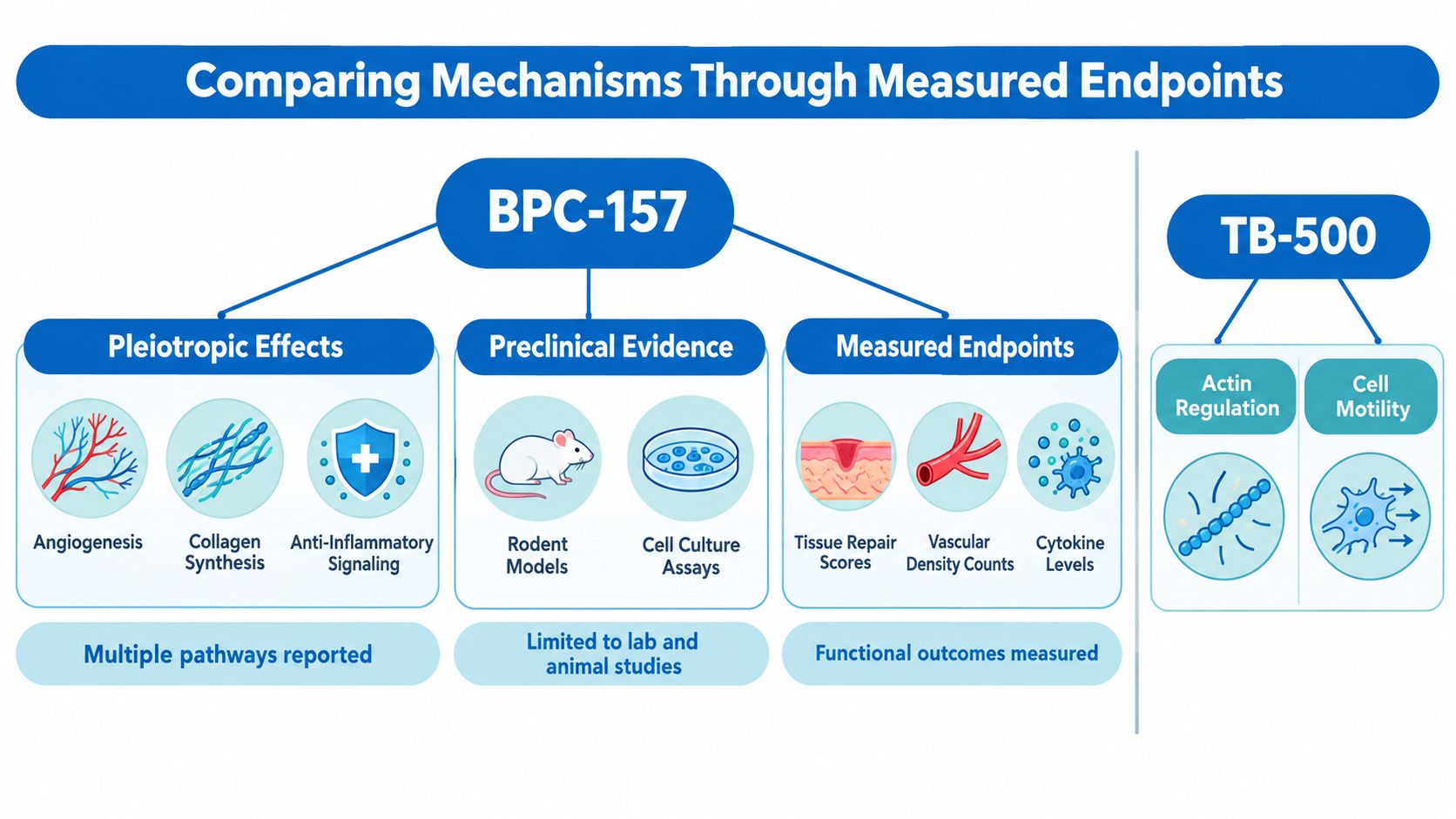
BPC-157's reported activity is pleiotropic, meaning that the literature discusses multiple pathways rather than one established receptor mechanism. Preclinical work has associated it with VEGFR2-linked signaling, Egr-1 responses, nitric-oxide-system modulation, and possible growth-hormone-receptor interactions, while thymosin beta-4 literature concerns actin polymerization, cell migration, angiogenesis, inflammation, and remodeling, as summarized in the mechanistic evidence synthesis.
The mechanism map is an orientation tool, not evidence that every illustrated relationship has been established for the TB-500 fragment.
Distinguish pathway activity from functional interpretation
A systematic review of BPC-157 signaling research discusses increased VEGF expression, ERK1/2 phosphorylation, downstream c-Fos, c-Jun, and Egr-1 activity, and nitric-oxide-related observations in animal and cellular models. Those findings describe measured biological responses under particular experimental conditions. They don't establish a validated human effect.
A laboratory protocol should name the intended observation before applying a broad label such as tissue repair. For example, a study measuring pathway phosphorylation addresses a different question from an experiment measuring collagen deposition. Reporting both may strengthen interpretation, but neither measurement should be relabeled as a universal healing mechanism.
Reported Research Mechanisms and Endpoints
| Compound | Reported mechanism context | Example research endpoint |
|---|---|---|
| BPC-157 | VEGFR2-linked angiogenic signaling | VEGFR2 phosphorylation and endothelial migration |
| BPC-157 | Transcriptional responses involving Egr-1 | Egr-1 expression under defined exposure conditions |
| BPC-157 | Remodeling and inflammatory-response research | Collagen deposition and inflammatory cytokines |
| Full-length thymosin beta-4 | Actin-associated movement and remodeling | Cell migration and wound-model vascularization |
| TB-500 fragment | Fragment-specific activity requires characterization | Migration assays with verified fragment identity and appropriate controls |
Interpret the assay before naming the mechanism
For TB-500, researchers should avoid assigning established parent-molecule functions to the fragment without testing that connection. A migration result can justify further investigation, but it shouldn't automatically be presented as evidence of the parent's intracellular behavior.
A defensible protocol should pair a mechanistic hypothesis with a measurable endpoint and a control capable of challenging the interpretation. If the question concerns migration, researchers should specify how migration will be distinguished from other changes in the assay.
A pathway association explains what researchers should measure next. It doesn't replace the experiment needed to establish causality.
The procurement implication is specific: analytical identity and experimental endpoints belong in the same study record. Otherwise, a well-characterized biological response may remain attached to a poorly characterized material.
What Studies Can and Cannot Support
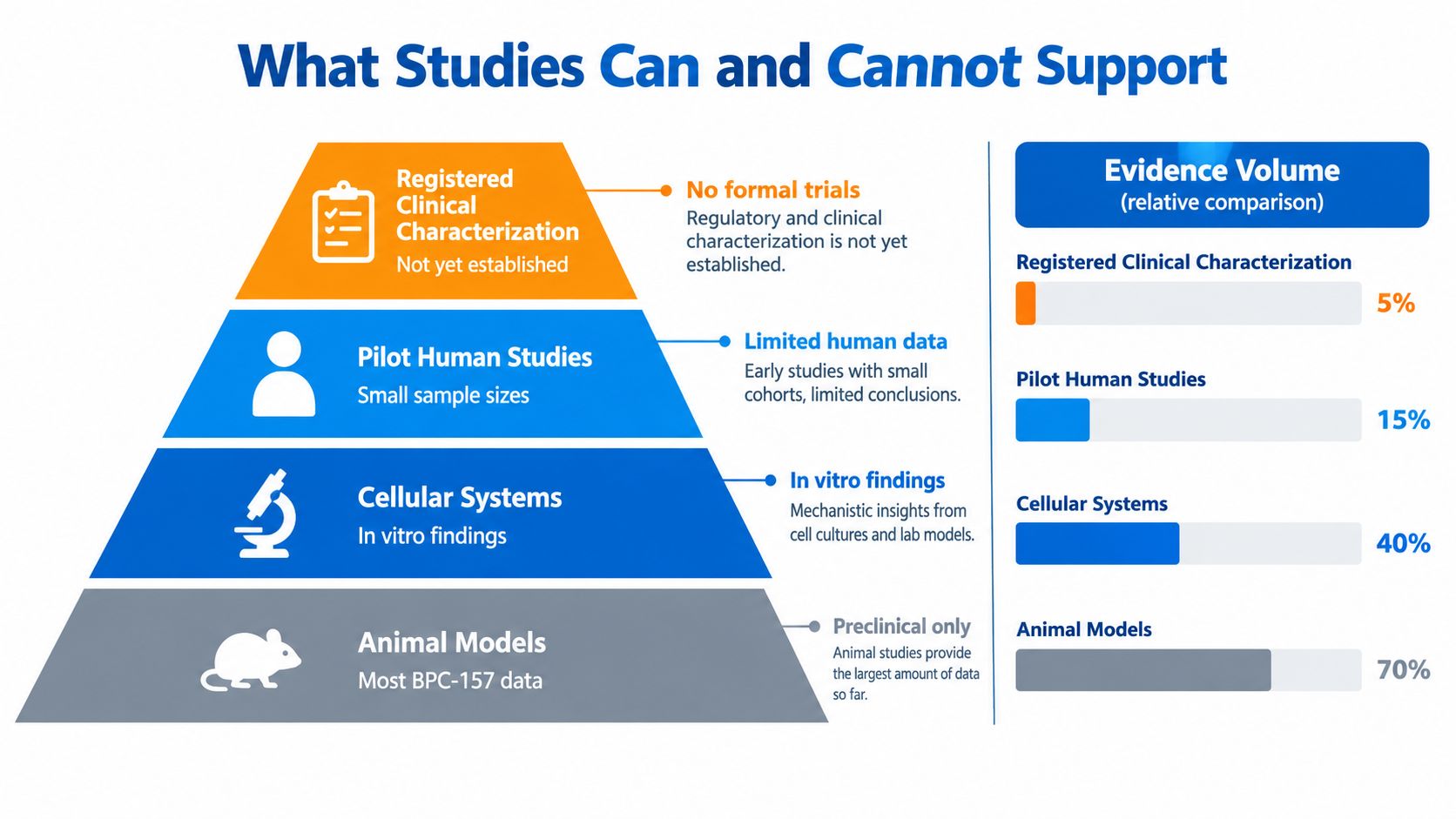
Evidence should be classified by study material, model, and endpoint, not only by publication count. The human pilot work identified in the BPC-157 review cited earlier concerns intra-articular knee pain, interstitial cystitis, and intravenous safety/pharmacokinetics. Those limited investigations don't establish broad clinical efficacy, and no peer-reviewed randomized controlled trial has established human therapeutic benefit.
The evidence graphic provides a broad visual orientation. Its bars shouldn't be read as a quantified literature analysis, and any suggestion of an absence of formal trials shouldn't override the distinction between registered research and published results.
Read findings within their model
In rat tendon and muscle injury experiments, BPC-157 was associated with early angiogenesis assessed through VEGF, CD34, and factor VIII markers. The reported response occurred in injured tissue in vivo rather than as a direct angiogenic effect in cell culture, an important qualification for assay selection.
Separately, full-length thymosin beta-4 wound-model research examined normal, diabetic, and aged mice and reported accelerated wound closure, increased vascularization, and hair-follicle stem-cell activity. These are parent-molecule animal findings, not fragment-specific human evidence.
A registered Phase 1/2 TB-500 study evaluates safety and tolerability in adults with stable atherosclerotic cardiovascular disease. Registration describes an investigation, not a completed demonstration of effectiveness.
Evidence Types and Interpretation Limits
| Evidence type | What it can support | What it cannot establish |
|---|---|---|
| Cellular experiment | Responses in a defined assay | Whole-organism or clinical outcomes |
| Animal model | Model-specific biological associations | Human effectiveness |
| Human pilot study | Preliminary observations in a limited setting | Broad clinical efficacy |
| Trial registration | Planned clinical characterization | Successful results or approval |
The accompanying video is supplementary context, not a substitute for inspecting study methods and results.
Angiogenesis requires context
A review addressing angiogenic signaling and translational uncertainty identifies unresolved long-term safety questions. Pro-angiogenic biology raises a plausible concern about effects in tumor-bearing or otherwise neovascular models, but that concern isn't proof that either compound causes cancer.
Researchers should therefore preserve species, injury model, tumor status where relevant, vehicle, exposure duration, and endpoint definitions. Short-duration observations can't resolve a long-term safety question they weren't designed to test.
Rationale and Considerations for Combined Research
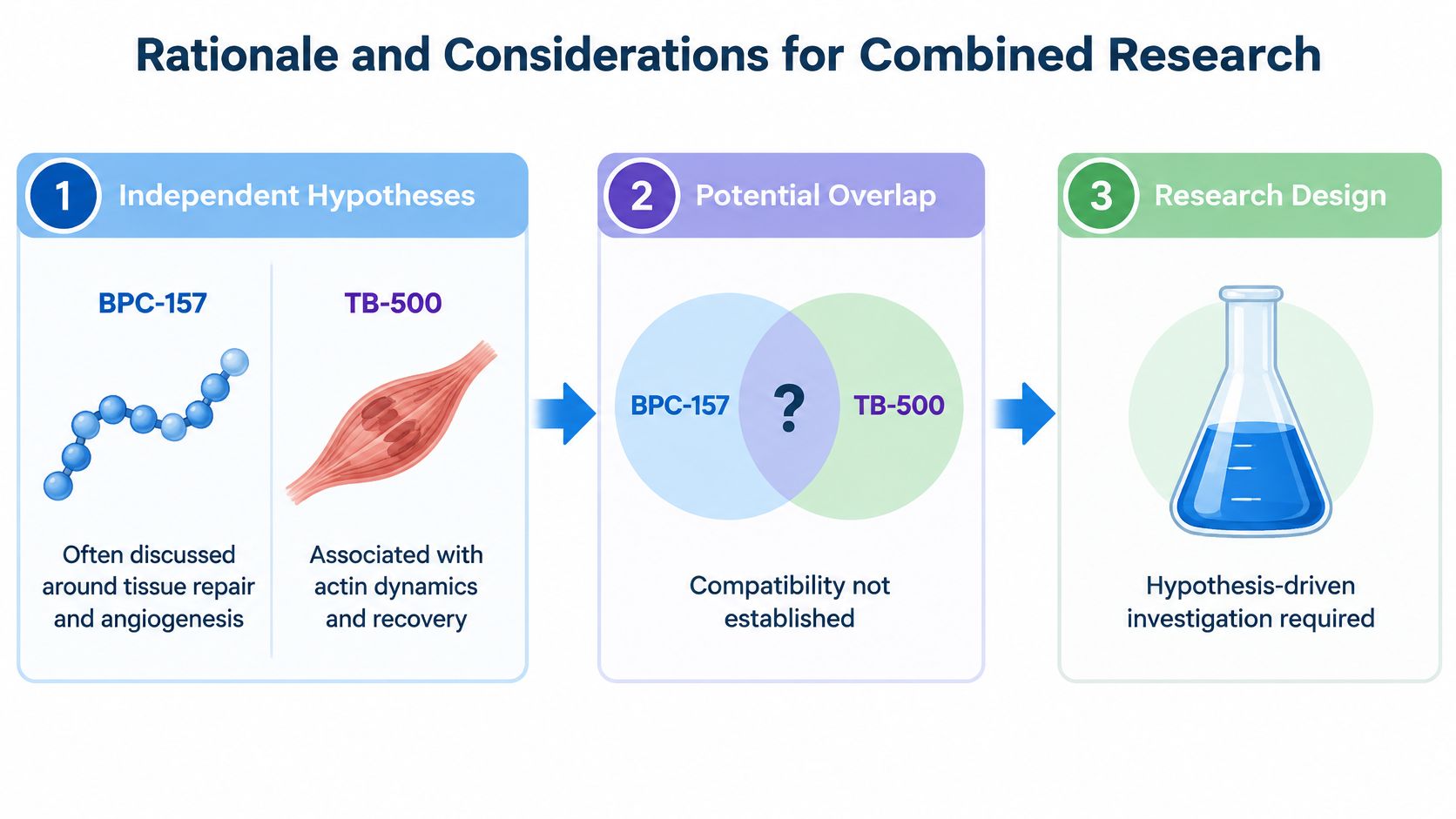
A combined experiment needs a narrower justification than a shared association with tissue repair. Researchers might hypothesize that angiogenic signaling and cell-movement endpoints interact, but the experiment must establish whether the specified materials produce distinguishable responses in the selected system.
The conceptual diagram represents that hypothesis-building process. Its reference to recovery applications shouldn't be interpreted as an established therapeutic outcome.
Biological overlap doesn't establish compatibility
The TB-500 evidence and identity summary emphasizes sparse direct fragment evidence and the limits of extrapolating from full-length thymosin beta-4. Sequence, acetylation state, formulation, stability, distribution, and binding behavior may differ. Those uncertainties remain relevant when a fragment enters a combined experimental system.
A defensible design should distinguish independent activity from a mixture-associated response. Single-compound conditions, a combined condition, and matched vehicle controls allow researchers to ask whether an observed difference depends on either constituent or the preparation itself.
Combined-Research Decision Matrix
| Design question | What to document | Decision threshold |
|---|---|---|
| Are the materials defined? | Molecular entity and analytical identity | Resolve ambiguity before combination work |
| Is the hypothesis specific? | Predicted endpoint and competing explanation | Avoid broad repair claims |
| Can constituent responses be separated? | Single-compound and vehicle controls | Retain independent comparison conditions |
| Is the mixture characterized? | Appearance, analytical recovery, and stability observations | Investigate unexplained changes before interpretation |
| Could the assay mislead? | Interference and aggregation checks | Resolve material-related artifacts |
A combination is a new experimental condition
The laboratory shouldn't assume that independently characterized samples remain equivalently characterized after mixing. Aggregation, formulation behavior, and assay interference should be treated as variables to investigate, not as documented problems known to occur with this pair.
The same caution applies to claims of synergy. A stronger combined signal isn't, by itself, enough to establish a particular interaction mechanism. Researchers should define the comparison and analytical criteria before interpreting the result.
Design boundary: A combined condition tests a hypothesis. It doesn't establish a unified mechanism merely because both materials appear in the same vessel.
The procurement conclusion follows from this distinction. Separate characterization supports purchasing decisions for each material, while mixture characterization supports interpretation of the combined condition. Neither record should stand in for the other.
Formulation Stability and Laboratory Sample Preparation
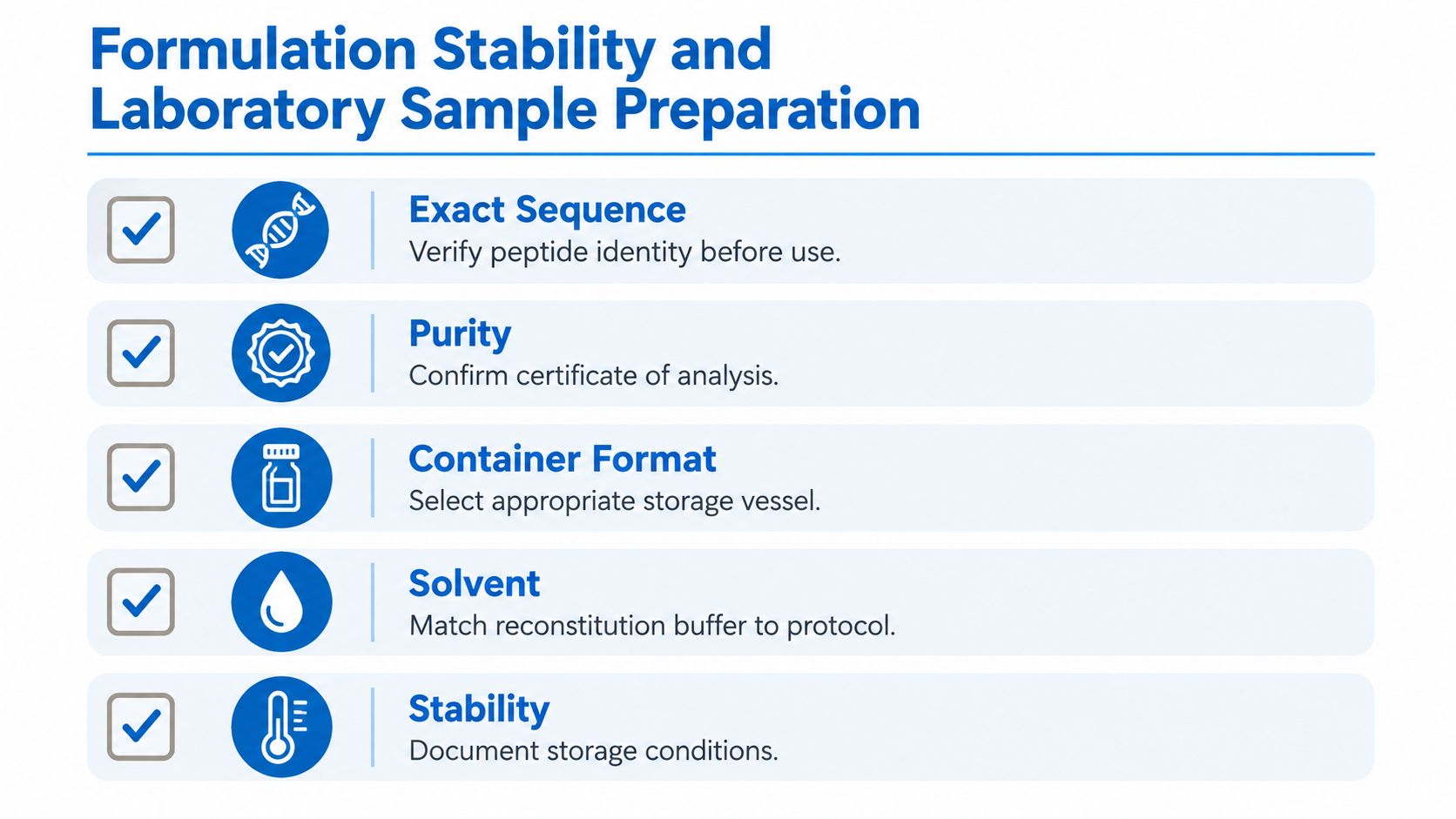
Laboratory sample preparation should follow a documented protocol, with material-specific handling information retained alongside the study record. The checklist below is intended for experimental planning, not human administration.
The visual summarizes documentation categories. It doesn't provide validated preparation conditions for either compound.
Preserve the material's preparation history
The recommended record should connect the received material to the sample evaluated in the assay. Researchers should document the solvent or vehicle, preparation state, container format, storage history, temperature exposure, and freeze-thaw history rather than reconstructing those details after an unexpected result.
A product-level storage recommendation isn't a universal stability guarantee. Any stated timeframe should remain attached to the supplier's specified material state and conditions, and departures should be recorded as departures rather than assumed equivalent.
Laboratory Handling Documentation Checklist
| Variable | Record for each material | Why it matters |
|---|---|---|
| Molecular specification | Sequence, molecular form, and acetylation status | Connects preparation to identity |
| Purity documentation | Batch result and analytical method | Defines the starting material |
| Container format | Received packaging and subsequent transfers | Preserves handling traceability |
| Solvent or vehicle | Composition and preparation record | Defines the assay environment |
| Sample state | Received form and subsequent preparation | Separates distinct handling stages |
| Storage history | Conditions, interruptions, and temperature exposure | Supports investigation of variability |
| Freeze-thaw history | Recorded events and sample allocation | Prevents undocumented handling differences |
| Exposure conditions | Duration and experimental system | Connects observations to the protocol |
Match checks to the experimental question
For a TB-500 migration experiment, the proposed preparation checklist should include aggregation, endotoxin, and cell-migration controls. These checks help investigators challenge alternative explanations rather than assigning every observed change to fragment activity.
For BPC-157 work, records should preserve vehicle, exposure duration, and mechanism-specific endpoints. In animal experiments, species-specific pharmacokinetic considerations should remain separate from assumptions derived from another species.
- Before preparation: Reconcile the protocol with the supplied material specification.
- During preparation: Record deviations, visible changes, and transfers.
- Before interpretation: Review whether handling differences could explain differences between experimental conditions.
Where stability information is incomplete, the appropriate conclusion is limited characterization. The laboratory should establish suitable acceptance criteria or restrict its interpretation, not convert missing documentation into an assumption of stability.
COAs Purity and Cold-Chain Sourcing
A Certificate of Analysis, or COA, should be matched to the lot assigned to the experiment. Procurement staff should distinguish a batch result from a general specification, a representative report, or a site-level statement.
The publisher's testing documentation provides a starting point for reviewing its declared framework. The stated third-party program covers seven categories: identity, purity, net content, sterility, endotoxins, heavy metals, and conformity, with batch-specific COAs and optional cold-chain shipping for temperature-sensitive materials.
Review the result, not just the category
A listed test category should prompt inspection of the corresponding report. Researchers should determine which method was applied, what result was reported, and which acceptance criterion the supplier used.
Batch Verification Checklist
| Document or control | Verify before study start | Record in study file |
|---|---|---|
| Identity report | Match to the intended molecular entity | Method, result, and lot |
| Purity report | Batch-specific result and specification | Analytical report and acceptance decision |
| Net content | Reported content and measurement basis | Relevant certificate entry |
| Sterility and endotoxins | Separate results and stated criteria | Methods and findings |
| Heavy metals | Reported panel and acceptance criteria | Test documentation |
| Conformity | Agreement with the defined specification | Specification revision |
| Shipping controls | Requested conditions and available transit records | Dispatch and receipt records |
A declared purity value shouldn't be generalized across products or lots. Nor should purchasing staff infer that one analytical result answers every contamination or identity question.
Preserve an auditable receiving decision
Optional cold-chain handling can be incorporated into a laboratory's shipping plan, but its availability isn't proof that a particular shipment remained within specified conditions. The receiving record should distinguish the service requested from the evidence available on arrival.
Similarly, rapid processing and research-use eligibility checks concern fulfillment and procurement controls. They don't establish biological activity, stability under every condition, or therapeutic value.
A complete purchasing file explains why the laboratory accepted the material, not merely where it bought it.
Before study release, procurement staff should resolve concrete questions: Does the COA identify the received lot? Does the specification resolve the fragment-versus-parent question? Are storage and transit records available? Who approved any missing documentation or deviation?
The laboratory can then preserve the supplier's answers alongside its acceptance decision. That creates a reviewable trail without overstating what supplier testing proves.
Final Research Takeaways and Compliance Boundary
The responsible comparison is between defined materials in defined experiments, not between broad reputations. Molecular specification, evidence type, independent controls, formulation records, and lot acceptance should remain connected throughout the study.
The research literature includes in-vitro and in-vivo investigations, but a publication's experimental setting doesn't expand a purchased material's permitted scope. Laboratories should reconcile protocols with institutional requirements and the applicable research-use-only policy; these materials aren't interchangeable human or veterinary products.
Laboratory takeaway: Approve the material, the experiment, and the documentation separately. Agreement among those records supports an interpretable study, not a therapeutic claim.
For laboratories evaluating BPC-157 and TB-500, Pro Tec Pep offers research materials with batch-specific COAs and optional cold-chain shipping for temperature-sensitive materials. Procurement teams can visit the catalog to compare molecular specifications and request lot documentation before approving a purchase.
For laboratory research use only. Not for human or veterinary use. Not a drug, food, or cosmetic. Not evaluated by the FDA. Not intended to diagnose, treat, cure, or prevent any disease. By purchasing, you certify you are a qualified researcher and agree to use this product solely for in-vitro laboratory research.