Argireline Hexapeptide 3: A Research-Use Overview
Explore argireline hexapeptide 3 research, including sequence, synonyms, mechanism, solubility, storage, and batch verification for laboratory work.

The most common advice about Argireline is to compare products by the percentage printed on the label. For research work, that's the wrong place to start. First establish whether “Argireline,” “acetyl hexapeptide-3,” and “acetyl hexapeptide-8” refer to the same documented chemical form, then check the batch-specific identity data before comparing concentrations or results.
That distinction matters because published topical findings describe particular formulations and study conditions, not a universal activity threshold for purified material. A laboratory record should connect the name on the vial to the sequence, terminal chemistry, molecular mass, analytical results, and handling history.
What Argireline Hexapeptide 3 Actually Is
A change from “-3” to “-8” can look like a change of compound. For Argireline, acetyl hexapeptide-3 and acetyl hexapeptide-8 are names encountered for the peptide discussed in scientific literature and cosmetic nomenclature. The numbering difference alone does not establish a chemical difference. Equally, matching names cannot establish that supplier materials share the same terminal chemistry, salt status, or analytical identity.
The names function like catalogue entries: they help locate a substance, while the specification establishes what is in the vial.
Consider a product labelled “acetyl hexapeptide-3” whose certificate of analysis (COA) uses “acetyl hexapeptide-8.” That discrepancy calls for reconciliation against the documented structure, rather than automatic acceptance or rejection. The Cosmetic Ingredient Review (CIR) identifies acetyl hexapeptide-8 as the acetylated derivative of hexapeptide-8 and lists the amidated material under CAS No. 616204-22-9 (CIR safety assessment). This provides a reference identity, not verification of an individual batch.
Practical rule: Record the chemical form alongside the name before treating two materials as interchangeable.
Keep three layers distinct: Argireline is the familiar trade name; acetyl hexapeptide-3 and acetyl hexapeptide-8 are literature and ingredient names; and the sequence plus terminal modifications describe molecular identity. An amidated peptide and an acetate-containing record may carry different molecular-weight entries. Resolve that difference through the stated chemical form before interpreting it as an analytical disagreement.
For research-use-only procurement, a product page should connect those names to the specification and available batch documentation. A compound research library can orient researchers to compound records. The laboratory specification sheet should identify the sequence, terminal chemistry, salt status, and corresponding identifiers, with the COA providing batch-level evidence. Published findings remain tied to the material and experimental conditions studied, even when the familiar name matches.
Sequence, Synonyms, and Molecular Identity
The “3” in argireline hexapeptide 3 can distract from the identifiers that define the material. Acetyl hexapeptide-3 and acetyl hexapeptide-8 belong in the synonym field; the commonly reported amidated sequence, Ac-Glu-Glu-Met-Gln-Arg-Arg-NH₂, belongs in the structure field. Read it from left to right: “Ac” specifies N-terminal acetylation, the amino-acid abbreviations specify the chain, and “NH₂” specifies C-terminal amidation. The suffixes are part of the identity.
The CIR safety assessment lists CAS No. 616204-22-9 and an approximate molecular weight of 889 Da for the amidated form. The related acetate-containing entry in the PubChem record for acetyl hexapeptide reports 949.0 g/mol. Compare these entries as differently specified chemical forms. Amidation describes terminal chemistry; acetate describes an associated component, so those labels should not be treated as mutually exclusive alternatives.
A specification works like a parts list: its mass must correspond to everything the listed formula includes.
| Identifier | Reported value | Source context |
|---|---|---|
| Common names | Acetyl hexapeptide-8; also acetyl hexapeptide-3 | CIR safety assessment |
| Sequence | Ac-Glu-Glu-Met-Gln-Arg-Arg-NH₂ | Amidated peptide described in the CIR assessment |
| CAS number | 616204-22-9 | CIR listing for the amidated form |
| Molecular formula | C₃₄H₆₀N₁₄O₁₂S | Amidated peptide portion, distinguished from the acetate-containing entry |
| Approximate molecular mass | 889 Da | Amidated form in the CIR assessment |
| Related acetate-form mass | 949.0 g/mol | PubChem CID 175699975 |
Each field answers a different question. The sequence identifies residue order and terminal modifications. The CAS number identifies a registry entry, while the formula and mass provide a consistency check on the declared composition. None establishes the identity of an individual batch.
A molecular-weight discrepancy calls for checking which chemical components the reported value includes.
For research-use-only procurement, follow the identity from the product page to the laboratory specification sheet and then the COA. Preserve the full name, sequence, terminal modifications, salt status, applicable CAS number, formula, molecular mass, and analytical method. A certificate containing only a trade name and purity result leaves the chemical form unresolved, limiting reproducibility even when the reported purity appears satisfactory.
Mechanism Model and What Has Actually Been Studied
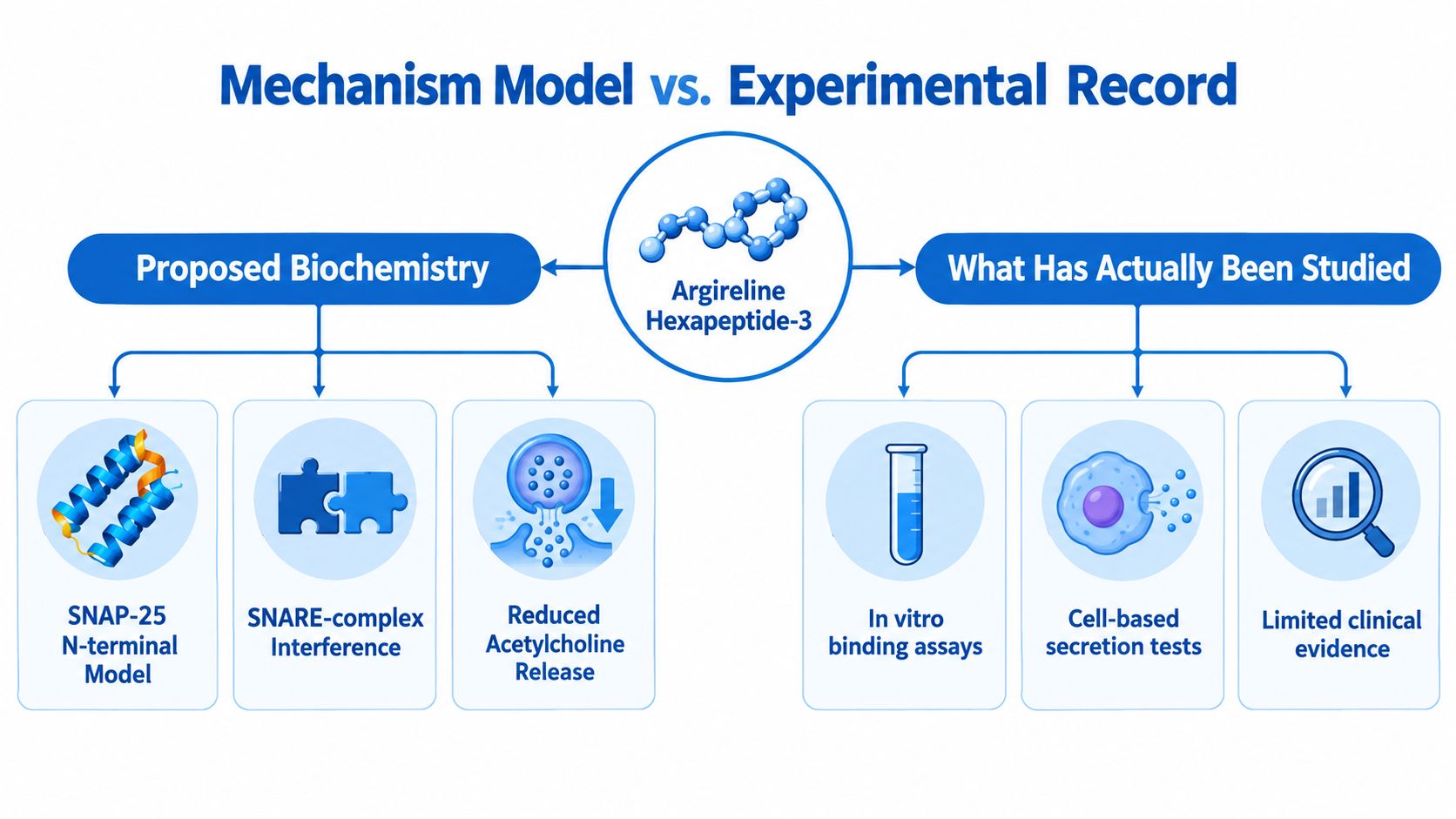
Argireline's proposed mechanism begins with SNAP-25, a protein involved in the release of neurotransmitter-containing vesicles. The peptide is modeled on the N-terminal region of SNAP-25. In the proposed model, it competes with SNAP-25-related interactions needed to assemble the SNARE complex, a protein machinery involved in vesicle fusion and release. That pathway provides a biochemical rationale for possible changes in acetylcholine release and downstream muscle contraction (mechanistic review).
The sequence of proposed events is plausible as a model: interference with SNARE-complex assembly could reduce acetylcholine-vesicle exocytosis, which could in turn reduce muscle contraction. But each “could” matters. A mechanism proposed from molecular interactions isn't the same as demonstrating that a topical formulation delivers enough intact peptide through skin to produce that effect in human tissue.
Separate the model from the evidence
The literature includes mechanistic and laboratory investigations, alongside topical studies that assess wrinkle-related outcomes. Those evidence types don't answer the same question. A binding or cell-based experiment can help examine a proposed molecular interaction or secretion pathway, but it can't by itself establish skin penetration, target engagement in facial tissue, or a clinical outcome. The clinical literature has also been described as limited and heterogeneous, with no direct comparison establishing equivalence between topical acetyl hexapeptide-8 and botulinum toxin (2025 dermatology review).
The delivery problem is central. Review literature notes that the peptide's relatively large size and hydrophilic character limit passage through the skin's lipophilic stratum corneum. Formulation and analytical verification therefore influence how researchers should interpret topical work. A result from a cream or gel-cream can't be transferred automatically to purified peptide in a different vehicle, or to an in-vitro assay that bypasses the skin barrier.
The careful conclusion is narrow: the SNAP-25/SNARE explanation is a proposed biochemical model, while the extent to which topical application inhibits muscle contraction remains incompletely understood. Researchers should describe the mechanism as a rationale under investigation, not as proven topical pharmacology.
Evidence Snapshot From Topical and Animal Studies
A wrinkle-response percentage belongs to a tested preparation, not to the name “Argireline.” Before comparing results under argireline hexapeptide-3 or acetyl hexapeptide-8, check the material identity and formulation. A shared name is a filing label, not proof that two experimental samples match.
The exploratory topical study reported in 2002 by Blanes-Mira and colleagues is an early efficacy signal discussed in a summary of the early study. That secondary account describes an oil-in-water emulsion and skin-topography measurements, but it cannot replace the primary publication for checking the numerical result or trial design. Its omission of sample size also limits interpretation. The reported improvement should therefore remain qualitative here.
For a later randomized, placebo-controlled study in Chinese participants, a review of topical neurocosmetic peptide evidence describes a 10% acetyl hexapeptide-8 preparation, 60 participants, and 48.9% total anti-wrinkle efficiency after four weeks, also reporting a 48.9% reduction in periorbital wrinkle depth versus 0% in placebo controls. “Total anti-wrinkle efficiency” and wrinkle-depth reduction should not be assumed to mean the same thing without checking the endpoint definitions in the original report.
A review of acetyl hexapeptide-8 evidence summarizes another daily-use evaluation reporting about 49% reduction in wrinkle depth over four weeks, alongside a separate evaluation of a 10% acetyl hexapeptide-8 gel-cream. The latter assessed hydration, elasticity, sebum, photographs, and investigator-rated appearance, reporting significant improvements and no documented allergic reactions during treatment. Those outcomes measure different aspects of skin response.
Keep the experimental models distinct
The human and murine study report distinguishes human wrinkle-related outcomes from increased type I collagen deposition observed histologically in murine skin. The animal finding supports investigation of tissue changes; it does not establish the corresponding human effect.
A formulation's response percentage is a study result, not a peptide potency specification.
For replication, record vehicle, nominal concentration, exposure period, application frequency, comparator, measurement method, and endpoint definition. On the laboratory specification sheet, distinguish peptide identity and amidated versus acetate form from clinical outcomes. The research-use-only documentation should identify the material being tested, rather than convert formulation findings into an efficacy guarantee.
Solubility, Storage, and Stability Guidance
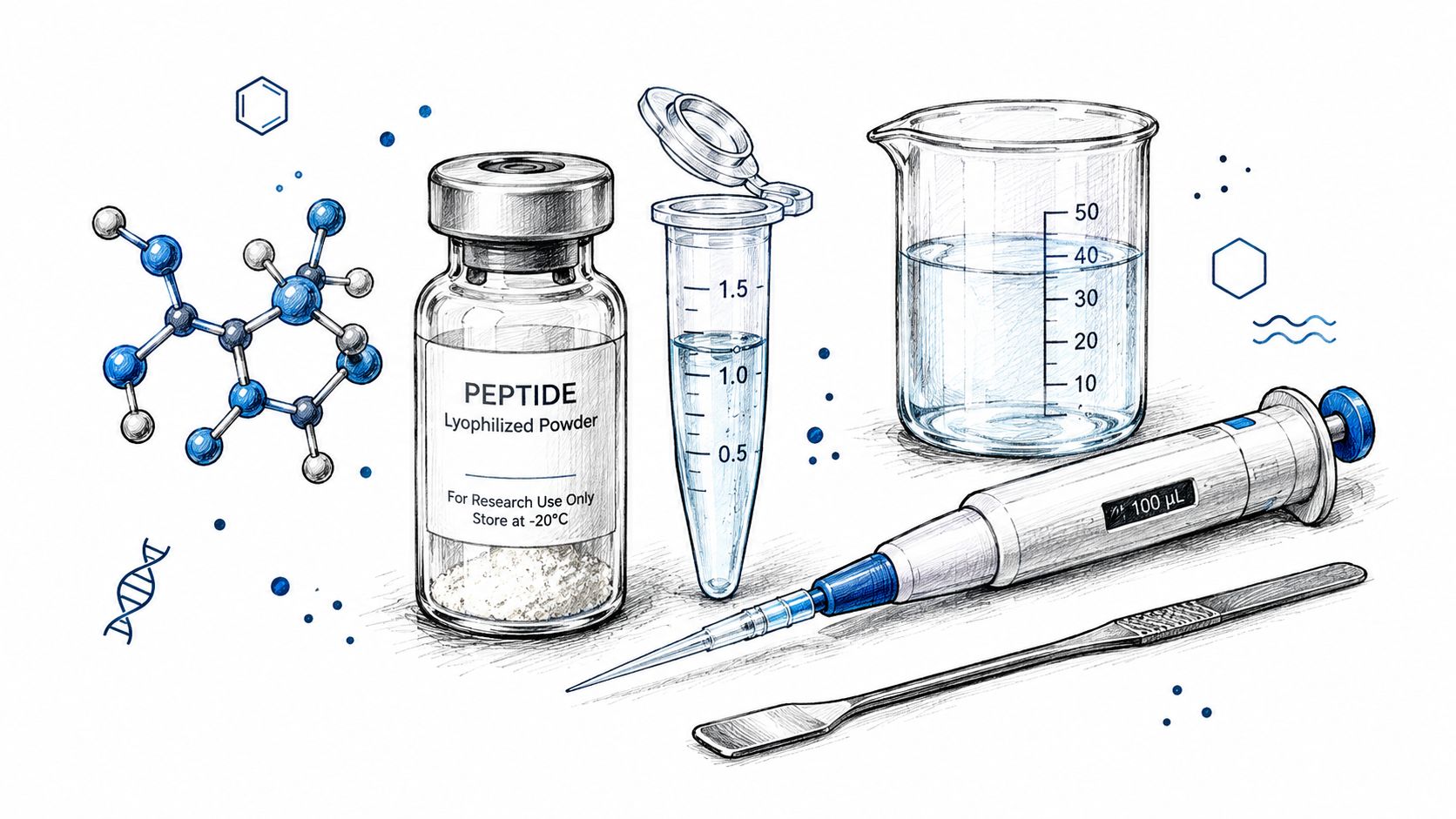
Laboratory handling records should begin with the physical material received and the supplier's stated form. A lyophilized peptide may require sample preparation for an analytical or experimental workflow, but the appropriate solvent and conditions depend on the batch documentation and the needs of the assay. Researchers should not assume that a vehicle suitable for one formulation will be suitable for every analytical method.
Water-based preparation and dilute acetic acid are commonly considered as laboratory vehicles for peptide sample preparation, but solubility should be confirmed for the specific material and intended experiment. Record the solvent, concentration prepared, appearance, and any conditions used to bring the sample into solution. If the assay requires a stock solution, document its preparation separately from any later working solution so the concentration and dilution history remain traceable.
Protect the analytical record
Storage guidance should come from the product specification and the laboratory's validated procedures. A commonly listed recommendation for peptide material is storage at approximately −20 °C, with protection from repeated freeze-thaw cycles. Because no verified stability timeframe is established here for a particular batch or solution, researchers shouldn't infer a fixed shelf life. Record the received condition, storage temperature, preparation date, and subsequent handling so that stability can be evaluated against the supplier's documentation and the experiment's analytical controls.
A practical bench record separates three states: unopened lyophilized material, prepared stock, and working solution. Each can have different handling and stability considerations. Label aliquots clearly where the workflow permits, minimize unnecessary temperature cycling, and retain the supplier's instructions with the batch record rather than relying on a generic peptide rule.
COA Fields and Research-Use-Only Compliance
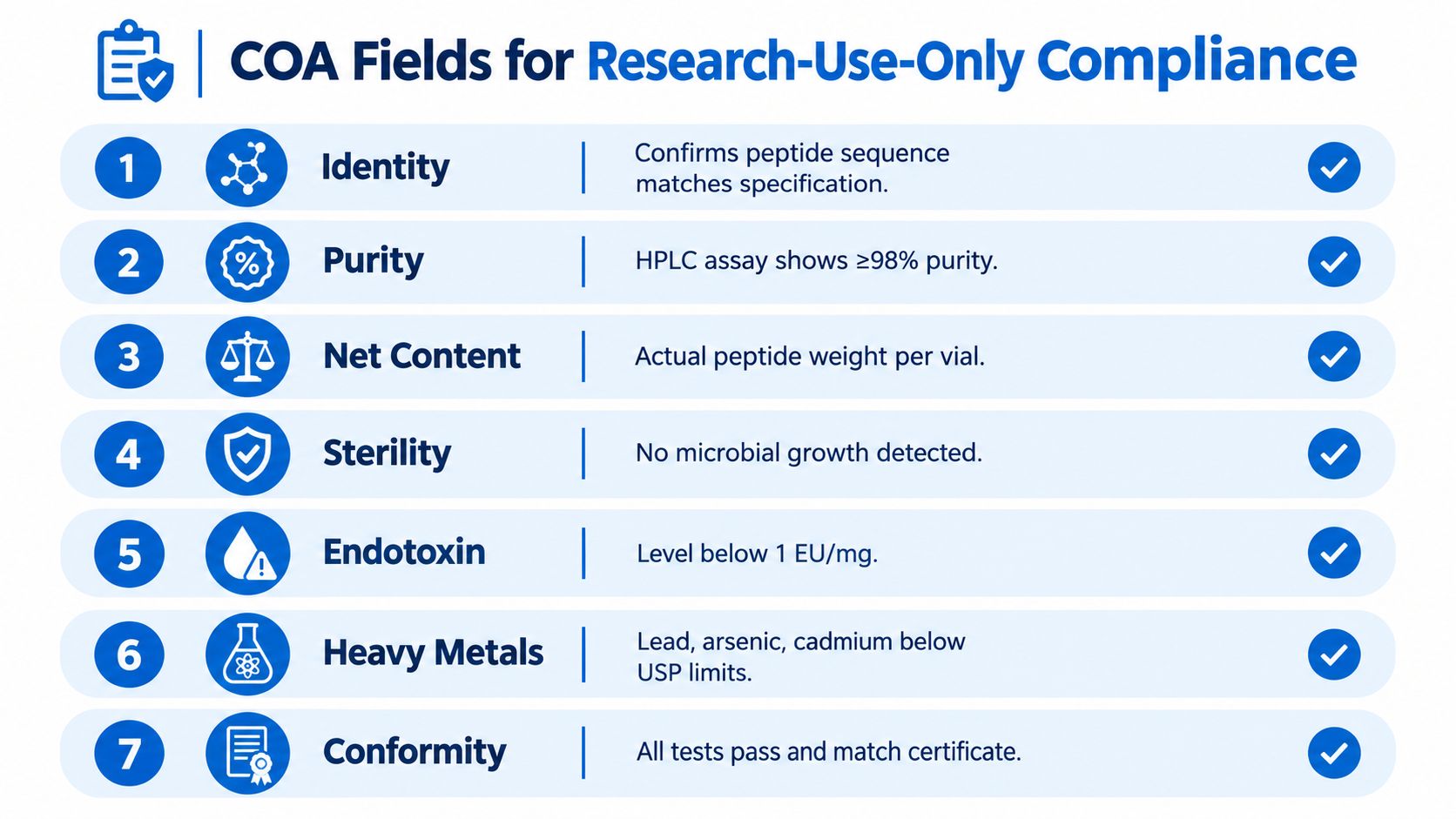
A certificate of analysis is useful only if it connects the material in the vial to the tested batch. Start with the lot number, chemical name, sequence, form, and identity method. Then check whether the COA reports purity, net content, sterility, endotoxin, heavy metals, and conformity results. The acceptance limits should come from the laboratory's own requirements and the supplier's stated specification, not from values copied from an unrelated product record.
Build a batch-level release check
- Identity: Confirm that the sequence and chemical form match the specification, and check what method supports the assignment.
- Purity: Review the chromatographic method and reported result. A purity percentage doesn't, by itself, prove the correct sequence or terminal chemistry.
- Net content: Verify the stated material quantity for the vial against the batch record.
- Sterility and endotoxin: Check whether these tests were performed and whether their reported outcomes meet the laboratory's requirements.
- Heavy metals: Review the named analytes and the basis for any stated limits.
- Conformity: Ensure that the recorded results agree with the certificate and the product specification.
A research-use-only (RUO) label is a boundary on intended use, not a substitute for quality review. Purchase eligibility, age verification, and compliance terms may form part of supplier procurement controls; each laboratory should also retain its own purchasing and approval records. Batch-linked COAs make it possible to trace an assay result back to the exact material tested.
For a practical overview of laboratory documentation and batch testing, consult the supplier's research testing information. Before release to an assay, preserve the lot number, sequence confirmation method, chromatographic purity, storage history, and any internal acceptance decision. That record helps another researcher understand what material entered the experiment and why the team accepted it.
Common Misconceptions Worth Setting Aside
A product label is a starting point, not a complete identity. “A 10% Argireline label means 10% pure peptide” is not a safe assumption: the percentage may describe a supplier solution or blend rather than the peptide itself. Two topical preparations cannot be compared reliably unless their composition, concentration basis, chemical form, and vehicle are clear. The name can also obscure whether a specification refers to acetyl hexapeptide-3 or -8, so check the documented sequence and terminal chemistry rather than relying on the label alone.
“The mechanism proves a topical effect equivalent to botulinum toxin.” The SNAP-25/SNARE model gives researchers a rationale to investigate, much as a proposed pathway guides an experiment. It does not establish equivalent clinical performance. The reviewed literature provides no direct clinical comparison supporting that claim, and skin penetration and target engagement remain uncertain.
“A cosmetic safety conclusion applies to any research concentration.” The CIR panel concluded that available data support cosmetic use of acetyl hexapeptide-8 amide up to 0.005%; it found the data insufficient to determine safety above that concentration under intended cosmetic conditions. As noted earlier, that assessment does not prove that higher concentrations are unsafe in every laboratory context. It does limit how far a cosmetic-use conclusion can be extended.
The participant pool also narrows how broadly findings can be generalized. Per the 2025 JDD literature review cited earlier, participants were predominantly female, 97%; the review also notes variation in formulations and statistical significance. Treat cosmetic safety, laboratory research, and clinical efficacy as separate questions. A clearly stated research-use-only policy defines intended research use, but cannot replace study-specific evaluation of the evidence or material.
Practical Takeaways for Research Procurement and Bench Use
A reproducible handoff begins with the name on the request and ends with a traceable batch record. Use this checklist before material enters an assay:
- Resolve the name: Confirm whether the specification identifies acetyl hexapeptide-3 or -8, then reconcile that label with the documented sequence and terminal modifications.
- Verify identity: Review batch-specific identity evidence, including an intact-mass LC–MS or high-resolution MS result where available, alongside chromatographic purity.
- Record the form: Keep the CAS number, formula, molecular mass, and salt or acetate status together so mass calculations use the correct chemical form.
- Preserve handling history: Log receipt condition, storage history, sample preparation, and any relevant temperature cycling.
- Release against criteria: Compare COA fields with internal acceptance requirements, then record who approved the batch and why.
- Keep the boundary visible: Attach the research-use-only disclaimer to procurement and assay records.
The next concrete step is to request the batch-specific COA and compare its sequence, chemical form, and mass information with the laboratory's specification before purchasing or releasing material.
For laboratory research use only. Not for human or veterinary use. Not a drug, food, or cosmetic. Not evaluated by the FDA. Not intended to diagnose, treat, cure, or prevent any disease. By purchasing, you certify you are a qualified researcher and agree to use this product solely for in-vitro laboratory research.
Pro Tec Pep supplies research-use-only compounds with batch-specific documentation intended to support laboratory procurement and material verification. Researchers evaluating Argireline should review the product specification and applicable batch records, then visit Pro Tec Pep to find research materials and documentation.