AOD 9604 5mg Research Reference Guide
Complete research reference for AOD 9604 5mg vials covering specifications, reconstitution, storage, and COA verification for laboratory workflows.
A sealed AOD 9604 5mg vial is sitting at the receiving bench. The label looks simple, but the research decision starts before the crimp seal is broken. The vial size, molecular identity, batch record, cold-chain history, certificate of analysis, and intended assay all need to agree.
AOD 9604 is a synthetic 16-amino-acid analogue of the C-terminal lipolytic region of human growth hormone, associated with residues 176–191 and an added N-terminal tyrosine in research descriptions. PubChem lists the formula as C78H123N23O23S2 and the molecular weight as 1815.1 g/mol. Those details make the 5 mg presentation a defined laboratory reagent, not a cue for human administration. PubChem's AOD 9604 record provides the core chemical identity used for analytical planning.
What the AOD 9604 5mg Vial Represents in a Research Workflow
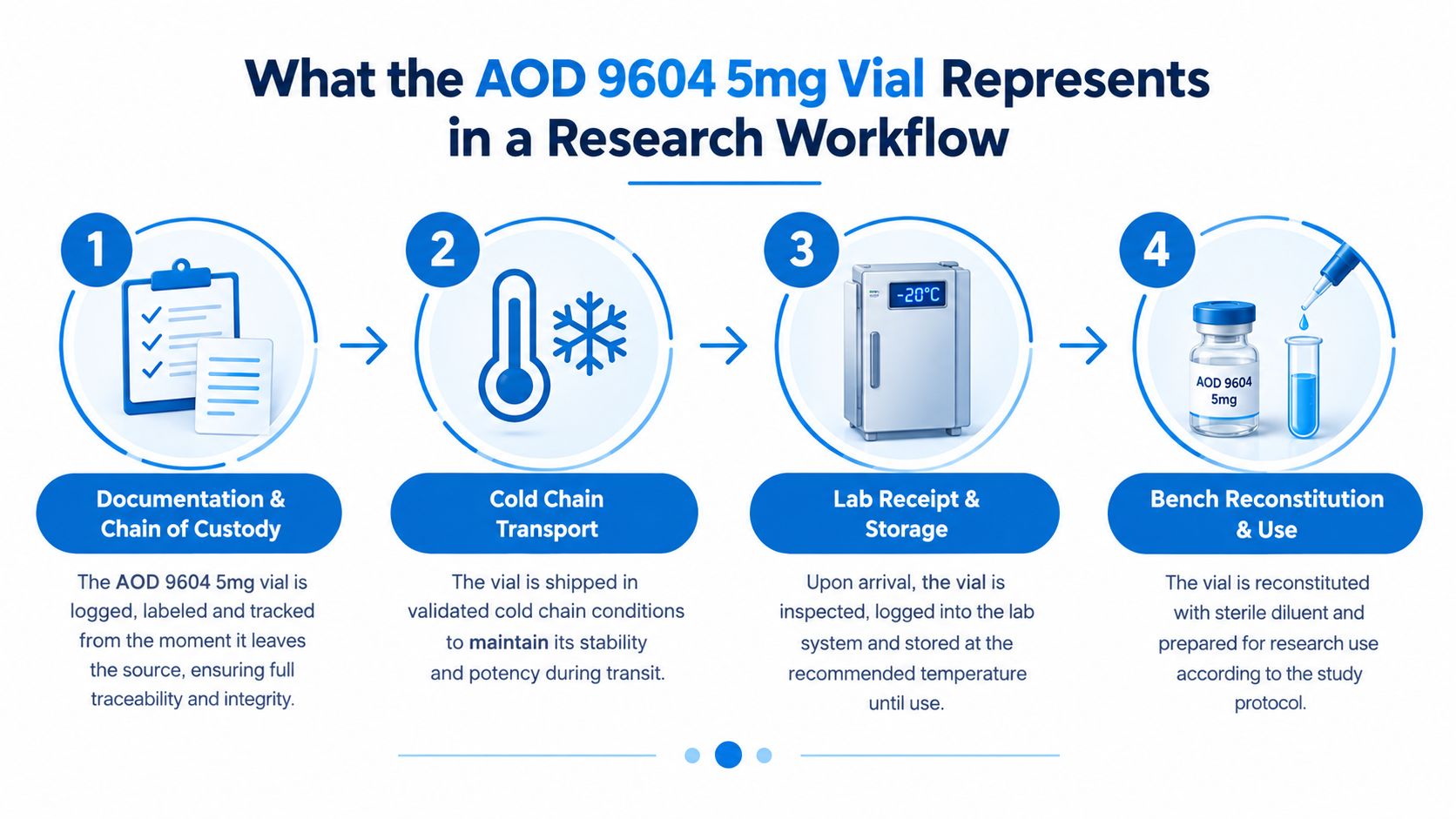
At the receiving bench, a sealed AOD 9604 5mg vial is a documentation object as much as a container. Its label, purchase record, shipping history, storage requirement, batch-specific COA, and intended assay should form one consistent record before the crimp seal is broken. The 5 mg designation describes the supplied research quantity. It does not prescribe a human-use amount.
A controlled receipt begins with quarantine. Staff record the lot number and inspect the vial, seal, label, and outer packaging. They then compare the physical details with the order, retrieve the exact COA, and review transport conditions before assigning storage. This sequence is deliberately routine because a mismatch discovered after opening can make the assay result harder to interpret.
Published work includes human tolerability and metabolic research, while the compound's late-stage obesity program did not establish statistically significant standalone efficacy. That history supports careful interpretation of the reagent and makes supplier documentation more informative than promotional wording. The clinical and translational review in the Journal of Functional Medicine describes the experimental background and solid-phase peptide synthesis history.
A practical receipt sequence
- Quarantine first: Keep the vial outside active inventory until the lot number, packaging, and shipping condition are recorded.
- Cross-check the label: Confirm the compound name, stated quantity, lot identifier, formulation state, and storage notation.
- Reconcile the COA: Match the lot to identity, purity, content, residuals, water, microbial, endotoxin, and metals results.
- Allocate storage: Place the sealed lyophilized vial in the temperature-controlled location specified by the supplier and laboratory quality system.
Practical rule: Treat the vial as analytically available only after the physical label and batch documentation agree.
That record should remain attached to the material through reconstitution, aliquoting, and inventory checks. Each working tube needs the compound name, lot, concentration, preparation date, solvent, and responsible operator. These entries function like a chain of custody: if an assay fails, the laboratory can separate a biological finding from a preparation, storage, or documentation problem.
Molecular Identity and Specification Block
Before the vial is opened, its label should connect to one defined molecular record. PubChem lists AOD 9604 with the molecular formula C78H123N23O23S2 and an average molecular weight of 1815.1 g/mol. Research descriptions identify it as a synthetic fragment associated with the human growth hormone C-terminal region, commonly linked to residues 176–191 and an N-terminal tyrosine modification. The Peptide Science Institute reference describes that structure, while the PubChem compound entry provides the formula and molecular-weight record.
The specification sheet must separate average molecular weight from the mass expected in a high-resolution mass spectrum. Average molecular weight is a calculated compositional value. High-resolution MS instead examines charge states, isotope patterns, and the measured mass of the ionized material. HPLC answers a different question by separating chromatographic components. Identity review is therefore strongest when MS and HPLC results are read against the declared sequence, modification, and salt or counter-ion form.
The label should also define what 5 mg represents. It may mean net peptide content, a salt-adjusted amount, or total material. That distinction changes how the quantity is recorded and how concentration calculations are checked. Any stated acetylation, amidation, counter-ion, or other terminal modification must match across the product page, specification sheet, COA, and analytical result. A sequence or terminal-chemistry mismatch can alter the expected mass even when the product name is unchanged.
AOD 9604 Specification Block
| Field | Expected Value | Verification Method |
|---|---|---|
| Compound identity | AOD 9604, synthetic hGH-derived lipolytic fragment | Supplier documentation, MS, HPLC |
| Structural description | 16-amino-acid analogue associated with hGH residues 176–191 and an N-terminal tyrosine in research descriptions | Sequence review and MS |
| Molecular formula | C78H123N23O23S2 | Formula check against PubChem and supplier record |
| Average molecular weight | 1815.1 g/mol | PubChem record, calculated mass |
| Monoisotopic mass | Must be calculated from the declared sequence and modifications | High-resolution MS |
| Sequence and terminal chemistry | Must match the batch specification, including any stated acetylation or amidation | Sequence record, MS/MS where available |
| Salt or counter-ion form | Must be stated if present | COA and product specification |
| Purity | Batch-specific value with method and chromatogram | Reverse-phase HPLC |
| Content | Net peptide amount, distinguished from gross vial mass | Amino acid analysis or validated UV method |
A predicted extinction coefficient can support planning, but it does not verify concentration by itself. The coefficient depends on the declared sequence and analytical assumptions, while short peptides may lose material through adsorption or incomplete recovery during preparation. For quantitative assays, retain the supplier's calculation, record the wavelength and path length, and confirm concentration with a method suited to the assay.
Reading the Product Detail Page Like a Lab Scientist

A researcher receives a sealed vial, its product page, and a COA. Before opening it, they should be able to trace each label statement to a document or test result. The page is useful when it functions as a controlled specification record rather than a sales summary.
Start with net peptide content. “5 mg” should identify the amount of AOD 9604, yet the page may not state whether the figure describes peptide alone, total powder, or a salt-adjusted quantity. The COA should resolve that distinction. Purity also requires a method, a batch identifier, and a clear measure. “High purity” has little analytical value unless the page identifies reverse-phase HPLC, reports the batch result, and states whether the value is area percent or another metric.
Screenshot from https://example.com/aod-9604-5mg-product-page.png
The fields that deserve a close read
- Net content: Separates the intended peptide amount from the stopper, glass, moisture, or excipients.
- HPLC purity: Shows the acceptance criterion and the chromatographic method used to obtain it.
- Appearance: Provides a physical reference for the supplied cake or powder.
- Endotoxin ceiling: Defines the stated limit for sensitive biological assays.
- Residual solvents: Indicates whether detectable process solvents remain.
- Storage condition: Specifies how the sealed material should be protected after receipt.
Treat these fields like checkpoints on a chain of custody. A missing method, undefined quantity, or absent batch reference leaves the specification incomplete and should trigger a request for clarification before the vial enters the workflow.
A live product page can change after purchase. The purchasing record should therefore retain a PDF export or screenshot, the capture date, and the batch documents shipped with the vial. This archive preserves the specification that applied when the material was ordered.
The page also does not establish clinical performance. AOD 9604's larger obesity program enrolled 536 subjects over 24 weeks and did not show statistically significant weight loss versus placebo, according to the clinical review available through the National Library of Medicine. The product page documents what was supplied. It does not demonstrate a human endpoint.
Reconstitution Notes for Laboratory Sample Prep
Reconstitution is a laboratory sample-preparation decision, not a human administration step. For a 5 mg lyophilized vial, the operator first checks the COA for net peptide content, reviews the downstream assay's solvent tolerance, and calculates the required volume from the actual material represented by the documentation.
Sterile water or bacteriostatic water is commonly selected for aqueous laboratory preparation. If dissolution is limited, a dilute acetic acid system or an analytical solvent such as acetonitrile may be appropriate for a validated analytical workflow. The solvent has to fit the assay. Benzyl alcohol from bacteriostatic water, for example, may be unsuitable for some sensitive cell systems, while an acidic solvent may require later dilution into the assay buffer.
A controlled preparation sequence
The vial should be allowed to equilibrate in a controlled environment before opening, which reduces condensation risk. The operator then records the solvent name, batch or lot, preparation date, target concentration, and responsible analyst before adding liquid.
Solvent should contact the vial wall rather than strike the lyophilized cake directly. Gentle swirling or slow rotation supports dissolution, while vigorous vortexing can introduce bubbles, foam, and unnecessary mechanical stress. A clear solution is generally expected, but any visible particles, persistent cloudiness, or unexplained color change should trigger a hold and review of the COA and solvent compatibility.
The concentration calculation should use the molecular weight documented for the declared form. For example, the relationship is:
molar concentration = mass concentration ÷ molecular weight
The laboratory should avoid treating the nominal 5 mg as analytically exact if the COA reports a different net peptide content. Any adjustment belongs in the notebook and in the assay calculation sheet.
Reconstitution Parameters for a 5 mg AOD 9604 Vial
| Target Concentration | Solvent Volume | Approx. Total Volume | Typical Use |
|---|---|---|---|
| 0.1 mg/mL | 50 mL | Approximately 50 mL | Broad screening or low-concentration exploratory work |
| 0.5 mg/mL | 10 mL | Approximately 10 mL | General assay stock preparation |
| 1 mg/mL | 5 mL | Approximately 5 mL | Concentrated master stock |
| 2.5 mg/mL | 2 mL | Approximately 2 mL | Small-volume stock, only if solubility is confirmed |
| 5 mg/mL | 1 mL | Approximately 1 mL | High-concentration analytical preparation, subject to validation |
The table gives nominal calculations from 5 mg and doesn't override the batch COA. The operator must also account for dead volume, adsorption to plastics, filter recovery, and any dilution step before the sample enters an assay. Aliquoting into labeled working stocks usually gives better control than repeatedly opening one master tube.
Storage Stability and Cold-Chain Planning
A shipment arrives with the vial intact, yet the temperature record is incomplete. The correct action is to quarantine the material, not place it directly into inventory. For a 5 mg AOD 9604 vial, storage decisions begin with the documented state of the material and the evidence supporting that state.
The sealed lyophilized powder and the reconstituted solution require separate stability plans. Powder should be protected from moisture, light, and temperature excursions. Once liquid is prepared, hydrolysis, oxidation, adsorption, and microbial contamination become more relevant.
The receiving record should capture the shipping condition before storage. Record arrival temperature, inspect the stopper and vial for damage, and review any shipping indicator or cold-chain documentation. An intact vial with interpretable records can then be assigned to the laboratory's validated storage location. If the records are missing or the container is damaged, hold the lot for review against the supplier documentation.
Sealed powder and prepared solution
Short-term access to sealed powder may be managed under refrigerated conditions. Longer storage commonly uses frozen conditions when the supplier's documentation supports that choice. Reconstituted material should be divided into labeled aliquots sized for the planned assays, limiting handling and freeze-thaw exposure.
The laboratory's own stability study takes precedence over generic storage language. A working solution can behave differently in sterile water, buffered saline, acidic solvent, or a cell-culture matrix. Methionine-containing peptides require attention to oxidation, while non-sterile buffers raise microbial risk. The solvent, container, preparation date, and storage location should therefore appear in the sample record.
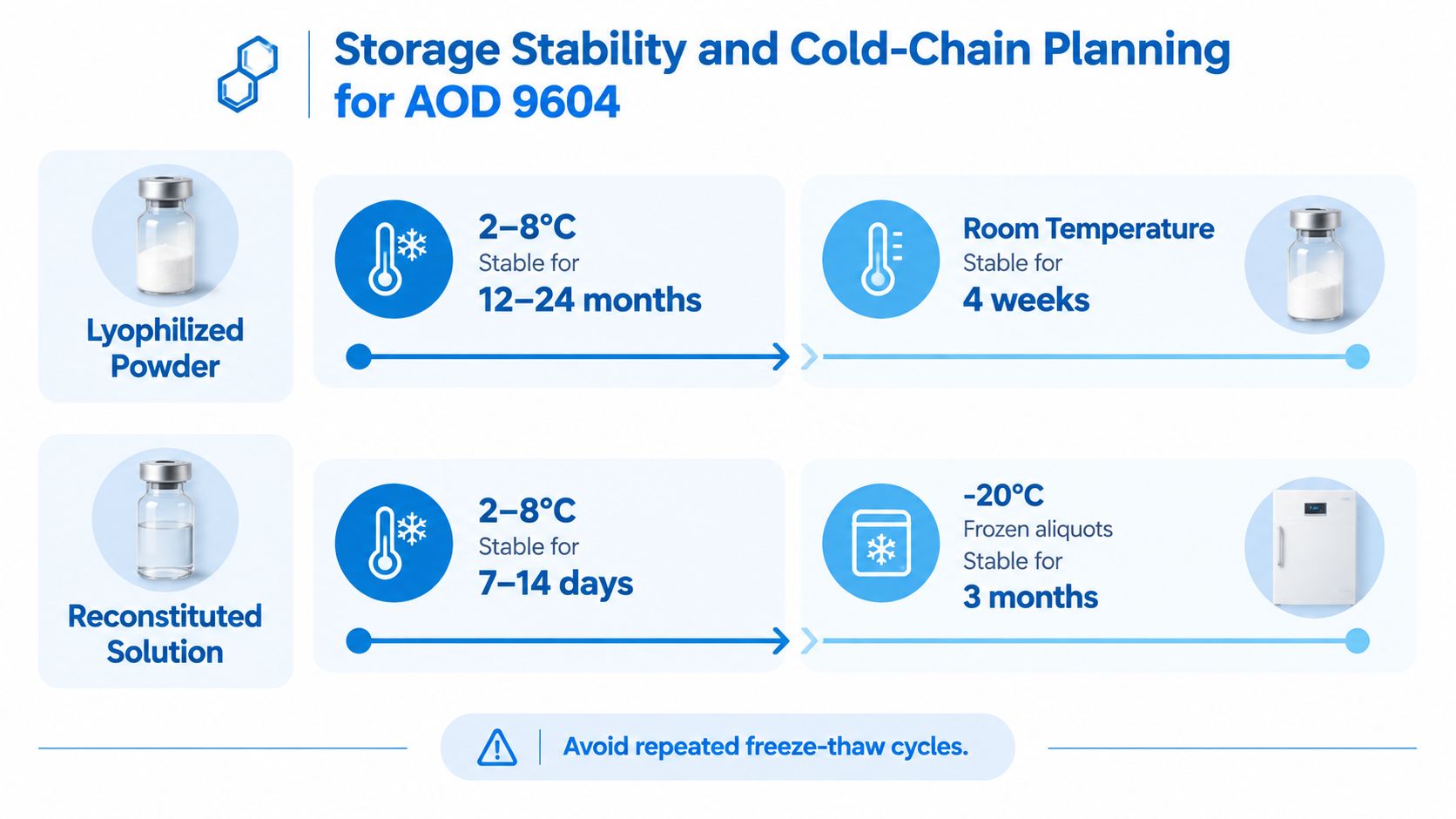
Cold-chain record: Temperature history is part of the sample's identity. A lot that arrives warm, damaged, or without interpretable shipping records should remain quarantined until reviewed.
Repeated freeze-thaw events may change peptide recovery and aggregation behavior. Set a local maximum, record every event, and keep a repeatedly opened stock out of long-term inventory. Literature on peptide handling also supports protecting lyophilized material from moisture and temperature excursions, while treating reconstituted material as a short-life, aliquoted reagent.
The following video provides visual orientation to laboratory peptide handling concepts:
Inside the COA The Seven Test Categories Explained
A certificate of analysis is a batch-specific analytical report. It should connect the vial to defined methods, acceptance criteria, observed results, and a clear disposition. A generic certificate without a matching lot number cannot establish what was tested.
Seven Standard COA Test Categories for Research Peptides
| COA Category | Analytical Method | What It Verifies | Typical Acceptance |
|---|---|---|---|
| Identity | Mass spectrometry or amino acid analysis | Whether the material matches the declared peptide | Matches expected identity |
| Purity | Reverse-phase HPLC with chromatogram | Main peak relative to related substances | Meets the supplier's stated purity limit |
| Peptide content | Amino acid analysis or validated UV quantification | Actual peptide amount in the vial | Matches the declared content range |
| Residual solvents | Gas chromatography | Process solvent residues | Within the stated limit |
| Water content | Karl Fischer analysis | Moisture in the material | Within the stated limit |
| Microbial and endotoxin status | Microbial limits testing and LAL | Biological contamination relevant to research handling | Meets the listed microbial and endotoxin criteria |
| Heavy metals | ICP-based analysis | Elemental contaminants | Within the stated metals specification |
The COA's columns need careful reading. Specification describes the allowed range, result records the batch finding, and status indicates whether the finding passed. A chromatogram should be traceable to the reported HPLC result, and an MS trace should support the identity line rather than appear as an unrelated attachment.
Purity isn't the same as content. A sample can show a strong principal HPLC peak while still requiring a separate content measurement to determine how much peptide is present. That distinction matters when the laboratory prepares quantitative stocks or compares results between lots.
Any out-of-range result should pause downstream assay work. Purity and endotoxin deserve particular attention, but an unexpected water result, residual solvent finding, or missing identity trace can also affect interpretation. The responsible scientist should request clarification, document the decision, and preserve the vial's chain of custody.
Verifying Batch Documentation Before the Vial Is Opened
The physical vial, batch COA, and product detail page form a three-part record. Verification should happen while the vial remains sealed because an intact container gives the supplier and laboratory a clean reference point if a discrepancy appears.
The first comparison is the lot number. If the COA describes a different lot from the label, the document doesn't belong to the vial, even if the compound name and nominal quantity match. Manufacturing date, retest or expiration information, net peptide content, vial configuration, formulation state, and storage requirements should also align.
Vial Label vs. COA vs. Product Page Verification
| Field | Vial Label | Batch COA | Product Page |
|---|---|---|---|
| Compound name | Printed name and synonym | Declared test article | Listed product identity |
| Lot number | Physical identifier | Batch identifier | Current or linked batch reference |
| Net content | Stated vial amount | Measured or declared content | Product presentation |
| Manufacturing date | May be printed | Batch record field | May be listed or omitted |
| Retest or expiration | Printed if supplied | Formal validity field | Product-level guidance |
| Formulation state | Lyophilized or other form | Sample description | Product specification |
| Purity | Usually not shown in full | Result and chromatogram | Posted benchmark or range |
| Identity trace | Usually absent | MS or related evidence | Linked documentation |
| Storage | Label notation | Stability or storage statement | Shipping and storage guidance |
Misprinted net weight, an absent mass-spectrum trace, an unexplained purity difference, or a product page that conflicts with the COA should lead to quarantine. The operator shouldn't open the vial to “see whether it looks right.” Appearance cannot confirm sequence, purity, endotoxin, or net content.
A useful record includes a dated product-page capture, the downloaded COA, photographs of the intact vial, the receiving temperature, and the name of the reviewer. That package supports internal audits and makes vendor communication precise.
The supplier should be contacted before any sample preparation begins. If the discrepancy cannot be resolved from controlled documentation, the laboratory should retain the vial in quarantine and avoid assigning it to an active experiment.
Why 5 mg Sits Above the Tested Human Dose Range
The 5 mg presentation is a packaging unit, not a human dosing cue. Human studies included a 12-week randomized trial in which the reported 1 mg-per-day group lost an average of 2.6 kg compared with 0.8 kg for placebo, while a later dose-escalation design included daily arms of 1, 5, 10, 20, and 30 mg. The larger Phase IIb program enrolled 536 obese subjects over 24 weeks and did not show statistically significant weight loss versus placebo, after which development was terminated in 2007. The FDA-hosted regulatory review documents the studied dose designs and development history.
Those facts create an important distinction. A vial's total peptide content can exceed the amount associated with a particular clinical study period, yet that doesn't make the vial a clinical product or establish a protocol. In a laboratory, the same material may be distributed across plates, master stocks, analytical injections, or replicate assays according to validated experimental design.
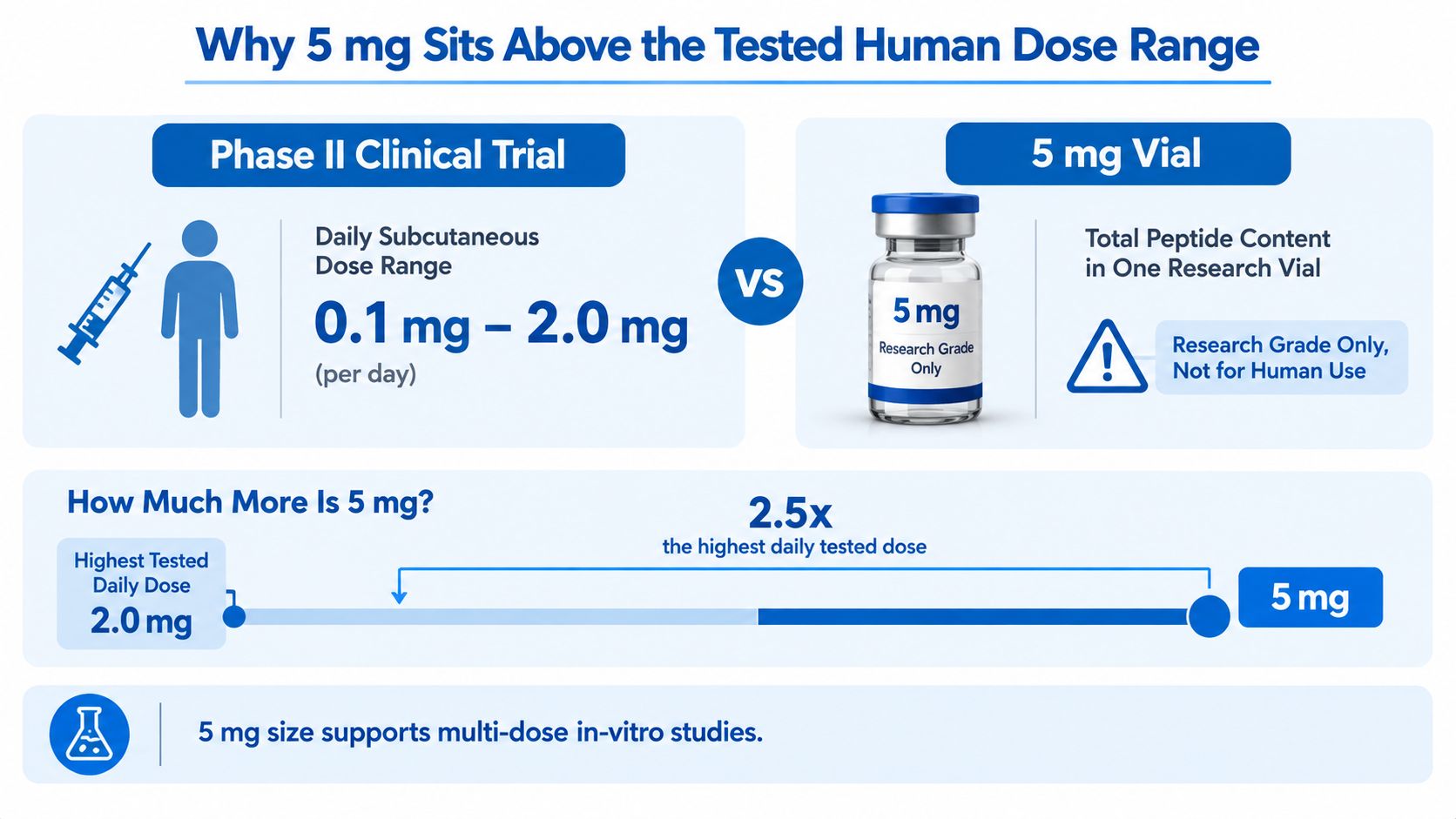
A researcher should separate amount per vial, concentration in a prepared stock, and concentration delivered to an assay. These are different variables with different documentation requirements. The 5 mg label describes total material supplied, while the assay plan determines how that material is allocated.
The historical record also explains why the compound remains a research-use material rather than an approved obesity therapy in major markets. Early signals and tolerability findings don't replace a successful key endpoint, and packaging must not be read as evidence of clinical efficacy.
Framing AOD 9604 as a Probe of Adipose Biology
AOD 9604 is most informative when treated as a probe of adipose biology, not as a mature anti-obesity candidate. Mechanistic and preclinical literature describes lipolytic activity in adipose tissue and a β3-adrenergic receptor-linked signaling framework, while the human development record contains a clear failure to establish significant standalone weight loss in the key obesity program. The mechanistic overview in PeptidePedia presents the research framing around adipose lipolysis and β3-adrenergic signaling.
That contrast should shape the assay question. A cell-based study might examine lipid breakdown, receptor-linked signaling, or changes in adipocyte phenotype. An animal study might evaluate tissue distribution, adipose remodeling, or metabolic markers. A translational comparison could then ask why a plausible pathway did not translate into a reliable weight-loss endpoint.
A negative clinical endpoint narrows the question. It doesn't erase the molecule's value as a controlled experimental probe.
The compound's identity as a modified growth hormone fragment matters here. It was designed around a lipolytic region rather than the complete hormone, which lets researchers separate fragment-specific metabolic signaling from the broader biology of intact growth hormone. That separation is experimentally useful, but it shouldn't be expanded into claims that the fragment has established therapeutic performance.
A strong study design should therefore define the endpoint before selecting the concentration range. The laboratory can compare vehicle, peptide, pathway antagonist, and positive-control conditions, then interpret lipid metabolism results alongside peptide identity and stability data. The unanswered question isn't whether AOD 9604 “reduces fat.” It is which experimental contexts, endpoints, and formulation variables best explain the gap between mechanistic plausibility and late-stage human outcome. The translational discussion in the Journal of Functional Medicine addresses that evidence gap.
Quick Reference Card for the Bench
The bench card should stay beside the analytical balance, pipettes, freezer log, and sample-preparation record. It isn't a substitute for the current COA. Its purpose is to prevent the operator from searching through multiple documents for recurring fields during a controlled laboratory workflow.
The expected product presentation is 5 mg of stated peptide content, subject to reconciliation with the batch COA. Supplier documentation may identify a greater-than-98% HPLC purity benchmark, but the batch result, chromatogram, method, and acceptance criterion must be reviewed together rather than copied into an assay sheet without verification.
Bench Quick Reference, AOD 9604 5 mg
| Parameter | Expected Value |
|---|---|
| Research identity | AOD 9604, synthetic hGH-derived lipolytic fragment |
| Stated vial content | 5 mg, confirm net peptide content on the COA |
| Molecular formula | C78H123N23O23S2 |
| Molecular weight | 1815.1 g/mol average molecular weight |
| Purity documentation | Supplier-stated HPLC benchmark, with batch result and chromatogram |
| Primary aqueous diluent | Sterile water or bacteriostatic water, subject to assay compatibility |
| Analytical alternative | Dilute acetic acid or acetonitrile where validated solubility requires it |
| Working concentration | Laboratory-selected range based on assay design and solubility validation |
| Lyophilized storage | Follow the supplier's sealed-vial storage specification |
| Reconstituted storage | Aliquot and manage according to validated short-term stability data |
| Freeze-thaw record | Record every event and avoid unnecessary repeat cycling |
| COA identifiers | Batch number, lot ID, manufacturing date, retest interval, and assay results |
| Seven assay categories | Identity, purity, content, residual solvents, water, microbial or endotoxin status, heavy metals |
The working range should come from the experimental design, not from the vial label. Concentration calculations should use the declared molecular weight and the actual net content documented for that batch. If a cell-based assay is involved, solvent controls and filter-recovery checks should be included where relevant.
For laboratories comparing suppliers, Pro Tec Pep provides product-level specifications and batch-linked COA access for research compounds, including AOD 9604, with ordering and cold-chain options described around laboratory procurement workflows. Researchers can review the available documentation and research-use terms by visiting Pro Tec Pep.
For laboratory research use only. Not for human or veterinary use. Not a drug, food, or cosmetic. Not evaluated by the FDA. Not intended to diagnose, treat, cure, or prevent any disease. By purchasing, you certify you are a qualified researcher and agree to use this product solely for in-vitro laboratory research.