Acetic Acid for Reconstitution: A Laboratory Research Guide
Learn when and why to use acetic acid for reconstitution in lab research, including concentrations, compatibility testing, and stability protocols.
0.6% acetic acid in sterile water gives a pH near 3, and that is why it's commonly used when a lyophilized peptide stays cloudy in plain water. The catch is simple, though, and it matters more than the solvent itself, each peptide has to be validated before a full batch is committed.
A cloudy vial on the bench creates a familiar temptation. The easiest move is to reach for the most acidic option and hope the powder clears, but solvent choice changes charge state, aggregation behavior, and the numbers that come out of the assay later. That is why acetic acid for reconstitution is a compatibility problem first and a dissolution problem second.
The Solvent Selection Challenge in Peptide Research
A graduate student opens a vial, adds sterile water, and watches the material turn into a stubborn haze instead of a clear solution. The instinct is to fix the cloudiness fast, but the key question is not whether acid can make the vial look better, it's whether that solvent leaves the peptide chemically intact and analytically readable.
Why the first solvent choice matters
Peptide researchers run into this when a sequence resists neutral water, especially if the material sits near its isoelectric point or has a charge pattern that encourages self-association. Acetic acid enters the conversation because dilute acid can shift that balance, but the solvent is still an experimental variable, not a housekeeping detail. The decision affects solubility, aggregation, and whatever downstream assay comes next.
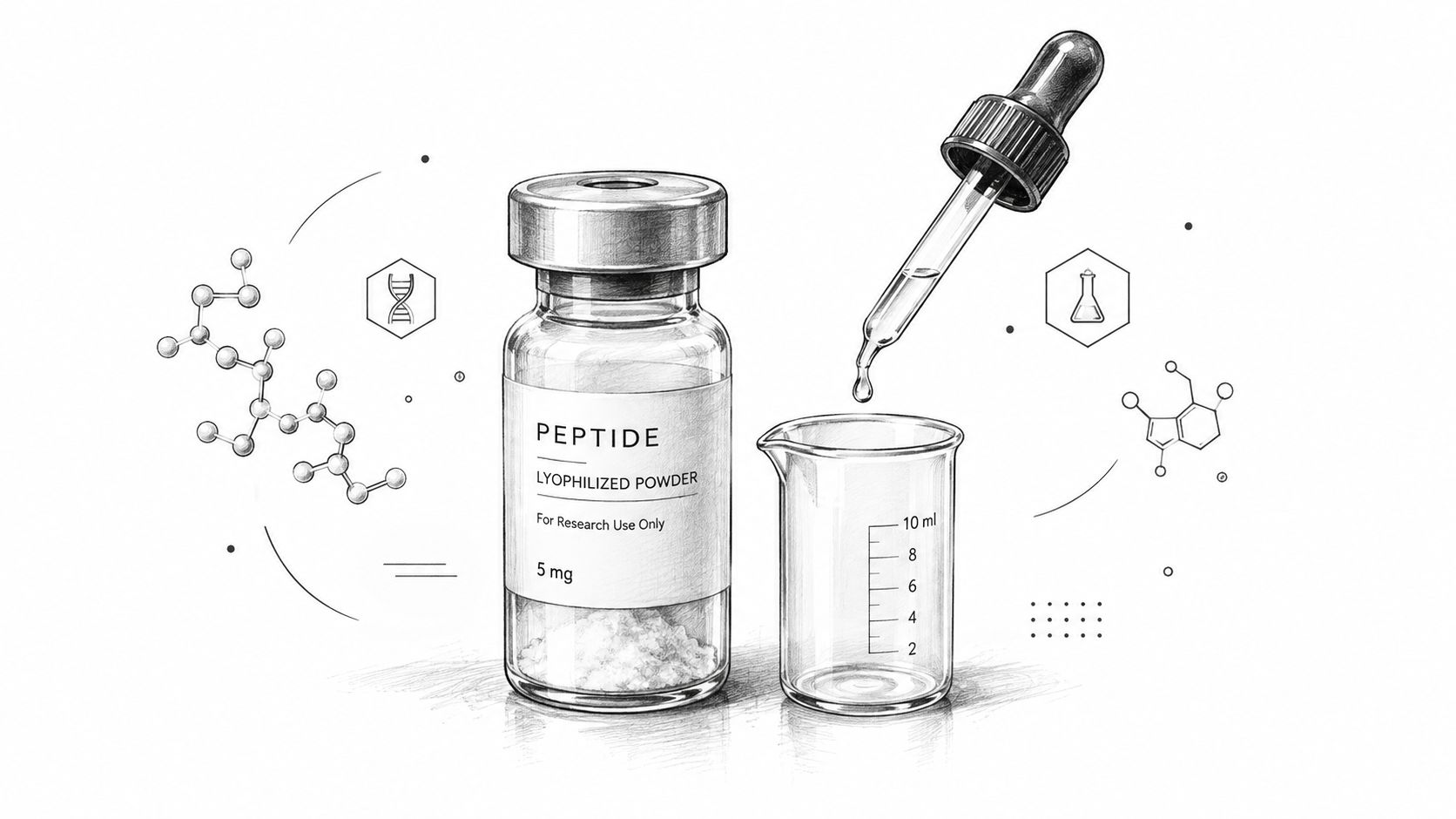
The history of acetic acid helps explain why it became a practical lab solvent at all. Its use in acidic aqueous mixtures has a long pedigree, and contemporary industrial production now comes mostly from methanol carbonylation, with biological production still important for vinegar manufacturing acetic acid overview.
Practical rule: visual clarity is only a starting point. A solution that looks better can still fail chemically, so the solvent has to be chosen with the assay in mind.
A decision point, not a reflex
Acetic acid belongs in the workflow when the peptide documentation or early screening suggests that a low-pH environment may help the material dissolve. It does not replace sterile water, buffered media, or another validated diluent just because a vial is cloudy. The safer habit is to treat the solvent as a decision that deserves a record, not a reflex that happens on autopilot.
That mindset matters because the wrong guess can distort the readout long before any chemistry looks obviously wrong. A better habit is to compare small-scale conditions first, then move forward only when the material, the solvent, and the assay all agree. For a broader library context, the compound research resources at Pro Tec Pep show how documentation-driven workflows are organized around batch-level verification.
Why Acetic Acid Improves Solubility for Some Peptides
Acetic acid works because it changes the electrical environment around the peptide. It is a weak monoprotic carboxylic acid with a reported pKa of 4.76 at 25 degrees Celsius, and it is fully miscible with water pKa and miscibility. In plain terms, that means it can lower pH without behaving like a harsh, immiscible solvent.
What the acid is doing at the molecular level
At a solution pH around 3, basic side chains on a peptide carry more positive charge than they would in near-neutral water. That extra protonation can reduce peptide–peptide attraction and weaken the hydrophobic clustering that often causes visible precipitation. The result is not magic, just a more favorable charge balance for certain sequences.
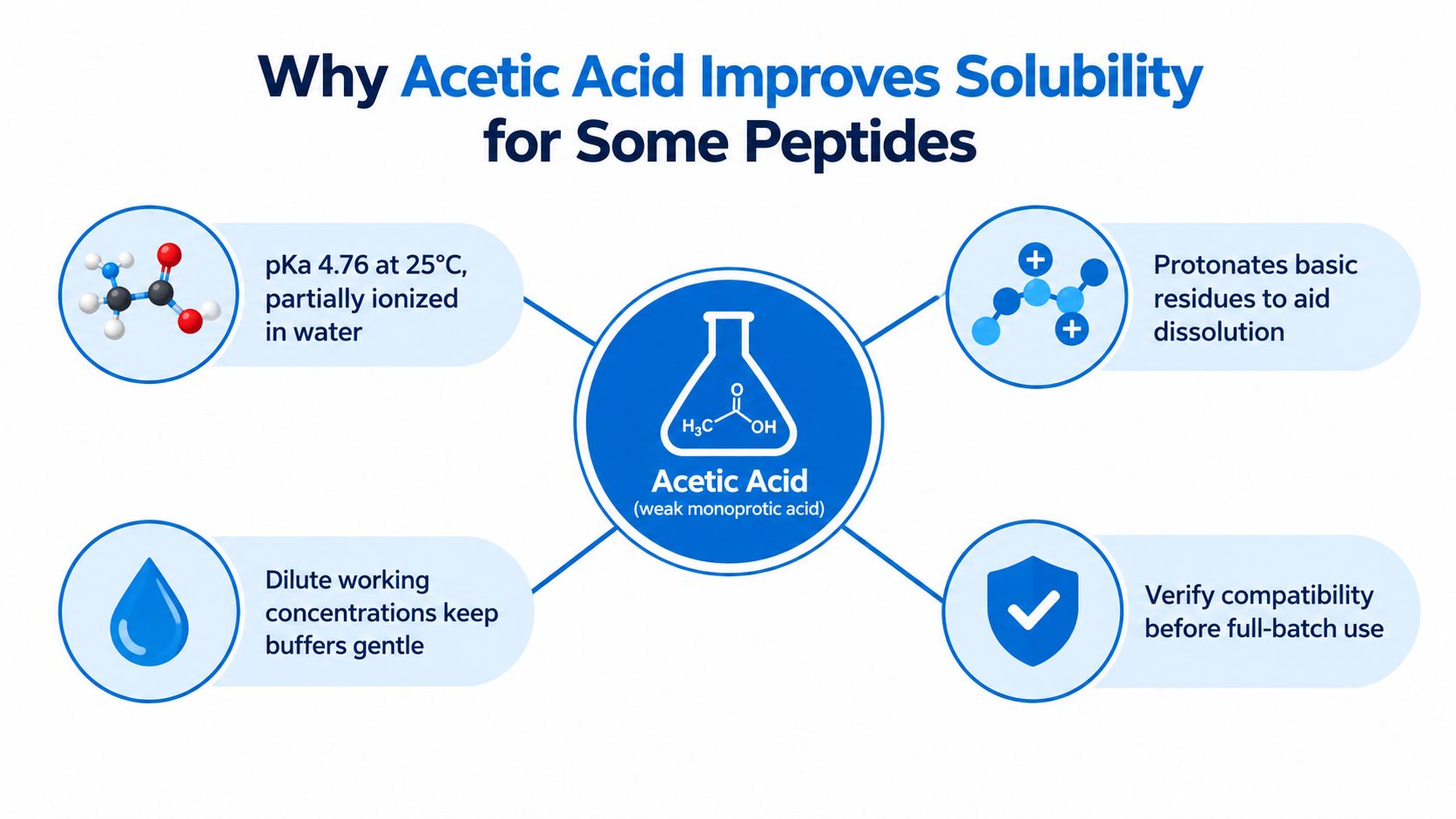
A useful mental model is a crowded room. When the peptide molecules carry more like charges, they repel each other a little more, so they are less likely to pile up into clumps. That is why a dilute acidic solvent can make a peptide look cleaner in solution than neutral water does.
Where the chemistry stops helping
The same acidic environment that improves apparent dissolution can also create new problems. Acid-labile sequences may undergo hydrolysis, deamidation, oxidation, or conformational change during low-pH exposure, so visual clarity is not the same thing as stability. A peptide that clears in acid may still be unsuitable for the intended assay if its structure changes along the way.
That is why acetic acid should be treated as a solubility aid, not proof of long-term compatibility. The solvent concentration, pH, temperature, exposure time, and material-specific tolerance all matter, and none of them should be guessed from appearance alone.
A low-pH screen is most useful when the peptide's charge state is the main barrier to dissolution. It is less useful, and sometimes risky, when the sequence is known or suspected to be acid-sensitive. In practice, the best solvent is the one that gets the peptide into solution without changing the measurement that follows.
Preparing a 0.6 Percent Acetic Acid Reconstitution Solution
A common preparation starts with 0.6 mL glacial acetic acid added to sterile water and brought to a final volume of 100 mL. That gives an approximate 0.1 mol/L solution with a pH near 3 preparation example. The key point is simple: define the concentration from the final volume, not from an unmeasured amount of water in the beaker.
Build the solution from the final volume
Add the acid carefully, then bring the mixture to the final volume with sterile water. That sequence keeps the formulation defined. A vessel that starts with “about enough water” is not a measured solution, and that matters if you want different preparations to behave the same way.
Purity and filtration are separate controls. The example specifies analytical-grade acetic acid at not less than 99.7% purity and passage through a 0.22 micrometer sterile filter into a sealed sterile vessel. Those steps reduce uncertainty in the solvent before the peptide ever enters it.
Bench rule: if the final volume is not defined, the concentration is not defined either.
Document the preparation
Record the acid lot, peptide lot, preparation date, measured pH, and storage conditions. That record makes later comparison possible when one batch dissolves cleanly and another does not. Without it, troubleshooting turns into guesswork.
Container choice belongs in the record too. A sterile vessel is part of the preparation, not an afterthought, because handling history becomes part of sample behavior. In acidic solvent, even small differences in preparation can change the result enough to matter.
Validating Compatibility Before Reconstituting a Full Batch
A clear vial can be misleading. A peptide may look better in acid, yet still suffer chemical damage that only shows up later in the assay. That is why compatibility testing has to confirm both dissolution and molecular integrity before a full batch is exposed to the same solvent.
Why clarity is not enough
Some sequences tolerate acid poorly even when the cloudiness disappears. Acid-labile motifs, including aspartyl-proline patterns and certain modified peptides, can still undergo hydrolysis in acidic conditions, so a visually improved solution can still be analytically compromised. The safer approach is to test the peptide against the solvent, then test the recovered material against the assay readout.
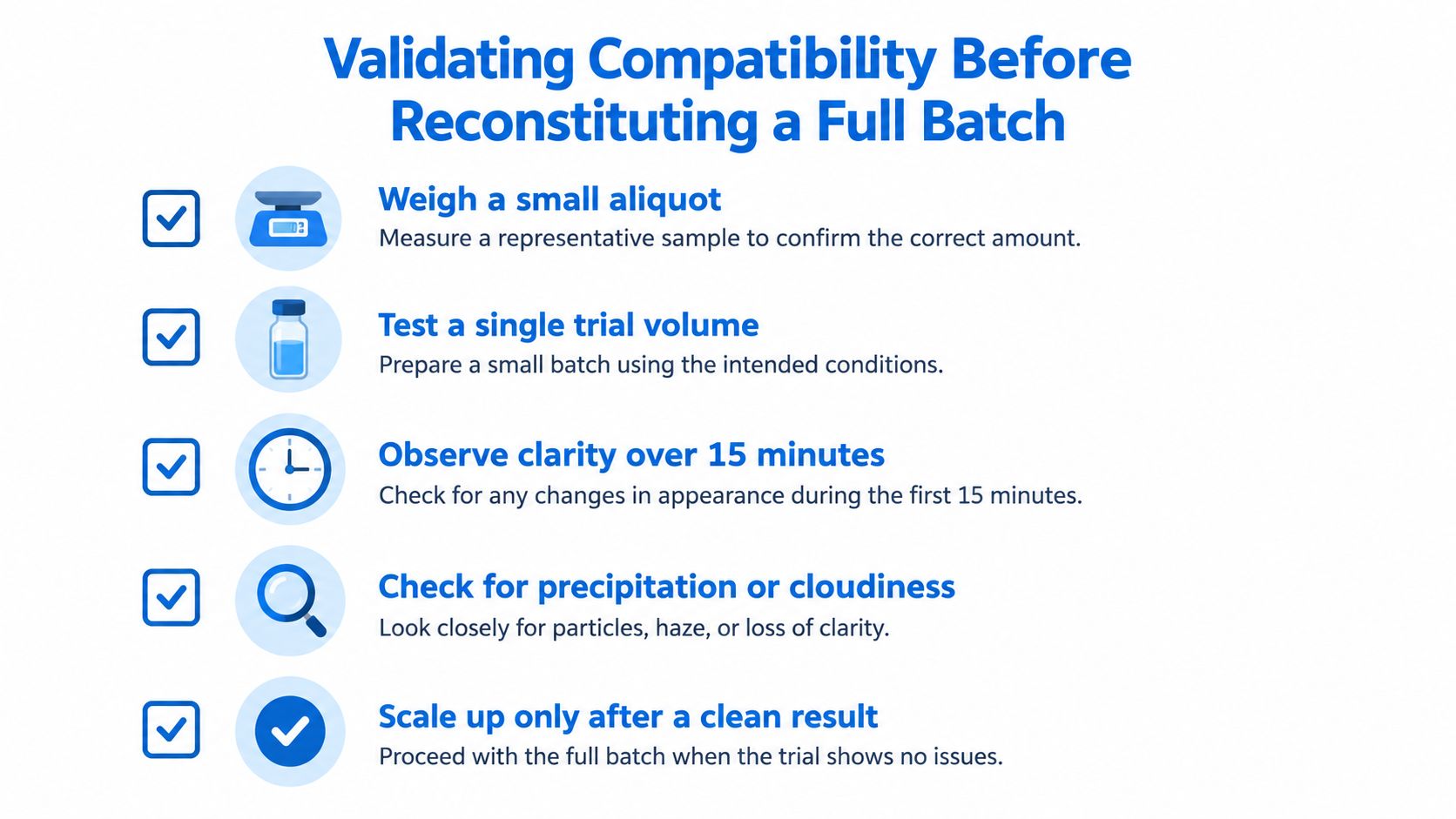
A practical screen compares neutral water, a few acetic-acid concentrations in the commonly discussed 0.1% to 0.6% range, and the intended final assay buffer. The screen should record pH, clarity, precipitation, and recovery, then confirm identity and purity with HPLC or LC-MS before any large-scale preparation proceeds. For a structured set of testing resources, the point is the same, compatibility has to be demonstrated, not assumed.
What to look for during the screen
- Neutral water first: If the peptide clears here, acid may not be necessary.
- One small acid trial: A single trial volume can show whether protonation improves dissolution.
- Observation over time: Clarity should be checked after mixing and again after a short wait.
- Final buffer check: The final assay buffer can reverse a good-looking dissolution if the pH shift triggers re-precipitation.
That last point is easy to miss. A peptide can look fine in the acidic diluent and then cloud again after dilution into the working buffer, so buffer compatibility deserves the same attention as the initial dissolution test.
Residual acid can also alter cell viability, enzyme activity, assay pH, or apparent potency after dilution. A small screen prevents that kind of downstream surprise by showing whether the solvent choice supports the assay conditions that follow. The screen ends with analytics. A clear vial is an observation, and the assay data decides whether the batch proceeds.
Comparing Acetic Acid Diluent With Other Laboratory Solvents
Solvent selection gets easier when the alternatives are laid out side by side. In peptide labs, the main comparison is usually between dilute acetic acid, bacteriostatic water, and neutral sterile water, because each one changes the sample differently.
How the solvents differ in practice
Bacteriostatic water typically relies on benzyl alcohol as a preservative, so it is not interchangeable with acetic-acid diluent by default. Neutral sterile water avoids added acid, which can help when the peptide is already soluble or when low pH would interfere with the assay. Acetic acid is the option that changes charge state most deliberately.
| Laboratory Reconstitution Solvent Comparison | Typical pH | Mechanism | Best Suited For | Key Limitations |
|---|---|---|---|---|
| Acetic acid diluent | Around 3 | Lowers pH and increases protonation of basic residues | Some charge-sensitive or aggregation-prone peptides | Can alter stability, assay pH, and downstream compatibility |
| Bacteriostatic water | Mildly acidic | Preservative-based aqueous diluent | Many routine peptide preparations | Not a low-pH rescue solvent, contains benzyl alcohol |
| Neutral sterile water | Near neutral | No added preservative or acid | Peptides already compatible with water | May not resolve cloudy or aggregation-prone material |
The useful question is not which solvent is strongest. The useful question is which one matches the peptide's isoelectric point, acid stability, and assay requirements. A solvent that works in one sequence can be the wrong answer in the next vial.
When a switch is justified
A switch is justified when small-scale testing shows that the peptide stays cloudy in neutral water but clears in dilute acid without visible precipitation on dilution into the final buffer. It is also justified when documentation or prior validation already points to acidic reconstitution. A switch is not justified only because the vial looks inconvenient.
A careful lab treats solvent choice as part of method development. That approach preserves both the material and the interpretation of the result, which is the actual goal in any reconstitution workflow.
Documentation Standards and Storage Practices for Research Materials
A cloudy vial may clear in acid and still fail later if the record is thin. The only way to separate solvent effects from storage effects is to know exactly what was prepared, how it was handled, and what changed over time.
What belongs in the record
A complete entry should list the solvent concentration, measured pH, acid lot number, peptide lot number, preparation date, observed clarity changes, and storage temperature. Those details let a new run be compared with the one before it and make it easier to trace a precipitation problem back to the source. Without them, troubleshooting turns into guesswork.
Storage notes matter just as much. Record aliquot dates, freeze-thaw count, and any visible drift in clarity or color after storage. Acidified solutions and lyophilized stock do not behave the same way, so the handling history has to stay attached to the sample history. A solution that looked acceptable at the bench can still change if its storage path is unclear.
The same discipline applies to internal handling rules such as the research use only policy, because labeling and tracking only work when the records match the material in hand. Good records keep the next experiment from repeating the same mistake, which is why they speed up troubleshooting rather than slowing down research.
Building a Repeatable Reconstitution Workflow
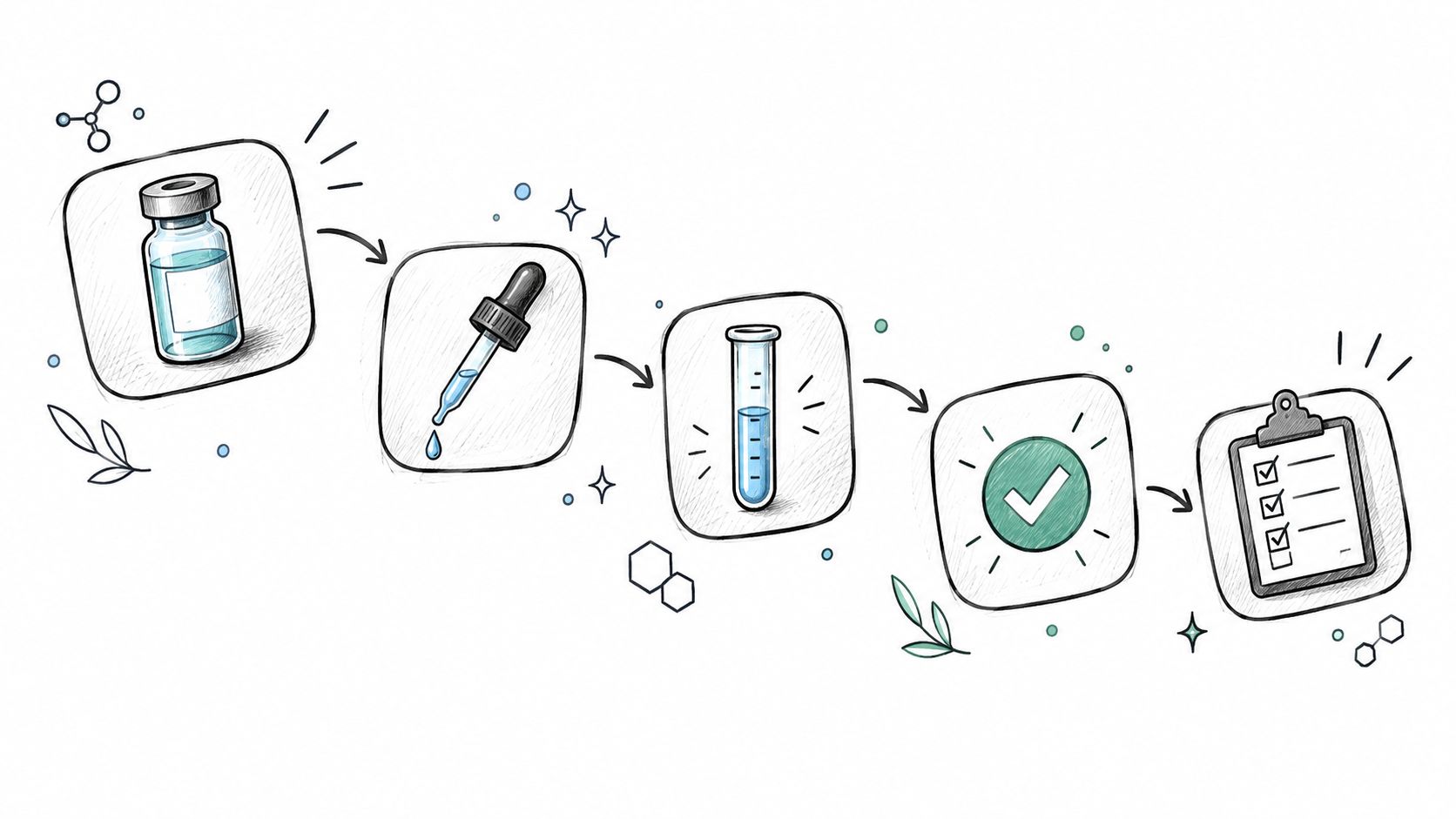
A repeatable workflow starts with a small question and ends with a documented answer. First, determine whether the peptide needs acidic reconstitution. Then prepare a defined dilute acetic acid solution, test compatibility on a small scale, and only scale up after the sample has passed both the visual and analytical checks.
A simple bench sequence
A researcher faced with a cloudy vial can run a small test in neutral water, then try a dilute acetic-acid condition, then check whether the sample remains clear after dilution into the intended assay buffer. If the trial clears but the HPLC trace or LC-MS readout looks wrong, the acid was a solubility aid, not a solution to the full problem. That difference saves material and protects the assay.
The key habit is to treat each preparation as a data point, not as a one-time fix. When the concentration, pH, clarity, and storage notes are captured together, the next batch becomes easier to interpret. That is how a lab builds a workflow that can be repeated without relying on guesswork.
A strong result here is not just a clear solution, it is a clear solution that still behaves correctly in the assay. That is the standard worth keeping, because acetic acid for reconstitution should improve handling without creating a new analytical problem.
Pro Tec Pep supports research teams that need batch-verified materials, transparent documentation, and workflow-friendly logistics for peptide studies and related compounds. For labs building a reproducible reconstitution method, the right next step is to visit Pro Tec Pep and review the lot-level documentation alongside the material you plan to study.