3rd Party Tested Peptides Explained for Research Labs
Learn what 3rd party tested peptides really mean, the 7 tests that matter, how to read a COA, and how to choose batch-verified materials
A laboratory can receive two vials bearing the same peptide name and obtain different assay results. That risk isn't theoretical. Independent peptide testing sources report that 73% of samples showed purity discrepancies versus supplier claims across more than 1,400 samples, with an average gap of 8.4 percentage points (ACS Lab Test data). For a research team, that gap can turn a carefully designed experiment into an unexplained failure.
A senior lab manager would treat the vial as an unknown variable until the exact lot has been verified. The question isn't whether a supplier uses the phrase 3rd party tested peptides. The question is whether independent data confirms the identity, composition, contamination profile, and documented conformity of the material needed for a specific workflow.
Introduction Why Peptide Quality Decides Reproducibility
A cell-based assay produces an unexpected viability result. The protocol is unchanged, the instrument passes calibration, and the researcher repeats the experiment. The second run shifts again. A review of the reagent cabinet reveals that the peptide name is identical, but the lot number has changed. The supplier's product page still displays the same general purity statement, yet no batch-specific evidence explains whether the new material has the same identity, content, degradation profile, or contaminant burden.
That situation creates a difficult diagnostic problem. Researchers may spend time adjusting incubation conditions, revisiting cell density, or questioning the assay design when the material itself introduced an uncontrolled variable. A generic Certificate of Analysis, or COA, can't resolve that uncertainty if it doesn't identify the exact lot under investigation.
Laboratory rule: A compound name identifies what a material is supposed to be. A batch record helps establish what the laboratory actually received.
Third-party testing matters because an outside laboratory evaluates the material rather than allowing the supplier to grade its own work. The strongest documentation combines batch linkage, disclosed methods, and results that answer different scientific questions. Identity testing can establish whether the expected molecule is present. Purity testing can assess related impurities. Contaminant testing can reveal hazards that neither identity nor purity data exposes.
The risks extend beyond a disappointing analytical result. A major independent testing source reported that 17% of submitted peptide samples contained detectable heavy metals above USP safety limits, including lead, cadmium, or mercury (ACS Lab Test contamination guidance). The same source describes quantitative endotoxin testing under USP <85> with sensitivity of 0.005 EU/mL for injectables. For laboratory teams, those findings reinforce a central point: quality verification must match the consequences of the experiment.
This guide treats research peptides as laboratory materials only. It applies the same logic to peptide products and related research compounds, while recognizing that HCG is a hormone and NAD+ is a coenzyme, not a peptide. Proprietary names such as KLOW and BBG70 also require examination of their individual components rather than an invented mechanism for the blend as a whole.
What Third Party Testing Means for Research Peptides
A supplier specification is a statement of intended quality. An independent result is evidence generated by a separate laboratory. The distinction resembles an internal report compared with an outside audit. Both may be useful, but they don't carry the same evidentiary role.
A credible third-party process begins with a physical sample from a defined production lot. The testing laboratory records the lot identity, applies disclosed analytical methods, and returns results that can be connected to the material in the researcher's possession. A generic certificate that lists a product name without the matching lot number doesn't provide the same level of traceability.
The term orthogonal testing describes methods that examine different properties through different analytical principles. LC-MS can confirm expected molecular mass and help identify wrong-sequence or substituted material. HPLC can quantify purity and separate related impurities. Neither method answers every question on its own.
Practical distinction: HPLC can indicate how much of the detected material behaves like the target compound. Mass spectrometry can help establish whether the molecular identity is correct. A high purity result doesn't replace identity confirmation.
A research buyer should therefore evaluate third-party testing in a sequence:
- Establish lot linkage. The lot number on the vial, package, or shipment record should match the COA.
- Identify the laboratory. The document should name the issuing laboratory and provide enough information for verification.
- Inspect the methods. “Tested” is incomplete without method names or analytical descriptions.
- Match the panel to the workflow. Analytical characterization, cell-based work, and in vivo studies create different contamination and reproducibility concerns.
- Record the evidence. The COA belongs with the procurement and experiment records, not only in an email thread.
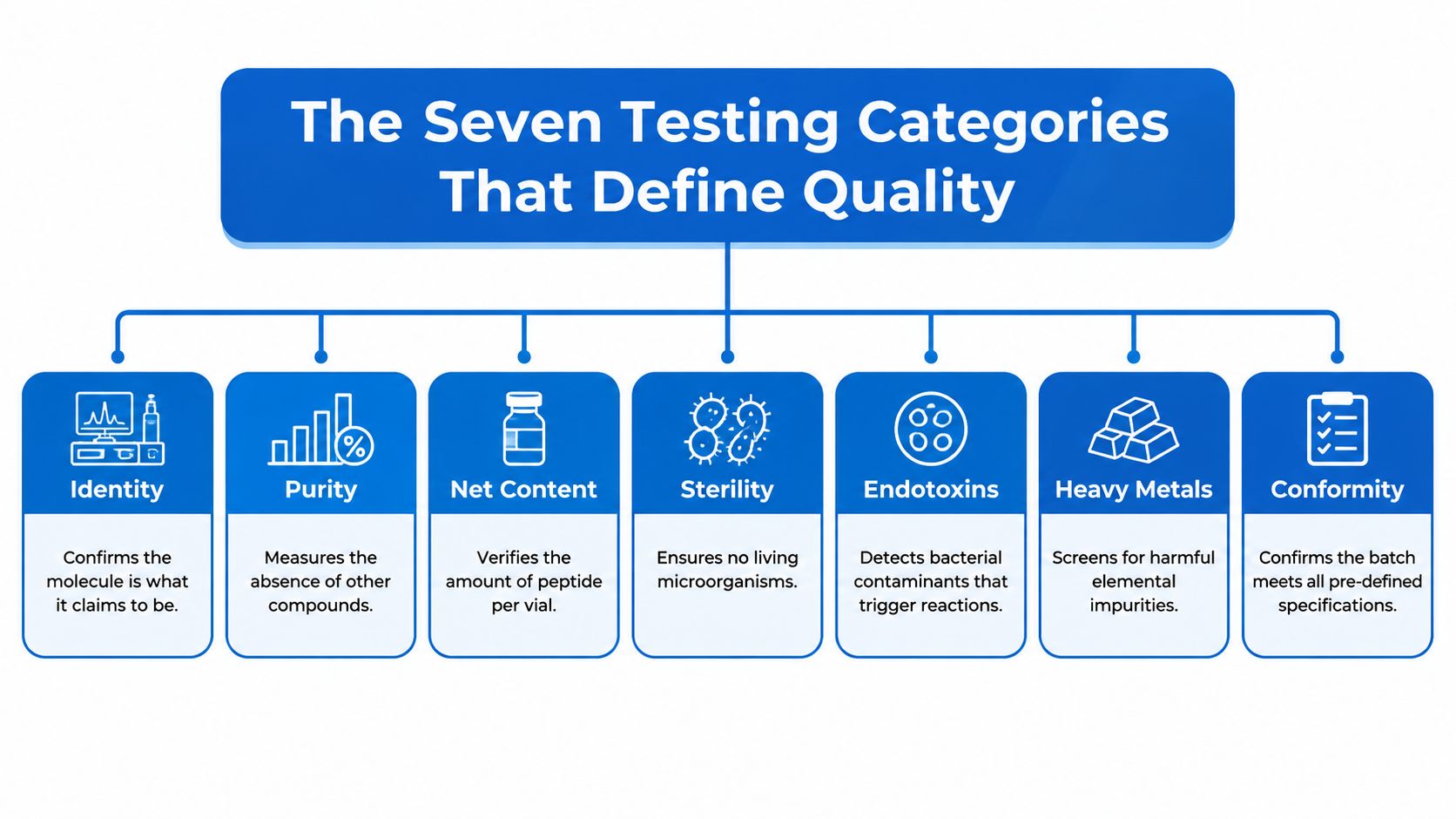
The seven-category model below provides a practical vocabulary for this review.
A short video can reinforce the difference between a marketing claim and a documented testing record.
The Seven Testing Categories That Define Quality
A complete panel answers seven separate questions. Treating them as interchangeable creates blind spots, because identity, purity, content, microbial status, endotoxins, elemental impurities, and specification conformity describe different dimensions of a research material.
Identity
Identity testing asks whether the molecule is what the label claims. LC-MS confirms expected molecular mass and can help rule out a wrong sequence or substituted material. HPLC can support characterization, but HPLC alone doesn't prove molecular identity.
Purity
Purity testing asks what else is present. HPLC separates the target peak from related impurities and estimates the proportion represented by the target material. A high HPLC result still needs context. If the wrong molecule produces a clean chromatographic profile, purity alone can create false confidence.
Net content
Net content asks whether the vial contains the declared amount of material. This matters for quantitative assay design, stock preparation, and comparisons across lots. Purity and content are not the same measurement. A material can have a strong purity profile while the total amount in the container differs from the declared specification.
Sterility
Sterility or bioburden screening addresses microbial contamination. This category becomes especially important when a laboratory works with cell cultures or biological systems that can be disrupted by living microorganisms. The relevant method and acceptance criteria should appear in the documentation rather than being implied by a purity percentage.
Endotoxins
Endotoxin testing detects bacterial contaminants that may trigger inflammatory responses or alter biological readouts. LAL and chromogenic assays are established approaches described in third-party testing guidance (Research Peptides Europe COA information). Endotoxins can remain invisible in ordinary identity and purity data, yet still distort cell behavior or in vivo observations.
Heavy metals
Elemental impurity analysis, commonly performed by ICP-MS, screens for metals such as lead, cadmium, arsenic, and mercury. These contaminants may originate during synthesis or handling and can affect assay performance, cell viability, and downstream reproducibility (Research Peptides Europe testing guidance).
Conformity
Conformity asks whether the batch meets its predefined specifications as a whole. It should connect the reported results to stated acceptance criteria, not just display isolated values. A conformity statement is meaningful only when the specifications, methods, and batch identity are visible.
Seven Category Testing Panel at a Glance
| Testing Category | Question It Answers | Typical Method |
|---|---|---|
| Identity | Is the expected molecule present? | LC-MS, mass spectrometry |
| Purity | How much related or unrelated material is present? | HPLC |
| Net content | Does the vial contain the declared amount? | Quantitative content assay |
| Sterility | Are living microorganisms absent or controlled? | Sterility or bioburden screening |
| Endotoxins | Are bacterial endotoxin contaminants detected? | LAL or chromogenic assay |
| Heavy metals | Are elemental impurities present? | ICP-MS |
| Conformity | Does the lot meet its stated specifications? | Specification review and batch assessment |
The value of this panel is cumulative. Identity and purity protect analytical interpretation, while content and conformity support quantitative planning. Sterility, endotoxins, and metals address contaminants that can change biological results without changing the compound name on the vial.
How to Read a Batch Specific Certificate of Analysis
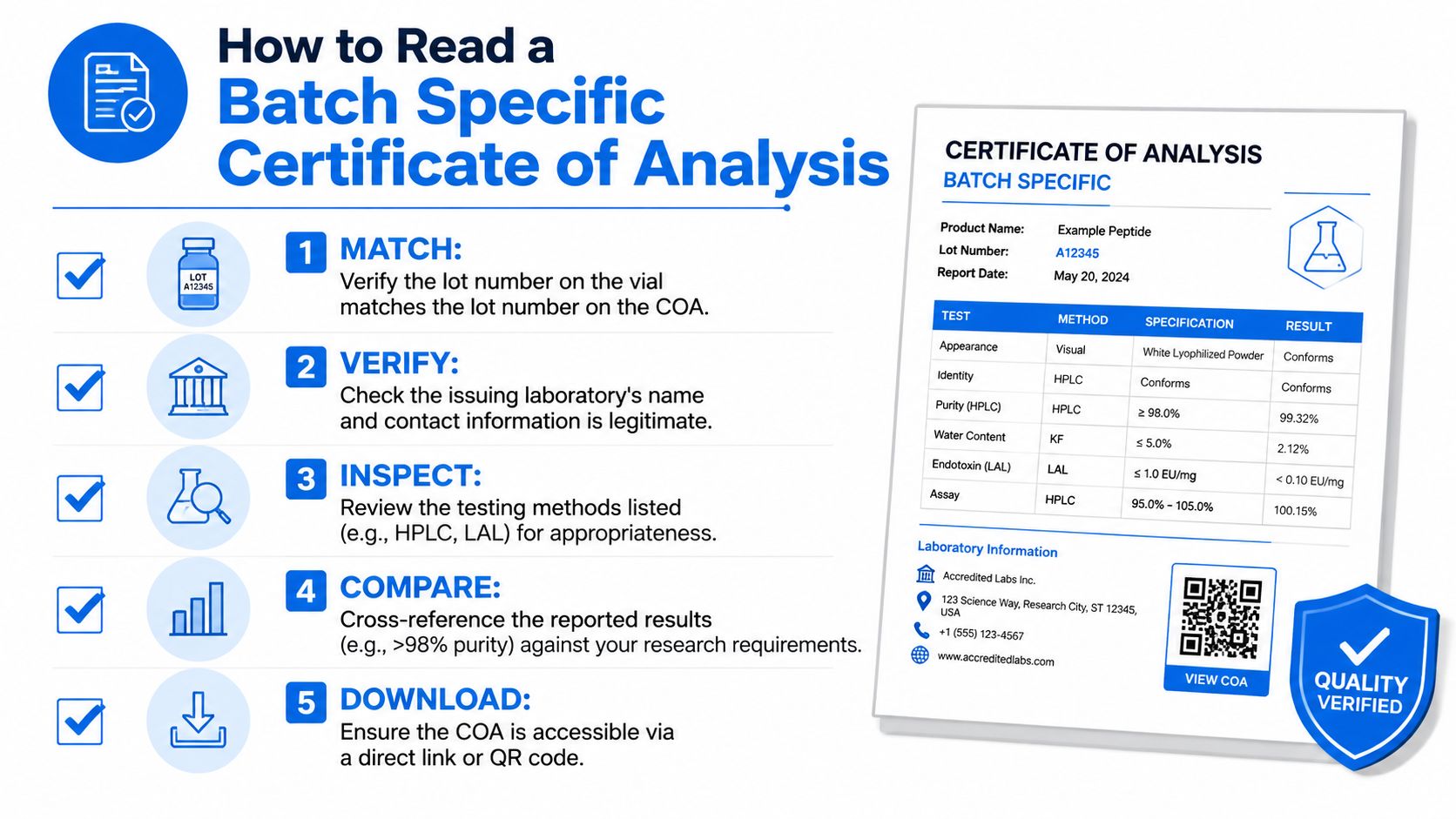
A COA should be read as an audit record, not as a decorative quality badge. The first line to check is the lot number. The identifier on the vial or package must match the identifier on the certificate, because a result for one batch cannot validate another.
The next check concerns the issuing laboratory. A credible record names the laboratory, identifies its contact information, and shows the methods used. A document that says “third-party tested” but omits the laboratory or analytical method leaves the buyer unable to assess independence or technical fit.
A practical document review
A useful review follows the same order every time:
- Match the material: Compare the product name, lot number, and physical label with the COA.
- Verify the laboratory: Confirm that the named laboratory is identifiable and that the document can be traced to it.
- Inspect the methods: Look for LC-MS or mass spectrometry for identity, HPLC for purity, and appropriate methods for contaminants.
- Compare acceptance criteria: Read the reported result beside the stated specification, not in isolation.
- Check document relevance: Confirm that the certificate applies to the current lot and remains relevant to the procurement record.
- Archive the file: Store the COA with purchasing records, sample preparation notes, and experimental documentation.
The most important technical reading involves orthogonal results. LC-MS and HPLC should be viewed together, because they answer different questions. A certificate that reports only one technique may be adequate for a narrow analytical purpose, but it shouldn't automatically be treated as complete evidence for cell-based or in vivo work.
Audit question: Could another researcher identify the exact vial, laboratory, methods, and acceptance criteria from the archived record alone?
Generic templates create a clear warning sign. So do certificates with missing lot numbers, unexplained abbreviations, no laboratory identity, or a purity claim that lacks method details. A document may look formal while still failing the basic traceability test.
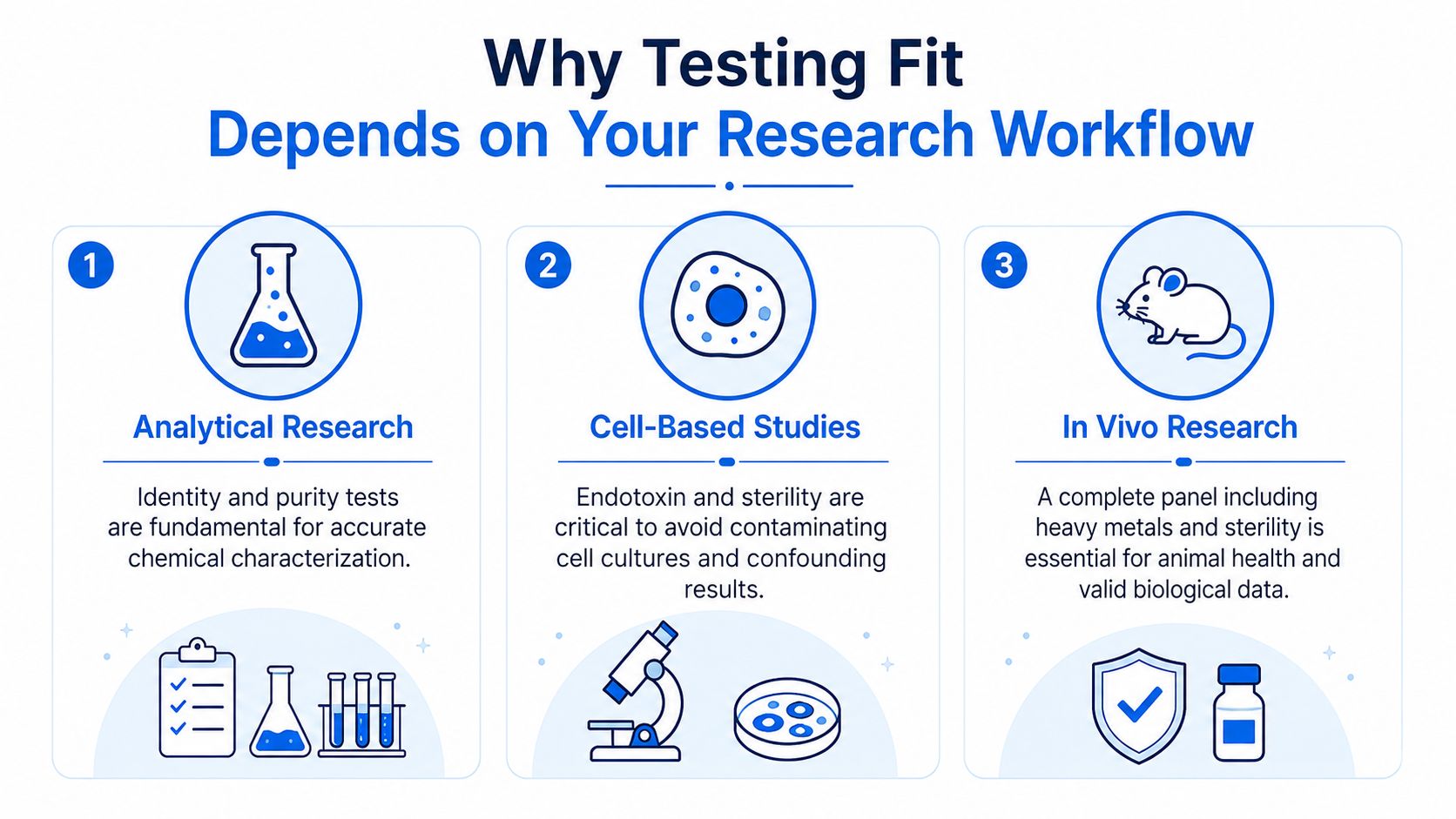
The workflow also determines what “complete” means. Analytical research may prioritize identity and purity. Cell-based work requires closer attention to microbial contamination and endotoxins. In vivo research generally demands a broader contamination review, including sterility and elemental impurities, with the laboratory's own institutional requirements governing the final decision.
Why Testing Fit Depends on Your Research Workflow
A purity percentage isn't a universal pass. It's one measurement inside a larger decision about what the material must do in the experiment and what contaminants could invalidate the result.
Analytical workflows
Analytical characterization usually starts with identity and purity. LC-MS helps establish the expected molecular mass, while HPLC helps separate and quantify related material. Researchers conducting quantitative work may also need net content, assay data, residual solvent analysis, or other method-specific information. A general COA may not answer every question required by a validated analytical method.
Cell-based studies
Cell cultures can respond to contaminants that don't appear in ordinary purity data. Sterility or bioburden screening helps address microbial concerns, while endotoxin testing matters because bacterial contaminants can create inflammatory or viability effects unrelated to the intended experimental variable. Elemental impurities may also matter when cells are particularly sensitive to chemical stress.
In vivo research
In vivo workflows require a broader view because biological systems can respond to microbial contaminants, endotoxins, metals, degradation products, or residual process materials. The appropriate panel should reflect the institution's animal research oversight, the study design, and the consequences of introducing an uncontrolled contaminant.
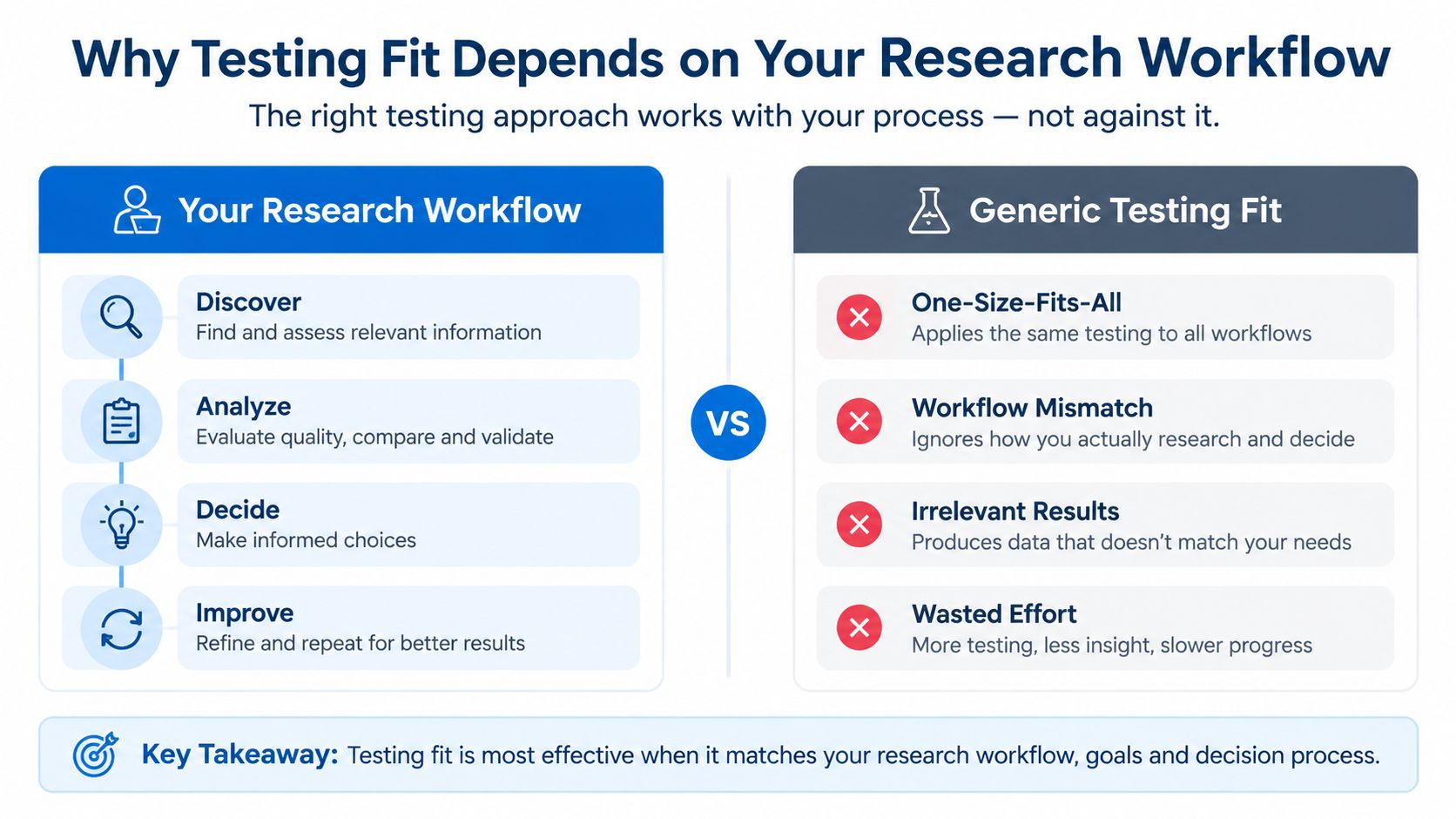
The same batch can therefore be acceptable for one narrow analytical purpose and inadequate for another research application. This isn't a contradiction. It reflects the difference between material quality and fit-for-purpose evidence.
A COA also has limits. It describes the tested sample and the reported methods, but it doesn't replace laboratory controls, validated sample preparation, correct storage, or appropriate experimental design. It may not establish stability after reconstitution, compatibility with a particular buffer, or performance in a specific assay unless those properties were separately evaluated.
Fit-for-purpose principle: The right question isn't “Was this peptide tested?” It's “Were the relevant properties tested for the experiment being planned?”
This distinction applies across a broad research catalog. Retatrutide, BPC-157, TB-500, Tesamorelin, GHK-Cu, MOTS-c, Ipamorelin, IGF-1LR3, AOD9604, CJC-1295, Tirzepatide, SS-31, Sermorelin Acetate, Semax, Selank, Epithalon, DSIP, and 5-Amino-1MQ should be evaluated through their specific identity, formulation, documentation, and workflow requirements. KLOW and BBG70 should be assessed by their named component compounds, while HCG and NAD+ should be classified accurately as a hormone and coenzyme, respectively.
Procuring Research Peptides With Confidence and Traceability
Procurement supports reproducibility when quality review happens before the order, not after an experiment fails. Start by defining the workflow, then inspect the product record, verify the exact lot, and set transport and storage requirements before purchase. Treat the material's documentation like a chain of custody: each link should connect the compound received to the assay that uses it.
Documentation before purchase
A useful product record gives researchers enough detail to plan protocols and support institutional review. Check the formal compound name, synonyms, CAS number where applicable, peptide sequence, molecular formula, formula weight, formulation state, solubility guidance, storage conditions, and stability information.
The COA should identify the tested batch and be accessible at the product level or through a verifiable document path. Compare its lot number with the vial and shipping paperwork, then retain the COA with the purchase order and experimental file. A certificate without lot matching is like a calibration record for a different instrument. It may look relevant, but it cannot document the material in your experiment.
Logistics as part of quality
Handling depends on formulation. Lyophilized materials are generally more stable during short transit than reconstituted solutions, while longer storage commonly requires refrigeration or freezing. Laboratory handling guidance describes 2–8°C for short-term refrigerated storage, −20°C for longer-term frozen storage, and, for some long-term archive conditions, −80°C (Nexara Labs cold-chain guidance).
Choose cold-chain arrangements according to the material and planned holding period. Temperature-controlled shipping may suit temperature-sensitive preparations, particularly solutions, but suitable packaging cannot repair an unsuitable storage plan after arrival.
Use a purchasing checklist that connects each review step to a research risk:
- Define the workflow: Record whether the material is intended for analytical, cell-based, or in vivo research.
- Review the specification: Confirm sequence or molecular identity, formulation, solubility, storage, and stability information.
- Inspect the panel: Check evidence for identity, purity, content, sterility, endotoxins, heavy metals, and conformity as appropriate. These categories address different risks, from misidentification to assay interference and cell-culture contamination.
- Confirm the lot: Match the physical package to the batch-specific COA.
- Plan receipt: Arrange prompt processing, suitable storage, and cold-chain logistics where required.
- Preserve records: Keep the COA, order details, shipping record, and sample-handling notes together.
For research teams seeking batch-verified compounds, Pro Tec Pep provides research-use-only materials with lot-specific documentation, seven-category testing information, and optional cold-chain logistics. Review the catalog and compare its records with your laboratory's fit-for-purpose requirements at Pro Tec Pep.
Building a Reproducible Research Workflow With Verified Materials
Reproducibility improves when laboratories treat every incoming lot as a variable requiring verification. A familiar product name shouldn't bypass the same checks applied to a new compound, because synthesis, handling, storage, and documentation can differ between lots.
The durable habits are straightforward:
- Record the lot before opening the package.
- Match the vial to the batch-specific COA.
- Confirm that the testing methods answer the research question.
- Separate identity, purity, content, and contamination evidence.
- Document storage and sample preparation conditions.
- Flag missing data before the material enters a critical experiment.
This approach changes the purchasing conversation. Instead of asking whether a supplier claims third-party testing, the laboratory asks which independent methods were used, which lot was tested, what specifications applied, and whether the panel fits the intended workflow.
Research materials in this category include peptides, proprietary blends, hormones, and coenzymes. Each requires accurate classification and documentation, and none should be evaluated through marketing language alone. The strongest record connects the physical material, the independent laboratory, the analytical methods, the storage history, and the experiment that used the lot.
A laboratory ready to order should compare the vendor's COA process with its internal quality requirements, confirm the exact lot before acceptance, and select shipping conditions that protect the material's documented integrity. That discipline turns 3rd party tested peptides from a label into a verifiable part of research practice.
For research teams seeking batch-verified compounds, Pro Tec Pep provides research-use-only materials with lot-specific documentation, seven-category testing information, product specifications, and optional cold-chain logistics. Visit Pro Tec Pep to review the available research catalog and verify whether its documentation and fulfillment process match the laboratory's procurement requirements.